


Summary
| Category | Data |
|---|---|
| Court | Supreme Court of India |
| Case Number | Crl.A. No.-004002-004002 – 2025 |
| Diary Number | 58851/2024 |
| Judge Name | HON’BLE MR. JUSTICE R. MAHADEVAN |
| Bench |
|
| Precedent Value | Binding Authority |
| Overrules / Affirms |
|
| Type of Law | Criminal Procedure; Constitutional Law (Articles 14 & 21) |
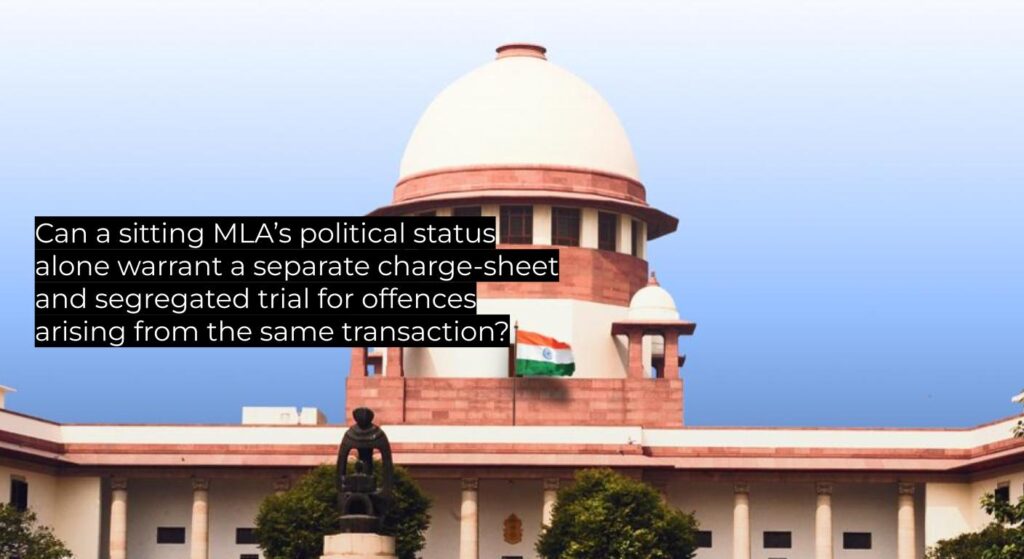
| Questions of Law | Whether a trial court can direct a separate charge-sheet and segregated trial solely because the accused is a sitting MLA, despite offences arising from the same transaction, under Sections 218–223 CrPC and Articles 14 & 21 of the Constitution. |
| Ratio Decidendi |
|
| Logic / Jurisprudence / Authorities Relied Upon |
|
| Facts as Summarised by the Court | A sitting MLA was arraigned in two FIRs for communal violence offences in Nuh (rioting, dacoity, mischief, intimidation). Trial Court sua moto directed a separate charge-sheet and day-to-day trial based solely on his MLA status. High Court dismissed quash petitions. Appeal to Supreme Court confined to legality of segregation order under Sections 218–223 CrPC. |
Practical Impact
| Category | Impact |
|---|---|
| Binding On | All subordinate courts |
| Persuasive For | High Courts and trial courts considering joinder/separation issues |
| Overrules | Application of Ashwini Kumar Upadhyay directions to segregate trials solely on political office |
| Distinguishes | Ashwini Kumar Upadhyay v. Union of India – expedition cannot override joinder norms |
| Follows |
|
What’s New / What Lawyers Should Note
- Reinforces that Sections 218–223 CrPC set joint trial as the default when offences arise from the same transaction.
- Clarifies that expeditious-trial guidelines in Ashwini Kumar Upadhyay do not permit segregation based solely on legislative status.
- Affirms that trial courts cannot suo motu order separate charge-sheets; investigation agency alone decides charge-sheet filing.
- Emphasises Article 14 equality and Article 21 fair-trial guarantees require notice and hearing before altering joinder.
- Warns against duplication of witnesses and risk of inconsistent findings if common-transaction cases are split arbitrarily.
Summary of Legal Reasoning
- Statutory Framework: Sections 218–223 CrPC govern joinder; joint trials avoid multiplicity, conflicting judgments, and promote efficiency.
- Trial Court Orders: Sua motu segregation directed solely for MLA’s day-to-day trial, citing Ashwini Kumar Upadhyay. No notice or application.
- Misapplication of Precedent: Ashwini Kumar Upadhyay prioritizes expedition but does not override statutory joinder; trial court exceeded jurisdiction.
- Precedents on Joinder: Nasib Singh and Cheemalapati establish joint trial rule except where distinct transaction or demonstrable prejudice.
- Constitutional Safeguards: Article 14 equality forbids preferential segregation; Article 21 mandates fair procedure, including notice and hearing.
- Conclusion: Segregation without legal justification quashed; joint trial directed with liberty for expeditious scheduling.
Arguments by the Parties
Petitioner (Appellant):
- Segregation arbitrary and based solely on legislative status.
- Offences arise from the same transaction; Section 223(d) mandates joint trial.
- Misapplication of Ashwini Kumar Upadhyay; no power to deviate from Sections 218–223.
- Separate trial prejudices fair-trial rights and risks double jeopardy.
- Court cannot direct separate charge-sheet; that lies with investigating agency.
Respondent (State):
- Over 70 co-accused; joint trial logistically cumbersome and delayed by non-appearance.
- Segregation ensures speedy disposal per Ashwini Kumar Upadhyay.
- Section 218 allows separate trials; Section 223 discretionary.
- No specific prejudice demonstrated by appellant.
- Speedy trial essential facet of Article 21.
Factual Background
The appellant, a sitting MLA, was named in two FIRs dated 01.08.2023 for communal violence offences in Nuh District under multiple IPC sections. During investigation, joint proceedings commenced before the Sessions Court, which on 28.08.2024 and 02.09.2024 directed a separate charge-sheet and segregated trial for the appellant due to his MLA status. The High Court dismissed petitions under Section 528 BNS Sanhita 2023 (analogous to Section 482 CrPC) challenging segregation. The Supreme Court hears appeals confined to the legality of that segregation.
Statutory Analysis
- Section 218 CrPC: General rule for separate trials for distinct offences, subject to exceptions.
- Sections 219–221 CrPC: Specific scenarios permitting joinder of offences by same person.
- Section 223 CrPC: Persons accused of offences in the same transaction “may” be tried together—joint trial is permissible and often mandatory to prevent multiplicity.
- Articles 14 & 21 Constitution: Equality before law and fair-trial due process require notice, hearing, and uniform application of joinder provisions.
Alert Indicators
- ✔ Precedent Followed – Reaffirms CrPC joinder jurisprudence (Nasib Singh, Cheemalapati).
- 🚨 Breaking Precedent – Limits misapplication of expeditious-trial directions in Ashwini Kumar Upadhyay.