


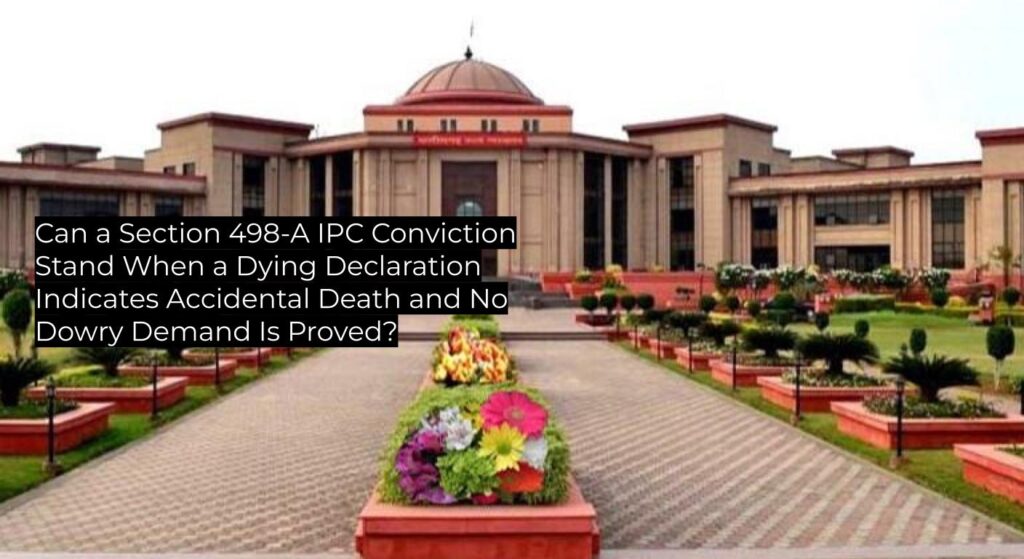
The Chhattisgarh High Court reversed the trial court’s 498-A conviction—affirming the acquittal under Section 304-B IPC—holding that a clear dying declaration and absence of proximate dowry-harassment evidence preclude criminal liability. Binding on all subordinate courts in Chhattisgarh, this judgment underscores the primacy of reliable dying declarations under Section 32 Evidence Act and the necessity of contemporaneous cruelty evidence to sustain a 498-A charge.
Summary
| Category | Data |
|---|---|
| Case Name | ACQA/141/2014 of Raju Rajput Vs State Of Chhattisgarh and Ors |
| CNR | CGHC010178122014 |
| Date of Registration | 27-05-2014 |
| Decision Date | 02-09-2025 |
| Disposal Nature | Criminal appeal allowed; acquittal appeal dismissed |
| Judgment Author | Hon’ble Shri Justice Radhakishan Agrawal |
| Court | High Court Of Chhattisgarh |
| Bench | Hon’ble Shri Justice Sanjay S. Agrawal and Hon’ble Shri Justice Radhakishan Agrawal |
| Precedent Value | Binding |
| Overrules / Affirms | Overturns conviction under Section 498-A IPC; affirms acquittal under Section 304-B IPC |
| Type of Law | Criminal law; Evidence |
| Questions of Law | Whether a 498-A conviction can be sustained in absence of any dowry-demand evidence and when the dying declaration describes an accidental injury. |
| Ratio Decidendi |
|
| Judgments Relied Upon |
|
| Logic / Jurisprudence / Authorities Relied Upon | Proximity test for Section 304-B IPC and Section 113-B Evidence Act; principles of dying declaration admissibility and reliability under Section 32 Evidence Act; statutory ingredients of Section 498-A IPC |
| Facts as Summarised by the Court | The deceased married in 2008; alleged dowry demands (sumo, cash) led to torture; on 27.11.2012 she sustained burns and died next day; dying declaration recorded by Tehsildar at Burn & Trauma Centre; trial court convicted under 498-A/34 IPC and acquitted on 304-B/34 IPC. |
| Citations | CRA No.365/2014; ACQA No.141/2014; Ex.P-16 (dying declaration); Ex.P-14 (FIR); Ex.P-24 (FSL report) |
Practical Impact
| Category | Impact |
|---|---|
| Binding On | All subordinate courts in Chhattisgarh |
| Persuasive For | Other High Courts |
| Overrules | Conviction order in Sessions Trial No. 21/2013 under Section 498-A/34 IPC |
| Follows | Supreme Court precedents on dying declarations (Sharad Birdhichand Sarda; Purshottam Chopra) |
What’s New / What Lawyers Should Note
- A reliable dying declaration describing an accidental cause of injuries negates an essential ingredient of Section 498-A IPC when no harassment for dowry is alleged.
- Absence of any dowry-demand mention in FIR or dying declaration, plus contradictory family testimony, undermines prosecution under 498-A.
- The proximity test (“soon before her death”) demands contemporaneous cruelty evidence; stale or omnibus allegations are insufficient.
- Reinforces that a fit-mind dying declaration under Section 32 Evidence Act can be sole basis for acquittal even without corroboration.
- Highlights the need for precise dowry-demand particulars in FIR and investigation to sustain cruelty charges.
Summary of Legal Reasoning
-
Dying Declaration (Section 32 Evidence Act):
- Examined Ex.P-16 recorded by Tehsildar PW-16; declarant in fit state; voluntary admission of accidental fire; no allegation against accused.
- Relied on Sharad Birdhichand Sarda and Purshottam Chopra for admissibility, proximity, and reliability principles.
-
Section 498-A IPC Ingredients:
- Cruelty “soon before” death for dowry demands must be proved.
- No dowry demand finds mention in FIR or dying declaration.
- Family witnesses (PW-1 to PW-4) gave contradictory, omnibus evidence, and admitted no contemporaneous police/community complaint.
-
Conclusion on 498-A:
- Prosecution failed to establish dowry-harassment cruelty element; conviction under 498-A/34 IPC set aside; appellants acquitted.
-
Section 304-B IPC:
- Trial court had acquitted accused on dowry-death charge; High Court affirmed that acquittal.
Arguments by the Parties
Appellants (in CRA No. 365/2014):
- Dying declaration (Ex.P-16) shows accidental death; no one at fault.
- No evidence of cruelty or dowry demand; trial court wrongly convicted.
State (Respondent in CRA No. 365/2014 & supporting appellant in ACQA No. 141/2014):
- Trial court conviction under 498-A IPC is lawful; acquittal on 304-B IPC is incorrect in part.
Complainant (Appellant in ACQA No. 141/2014):
- Trial court perversely acquitted accused of 304-B/302 IPC; harassment evidence proved.
Respondents Nos. 2 & 3 (in ACQA No. 141/2014):
- No dowry demand evidence; family never lodged complaint; inconsistencies in prosecution witnesses.
Factual Background
In 2008, the deceased married appellant No. 1. Within 3–4 months, alleged dowry demands (four-wheeler, cash) and harassment began. On 27.11.2012, at her parental home, she sustained severe burns and died on 28.11.2012. A dying declaration recorded in hospital attributed her injuries to an accidental stove fire. FIR was lodged; inquest and postmortem followed; trial court convicted under Section 498-A/34 IPC and acquitted on Section 304-B/34 and 302/34 IPC.
Statutory Analysis
- Section 32(1) Evidence Act: Exception to hearsay for statements on cause of death; proximity test not fixed; dying declarations admissible if voluntary and declarant fit.
- Section 498-A IPC: Defines cruelty as conduct likely to drive suicide or grave injury; harassment for dowry demand. Requires proof of cruelty “soon before” death.
- Section 304-B IPC: Dowry death presumption if death within seven years and soon before subjected to cruelty for dowry demands; proximity test applies.
Alert Indicators
- ✔ Precedent Followed
- 📅 Time-Sensitive (application of proximity test for dying declarations)
Citations
- (1984) 4 SCC 116 (Sharad Birdhichand Sarda v. State of Maharashtra)
- (2003) 1 SCC 217 (K. Prema S. Rao v. Yadla Srinivasa Rao)
- (2004) 9 SCC 157 (Kaliyaperumal v. State of T.N.)
- AIR 2000 SC 2324 (Kans Raj v. State of Punjab)
- (2020) 11 SCC 489 (Purshottam Chopra v. State, NCT of Delhi)
- CRA No. 365/2014; ACQA No. 141/2014; Ex.P-14 (FIR); Ex.P-16 (Dying Declaration); Ex.P-24 (FSL Report)