


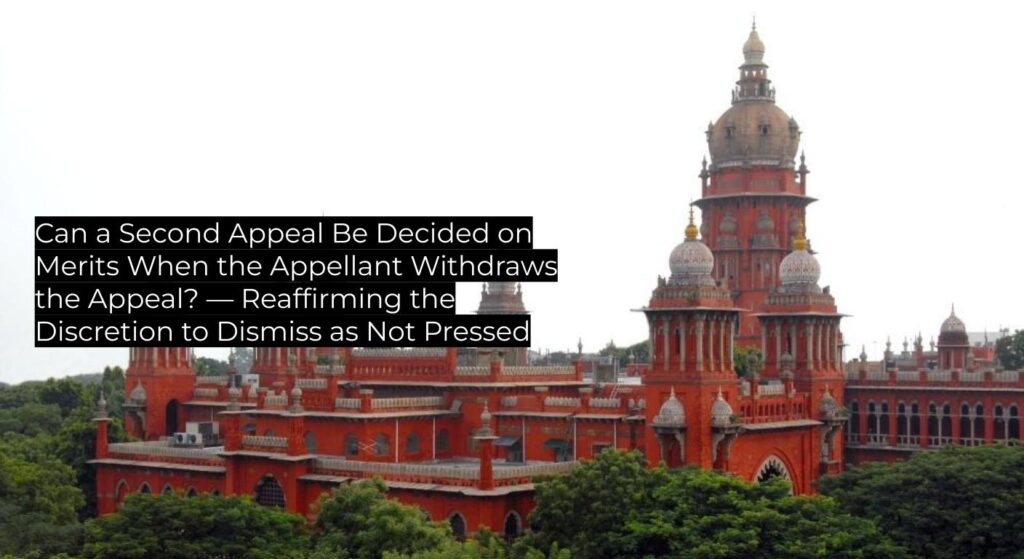
The Madras High Court confirms that an appellant may withdraw a second appeal under Section 100 CPC, resulting in dismissal as “not pressed”; this upholds existing procedural law, following established precedent, and serves as binding authority for subordinate courts in civil matters.
Summary
| Category | Data |
|---|---|
| Case Name | SA/163/2014 of M.KUMAR Vs AMIRUNNISA BEGUM SAHIBA |
| CNR | HCMA011029772014 |
| Date of Registration | 12-02-2014 |
| Decision Date | 02-09-2025 |
| Disposal Nature | WITHDRAWN DISMISSED |
| Judgment Author | HONOURABLE DR.JUSTICE A.D.MARIA CLETE |
| Court | Madras High Court |
| Precedent Value | Binding on subordinate courts within jurisdiction |
| Type of Law | Civil Procedure |
| Ratio Decidendi |
The court recorded the submission of the appellant’s counsel seeking leave to withdraw the second appeal. Upon such submission and affidavit, the court dismissed the appeal as not pressed, with no costs, and closed connected miscellaneous petitions. This affirms the principle that an appellant retains the right to withdraw a second appeal at any stage before final adjudication, and the court will dismiss the matter as not pressed when such withdrawal is recorded. |
| Facts as Summarised by the Court | The appellant’s counsel sought permission to not press the second appeal and filed an affidavit to that effect. The court, recording this, dismissed the appeal as not pressed. |
Practical Impact
| Category | Impact |
|---|---|
| Binding On | All subordinate courts within the jurisdiction of the Madras High Court |
What’s New / What Lawyers Should Note
- The judgment reiterates that appellants may unilaterally withdraw a second appeal at any stage before final adjudication by seeking the court’s permission and filing an affidavit.
- On such withdrawal, the High Court will record the same and dismiss the appeal as not pressed, closing all pending interlocutory applications.
- No costs are awarded when the second appeal is dismissed as not pressed in this manner.
- This approach follows established procedure and is binding precedent for subordinate courts within the jurisdiction.
Summary of Legal Reasoning
- Upon being moved by counsel for the appellant to withdraw the appeal (with an accompanying affidavit), the court exercised its discretion to dismiss the second appeal as not pressed.
- The court recorded the submission and, without proceeding into the merits, disposed of the matter accordingly, exemplifying the principle that procedural withdrawal by a party is permissible and sufficient to conclude appellate proceedings.
- All pending miscellaneous petitions connected to the appeal were also closed, and no costs were imposed.
Arguments by the Parties
Petitioner (Appellant):
- Sought permission to not press the second appeal.
- Filed an affidavit to that effect.
Respondent:
- No arguments recorded in the judgment.
Factual Background
The appellant had preferred a second appeal under Section 100 of the Civil Procedure Code against a decree passed in a suit concerning the parties. When the matter was called for hearing, counsel for the appellant sought leave to not press the appeal and submitted an affidavit to that effect. The court, recording this submission, dismissed the appeal as not pressed and closed all associated miscellaneous petitions.
Statutory Analysis
- Section 100 of the Civil Procedure Code, 1908 (Second Appeal) permits appeals to the High Court on substantial questions of law.
- No substantive interpretation or novel construction of statutes occurred; the judgment confirms that withdrawal of an appeal is procedurally permissible, given the appellant’s intention and affidavit.
Dissenting / Concurring Opinion Summary
No dissenting or concurring opinions were recorded in the judgment.
Procedural Innovations
No new procedural innovations, guidelines, or directions were set out in the judgment.
Alert Indicators
- ✔ Precedent Followed – The judgment affirms existing procedural law regarding withdrawal of appeals.
Citations
- Neutral citation: Not specified in the judgment.
- No SCC / AIR / MANU citations provided.