


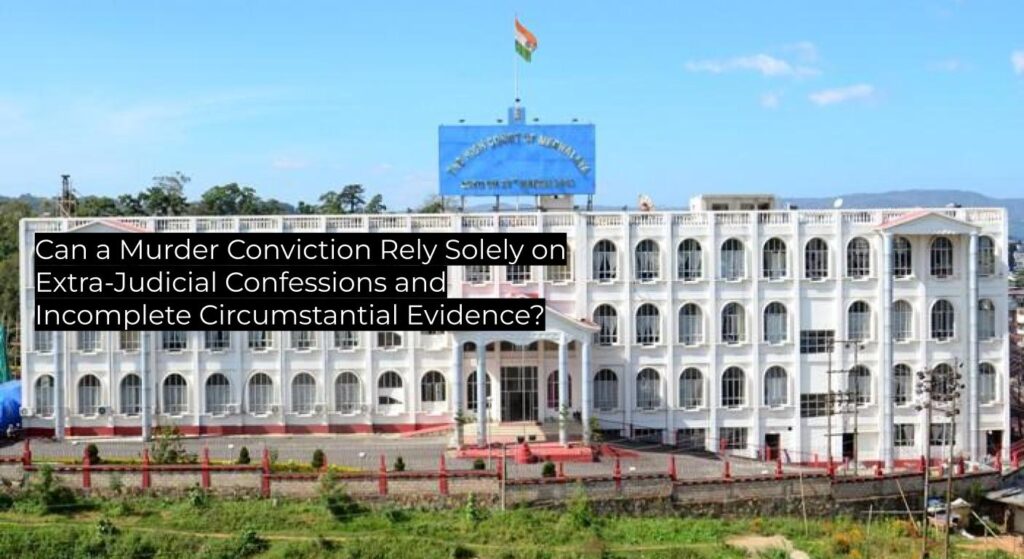
Reaffirming the Complete-Chain Rule in Circumstantial Cases and the Rigorous Test for Extra-Judicial Confessions; Quashing of Life-Sentence Upholds Supreme Court Precedents
Summary
| Category | Data |
|---|---|
| Case Name | Crl.A. No. 2 of 2024 of TIRET MAWLONG Vs STATE OF MEGHALAYA |
| CNR | MLHC010000532024 |
| Date of Registration | 05-02-2024 |
| Decision Date | 30-08-2025 |
| Disposal Nature | Disposed Off |
| Judgment Author | W. Diengdoh, J. |
| Concurring or Dissenting Judges | B. Bhattacharjee, J. (concurring) |
| Court | High Court of Meghalaya |
| Bench | Division Bench (Hon’ble W. Diengdoh & Hon’ble B. Bhattacharjee) |
| Precedent Value | Binding on subordinate courts in Meghalaya |
| Overrules / Affirms | Affirms principles laid down by Supreme Court on circumstantial evidence and extra-judicial confessions |
| Type of Law | Criminal Law (IPC, CrPC, Evidence Act) |
| Questions of Law | Whether a conviction for murder under Section 302 IPC can stand when based solely on extra-judicial confessions and a chain of circumstantial evidence that is incomplete or inconsistent. |
| Ratio Decidendi | The court held that in circumstantial cases every link must be fully proved and must exclude all hypotheses except the accused’s guilt. Extra-judicial confessions must be voluntary, truthful, inspire confidence, and be corroborated by independent evidence. Here, unsigned seizure lists, lack of forensic linkage, no eye-witness testimony, conflicting and hearsay accounts, and ambiguous admissions broke the chain of circumstances, entitling the appellant to the benefit of doubt and rendering the conviction unsustainable. |
| Judgments Relied Upon |
|
| Logic / Jurisprudence / Authorities Relied On | The five-link test for circumstantial evidence from Sharad Sarda; the criteria for admissibility and weight of extra-judicial confessions under Sections 24 and 25 of the Evidence Act as expounded in Ramu Appa Mahapatar and Harjinder Singh; benefit-of-doubt rule. |
| Facts as Summarised by the Court | The deceased was found dead outside the appellant’s house after a family dispute. Two weapons (a khasi dao and an iron rod) were seized on an unsigned list. No eyewitness saw the killing. The prosecution relied on inconsistent eyewitness accounts, hearsay, and extra-judicial confessions to village elders. No forensic examination linked the weapons to the appellant. The Trial Court convicted under Section 302 IPC; this Court quashed the conviction for failure to establish a complete circumstantial chain and credible confession. |
| Citations | 2025:MLHC:776-DB (Meghalaya H.C.); (1984) 4 SCC 116; (2025) 3 SCC 565; (2011) 14 SCC 117; SLP (Crl.) No. 8944 of 2022 |
Practical Impact
| Category | Impact |
|---|---|
| Binding On | All subordinate courts in Meghalaya |
| Persuasive For | Other High Courts and criminal courts across India |
| Follows | Sharad Sarda, Ramu Appa Mahapatar, Harjinder Singh |
What’s New / What Lawyers Should Note
- Reinforcement that each link in circumstantial evidence must be fully established and lead exclusively to guilt.
- Clarification that extra-judicial confessions must be proved voluntary, credible, and corroborated by independent evidence.
- Highlighting that unsigned seizure lists and absence of forensic reports break the evidentiary chain.
- Emphasis that no conviction should rest solely on hearsay admissions or inconsistent witness statements.
Summary of Legal Reasoning
- Prosecution Narrative: Alleged murder at appellant’s residence after inheritance dispute; inquest, post-mortem, seizure of two weapons, and arrests.
- Circumstantial Evidence Test: Applied five conditions from Sharad Sarda—complete proof of each circumstance, consistency with guilt alone, and an unbroken chain.
- Extra-Judicial Confessions: Assessed under Ramu Appa Mahapatar and Harjinder Singh—must be voluntary, truthful, inspire confidence, and be corroborated.
- Evidentiary Gaps: No eyewitness witnessed the killing; seizure list unsigned by IO; weapons not forensically examined; witness accounts were hearsay or inconsistent.
- Benefit of Doubt: Broken chain and uncorroborated confessions required acquittal; conviction thus quashed.
Arguments by the Parties
Petitioner/Appellant:
- No eye-witness; core evidence hearsay.
- Seizure list unsigned by IO; no forensic linkage of weapons.
- Extra-judicial confessions lack voluntariness and corroboration.
- Case of self-defence, plea admitted in statements.
Respondent/State:
- Confessions reported by multiple witnesses.
- Consistent post-mortem findings and inquest report.
- Seizure witness testimony identifying weapons.
- Premeditation inferred from weapon use and injuries.
Factual Background
On 03.06.2015 a family dispute over property culminated in the death of Riket Mawlong, whose body was found outside his sister’s (the appellant’s) home. An FIR under Sections 302/34 IPC was registered; two suspects—husband and wife—were arrested but the husband died before trial. Nine witnesses and two seized weapons (khasi dao and iron rod) formed the prosecution case, relying heavily on extra-judicial confessions and circumstantial links. The Trial Court convicted the appellant under Section 302 IPC and sentenced her to life imprisonment, subject to a fine. On appeal, this Court quashed the conviction for failure to prove a complete chain of circumstances or credible confession.
Statutory Analysis
- Section 302 IPC: Definition and punishment for murder.
- Section 34 IPC: Common intention (not specifically applied due to lack of motive against appellant).
- Section 24 Evidence Act: Voluntariness of confession.
- Section 173 CrPC: Investigating Officer’s report.
- Section 313 CrPC: Recording of accused’s statement.
Dissenting / Concurring Opinion Summary
Justice B. Bhattacharjee concurred with the majority judgment; no separate reasoning was recorded.
Procedural Innovations
No new procedural rules; reaffirmation of established standards for circumstantial evidence and extra-judicial confessions.
Alert Indicators
- Precedent Followed
Citations
- 2025:MLHC:776-DB (High Court of Meghalaya)
- (1984) 4 SCC 116 (Sharad Birdhichand Sarda v. State of Maharashtra)
- (2025) 3 SCC 565 (Ramu Appa Mahapatar v. State of Maharashtra)
- (2011) 14 SCC 117 (Manthuri Laxmi Narsaiah v. State of Andhra Pradesh)
- SLP (Crl.) No. 8944 of 2022, order dated 22.01.2025 (Harjinder Singh @ Kala v. State of Punjab)