


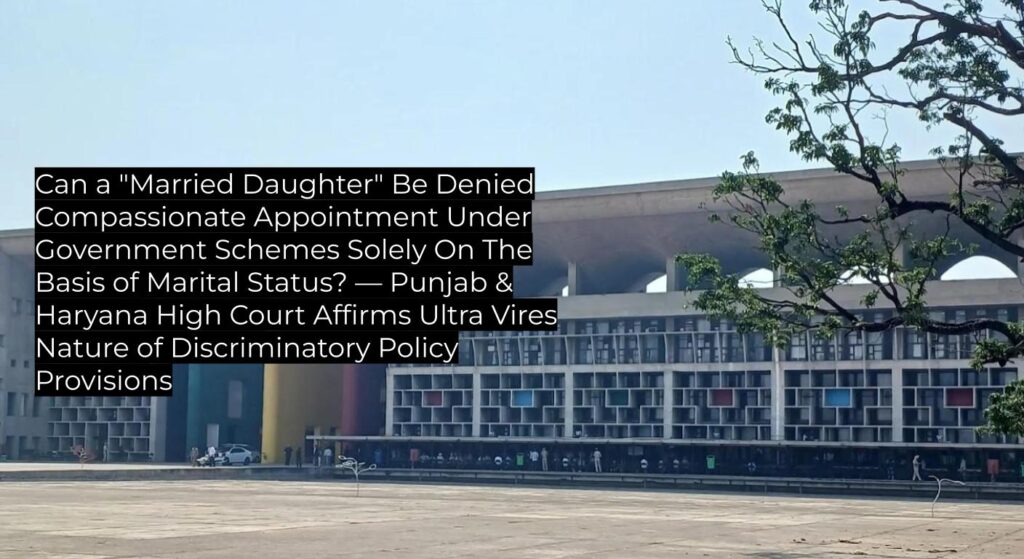
The Punjab & Haryana High Court reiterates that denying compassionate appointment to a “married daughter” is unconstitutional; upholds and applies previous precedent, with subsequent policy amendment by the State Government. The case reaffirms binding law for all similar matters within the State, as confirmed up to the Supreme Court level.
Summary
| Category | Data |
|---|---|
| Case Name | CWP/9820/2021 of NEELAM KAUR Vs PUNJAB STATE POWER CORPORATION LTD |
| CNR | PHHC010399642021 |
| Date of Registration | 12-05-2021 |
| Decision Date | 30-10-2025 |
| Disposal Nature | ALLOWED |
| Judgment Author | MR. JUSTICE HARPREET SINGH BRAR |
| Court | High Court of Punjab and Haryana |
| Precedent Value | Binding Authority within jurisdiction of Punjab & Haryana High Court; persuasive outside |
| Overrules / Affirms | Affirms Amarjit Kaur v. State of Punjab (CWP-2218-2017, 17.01.2020, affirmed in LPA No.462 of 2021 and SLP No.9356/2023) |
| Type of Law | Constitutional Law; Service & Employment Law; Compassionate Appointment Schemes |
| Questions of Law | Whether a “married daughter” can be denied compassionate appointment solely based on marital status under government policy |
| Ratio Decidendi |
|
| Judgments Relied Upon |
|
| Logic / Jurisprudence / Authorities Relied Upon by the Court |
|
| Facts as Summarised by the Court |
|
Practical Impact
| Category | Impact |
|---|---|
| Binding On | All subordinate courts and authorities within Punjab & Haryana High Court’s jurisdiction |
| Persuasive For | Other High Courts; relevant for Supreme Court where similar policy provisions exist elsewhere |
| Follows |
|
What’s New / What Lawyers Should Note
- Reiterates and enforces the legal principle that a “married daughter” cannot be denied compassionate appointment solely on marital status under government service schemes.
- Recognises the 2024 amendment to the Punjab Government’s policy, substituting “unmarried daughter” with “daughter”, i.e., the discriminatory provision is formally abolished.
- Confirms that eligibility for compassionate appointment must be determined as of the employee’s date of death or of application, not based on later policy changes.
- Rejection of applications based on prior, now-abolished, marital status distinctions must be reconsidered.
- Rejection of claim under the old and unconstitutional policy cannot be sustained if the candidate satisfies the remaining conditions.
- Lawyers can directly rely on this line of authority, as it stands affirmed by the Division Bench and the Supreme Court.
Summary of Legal Reasoning
- The Court first observes that previous policy provisions which excluded “married daughters” from compassionate appointments were held ultra vires Articles 14 and 15 of the Constitution in Amarjit Kaur (CWP-2218-2017).
- The said judgment has been affirmed by the Division Bench (LPA No.462/2021) and the Supreme Court (SLP No.9356/2023), and has also been followed in Jaspreet Kaur v. State of Punjab.
- The Government of Punjab has amended its policy (29.01.2024) to substitute “unmarried daughter” with “daughter”, fortifying the legal position.
- The Court holds that eligibility for compassionate appointment must relate to the date of death/the date of application, and an applicant cannot justly be denied on the technicality of marital status or policy change pending for years.
- The purpose of compassionate appointment is to provide immediate relief to bereaved families; imposing a requirement for daughters to remain unmarried, pending policy change, is contrary to the object of such schemes.
- The rejection of petitioner’s claim under the now-repealed provision could not stand.
- The Court, therefore, quashed the impugned order and directed reconsideration of the petitioner’s claim in light of the amended policy and the affirmed judicial precedent.
Arguments by the Parties
Petitioner
- The petitioner’s father died in harness; she applied for compassionate appointment under the relevant policy.
- Her application was rejected solely on the basis of being a “married daughter”.
- The issue regarding eligibility of “married daughters” has already been judicially settled in Amarjit Kaur and followed in Jaspreet Kaur.
- The ground of rejection is no longer tenable and is contrary to both the law and amended policy.
Respondent
- The respondents conceded that the issue regarding entitlement of a “married daughter” for compassionate appointment stands settled by legal precedent.
- No substantial contest on the point of law.
Factual Background
The petitioner’s father, employed as a Lineman with Punjab State Power Corporation Limited, died in harness on 13.04.2017. The petitioner, a divorcee daughter, applied for a compassionate appointment on 05.05.2017 as per the Punjab Government Scheme. Her claim was rejected on 19.04.2018 on the ground that there was no provision to provide compassionate appointment to a “married daughter.” Subsequent precedent and policy change addressed this issue.
Statutory Analysis
- Clause (c) of Note-I, sub-para 2 of paragraph 3 of the Punjab Government’s Scheme for Compassionate Appointment, 2002, previously restricted appointment to “unmarried daughters.”
- The provision was held to violate Articles 14 and 15 of the Constitution by the High Court in Amarjit Kaur’s case.
- The government notification dated 29.01.2024 has substituted the word “unmarried daughter” with “daughter” in the scheme, thereby deleting the earlier marital status-based distinction.
- No additional constitutional or statutory provisions were discussed beyond the above.
Dissenting / Concurring Opinion Summary
No dissenting or concurring opinions are recorded in this judgment.
Procedural Innovations
No new procedural precedents or innovations are laid down in this judgment.
Alert Indicators
- ✔ Precedent Followed – Existing law was affirmed and implemented in this decision.