


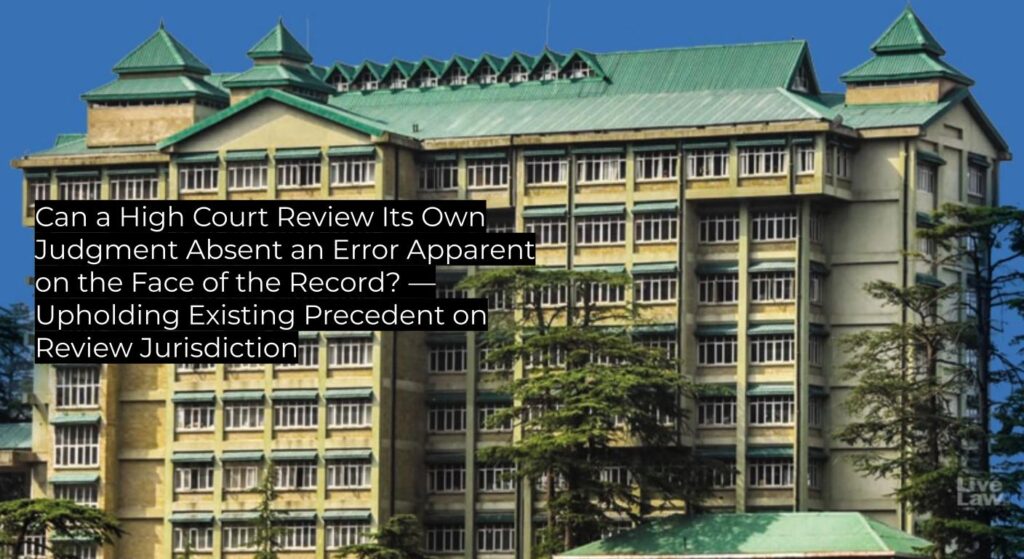
The High Court of Himachal Pradesh has reaffirmed that a review petition may be dismissed where no error apparent on the face of the record is found. This judgment upholds existing precedent on the narrow scope of review jurisdiction within the Code of Civil Procedure and serves as binding authority within the State, clarifying the threshold for maintainability of review petitions.
Summary
| Category | Data |
|---|---|
| Case Name | RP/91/2025 of KALPANA KUMARI Vs VIJAY KUMAR |
| CNR | HPHC010476832025 |
| Date of Registration | 08-10-2025 |
| Decision Date | 27-10-2025 |
| Disposal Nature | Disposed Off |
| Judgment Author | HON’BLE MR. JUSTICE SUSHIL KUKREJA, HON’BLE MR. JUSTICE VIRENDER SINGH |
| Court | High Court of Himachal Pradesh |
| Bench | HON’BLE MR. JUSTICE SUSHIL KUKREJA, HON’BLE MR. JUSTICE VIRENDER SINGH |
| Precedent Value | Binding authority within the jurisdiction of the Himachal Pradesh High Court |
| Type of Law | Review jurisdiction under the Code of Civil Procedure |
| Ratio Decidendi |
The High Court declined to review its earlier decision, stating that, in the absence of an error apparent on the face of the record, there is no ground to entertain a review petition. This reaffirms the principle that review is not an avenue for re-argument or reconsideration on merits absent a manifest and self-evident error. The judicial function at the stage of review is strictly limited to correcting patent errors apparent from the record that might have led to miscarriage of justice. |
| Facts as Summarised by the Court |
Review petition filed by Kalpana Kumari was heard; no one appeared for the respondent. The Court considered whether there was any error apparent on the face of the record, found none, and dismissed the review petition. |
Practical Impact
| Category | Impact |
|---|---|
| Binding On | All subordinate courts in Himachal Pradesh |
| Persuasive For | Other High Courts across India |
What’s New / What Lawyers Should Note
- Reaffirms the restrictive grounds for a court to exercise review jurisdiction — review is not an appeal in disguise.
- Dismissal of review for want of “error apparent on the face of the record” acts as a precedent for summary rejection of similar petitions.
- Lawyers should ensure specific, self-evident errors are pleaded when seeking review; re-arguments on merits will not suffice.
Summary of Legal Reasoning
- The Court heard the review petition and, after consideration, held that no error was apparent on the face of the record.
- The scope of review powers is limited to correcting mistakes that are obvious and self-evident on the face of the record.
- In the absence of such errors, a review petition does not lie, and the original order stands without interference.
- The Court consequently dismissed the petition, adhering to established principles that restrict misuse of review jurisdiction to prevent re-litigation.
Arguments by the Parties
Petitioner
- Sought review of the earlier judgment/order.
- Was represented by Ms. Anchal Sharma, Advocate.
Respondent
- None appeared for the respondent; no submissions were recorded.
Factual Background
The petitioner, Kalpana Kumari, filed a review petition before the High Court of Himachal Pradesh. The matter was listed and heard in the presence of counsel for the petitioner; the respondent was not represented. The Court examined the record to determine if any error apparent justifying review existed.
Statutory Analysis
- The Court referred to its jurisdiction to entertain a review petition, which is circumscribed by the requirement that an “error apparent on the face of the record” must be present.
- No expansive or restrictive new interpretation was recorded, but the standard for review was consistently applied.
Dissenting / Concurring Opinion Summary
No concurring or dissenting opinions were recorded; the order was delivered jointly by both judges on the Bench.
Procedural Innovations
No new procedural principles or innovations were discussed or established in this judgment.
Alert Indicators
- ✔ Precedent Followed – The judgment applies and upholds the established law regarding review jurisdiction; no new law or precedent was set or overturned.