


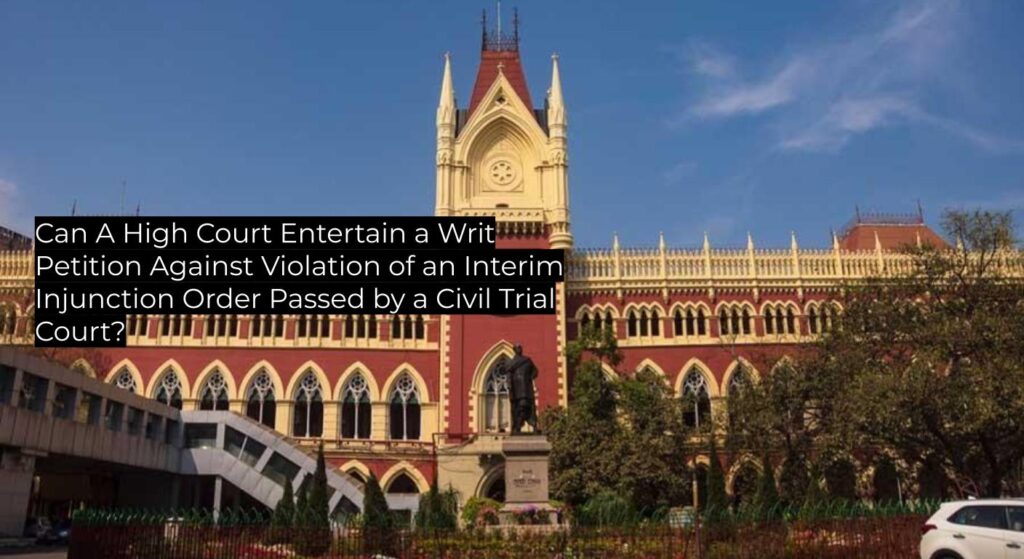
The Calcutta High Court reiterated that where a trial court’s interim injunction subsists, aggrieved parties must seek redress before the appropriate forum rather than resorting to writ jurisdiction; the judgment upholds existing civil procedural law principles, serving as binding precedent for similar writ petitions relating to enforcement of civil court orders.
Summary
| Category | Data |
|---|---|
| Case Name | WPA/23451/2025 of Rabiul Mistri @ Rabiul Mistry Vs State of West Bengal and Ors. |
| CNR | WBCHCA0457522025 |
| Date of Registration | 23-09-2025 |
| Decision Date | 27-10-2025 |
| Disposal Nature | DISPOSED |
| Judgment Author | HON’BLE JUSTICE SUVRA GHOSH |
| Court | Calcutta High Court |
| Bench | Single Judge |
| Precedent Value | Binding within jurisdiction |
| Type of Law | Civil Procedure/Writ Jurisdiction |
| Questions of Law | Whether a writ petition lies to the High Court in the case of alleged violation of a subsisting interim injunction passed by a civil trial court. |
| Ratio Decidendi |
When a civil court grants an ad interim injunction order and the petitioner alleges violation by private respondents, the correct procedural route is to seek redress before the appropriate forum, i.e., the civil court itself, and not to invoke High Court writ jurisdiction. Pendency of writ in such matters serves no fruitful purpose. Additionally, the State may take parallel preventive action for maintenance of peace if warranted, but that does not substitute private rights enforcement. |
| Facts as Summarised by the Court |
The petitioner filed a title suit before the trial court and obtained an interim injunction restraining defendants from interfering with property possession or its nature. Alleging violation of this injunction by private respondents, the petitioner filed a writ petition before the High Court. The State also reported proceedings under Section 126 of BNSS to maintain public order. |
Practical Impact
| Category | Impact |
|---|---|
| Binding On | All subordinate courts and authorities within the territorial jurisdiction of the Calcutta High Court |
| Persuasive For | Other High Courts in India when dealing with similar writ petitions involving enforcement of civil court orders |
| Follows | Established principles of civil procedural law regarding remedies for enforcement of injunctions |
What’s New / What Lawyers Should Note
- The High Court reaffirmed that violations of interim injunctions issued by civil courts must be addressed before the appropriate forum (the civil court), not through writ petitions.
- Writ petitions seeking enforcement or contempt of civil court orders are likely to be dismissed as not maintainable.
- Even if parallel action is initiated by the State under preventive statutes (such as Section 126 BNSS), individual civil rights enforcement must follow civil procedural remedies.
Summary of Legal Reasoning
- The court noted that the petitioner had been granted an interim injunction order by the trial court, which was still in force.
- Rather than invoking writ jurisdiction for alleged violation of the interim injunction by private parties, the petitioner was directed to pursue appropriate remedies before the trial court or competent forum.
- The High Court observed that, since alternative civil remedies exist, pendency of the writ petition would not serve any fruitful purpose.
- Preventive action by the police under Section 126 BNSS to maintain peace is distinct from enforcement of private civil rights.
- The court disposed of the writ petition with liberty to the petitioner to avail proper remedies.
Arguments by the Parties
Petitioner
Aggrieved by violation of the ad interim injunction granted by the trial court by private respondents.
State
Reported initiation of proceeding under Section 126 BNSS by the police to maintain peace and tranquility in the locality.
Respondents Nos. 10-12
No specific arguments captured in the judgment text.
Factual Background
The petitioner had obtained an ad interim injunction from the trial court in a title suit, restraining defendants from disturbing possession or altering the nature of the disputed property. Alleging that private respondents had violated this injunction, the petitioner approached the High Court with a writ petition seeking relief. The State, meanwhile, took preventive action under Section 126 BNSS to ensure public order.
Statutory Analysis
- Section 126 of BNSS (Bharatiya Nagarik Suraksha Sanhita) was noted as the statutory basis for police action to maintain peace and tranquility, initiated alongside the civil dispute.
- The judgment implicitly upholds the principle that contempt or violation of civil injunctions should be raised under relevant provisions before the civil court.
Alert Indicators
- ✔ Precedent Followed – The High Court reaffirms and applies existing law regarding appropriate forums for enforcement of civil court orders and the limits of writ jurisdiction in such matters.