


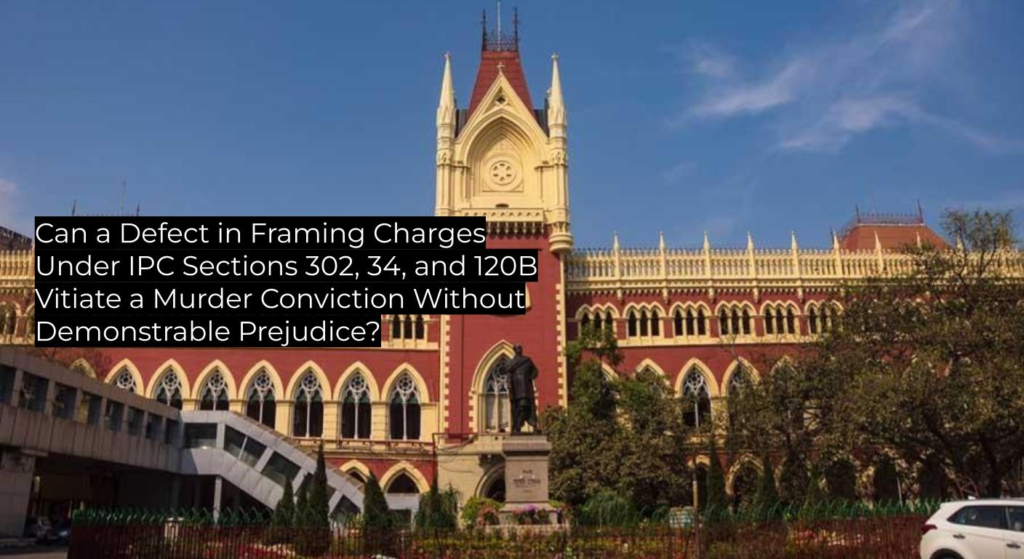
No Prejudice in Charge Framing Upholds Conviction; Chance-Witness Evidence, Section 27 Recoveries, and Inquest-PM Distinctions Affirmed by Calcutta HC
| Category | Data |
|---|---|
| Case Name | CRA/519/2016 of SURAJIT DAS @ NARKEL @ SUROJIT DAS & ANR. Vs STATE OF WEST BENGAL |
| CNR | WBCHCA0389722016 |
| Date of Registration | 19-08-2016 |
| Decision Date | 18-08-2025 |
| Disposal Nature | DISMISSED |
| Judgment Author | Hon’ble Justice Rajasekhar Mantha |
| Concurring or Dissenting Judges | Hon’ble Justice Ajay Kumar Gupta (concurring) |
| Court | Calcutta High Court |
| Bench | Two-Judge Bench (Mantha, J. and Gupta, J.) |
| Precedent Value | Binding on subordinate courts in West Bengal |
| Overrules / Affirms | Affirms existing Supreme Court precedents |
| Type of Law | Criminal law & procedure (IPC, CrPC, Evidence Act) |
| Questions of Law |
|
| Ratio Decidendi |
|
| Judgments Relied Upon |
|
| Logic / Authorities Relied Upon by the Court |
|
| Facts as Summarised by the Court | Three accused chased and shot the victim on 16 July 2012 at Kalitala, Lake Town. Two chance witnesses (auto-rickshaw driver and mason) saw and later identified Poka, Narkel, and Subrata in TI parades. Police conducted inquest, seized cartridges, weapons, motorcycle, and obtained ballistic matches. Trial Court convicted under IPC 302/34 and Arms Act. |
| Citations |
|
Practical Impact
| Category | Impact |
|---|---|
| Binding On | All criminal courts in West Bengal |
| Persuasive For | Other High Courts and the Supreme Court in framing charges and evaluating chance-witness and Section 27 Evidence Act recoveries |
| Distinguishes | Ramnath Madhoprasad v. State of M.P.; Mamfru Chowdhury v. Emperor; Mustaqeem v. State of Rajasthan |
| Follows | Willie (William) Slaney v. State of M.P. |
What’s New / What Lawyers Should Note
- Confirms that framing charges under Sections 302, 34 & 120B IPC together is not a ground for quashing absent demonstrated prejudice.
- Reiterates that an accused represented by counsel, who raises no objection to charge framing, is deemed to understand the charges’ purport.
- Affirms reliability of chance-witness testimony when their presence and conduct at the scene are reasonably explained and corroborated.
- Clarifies that minor discrepancies between inquest and post-mortem wound counts do not undermine causation or homicidal findings.
- Validates recovery of weapons under Section 27 Evidence Act based on a leading statement witnessed by one independent person and police, without strict two-civil-witness attestation.
Summary of Legal Reasoning
- Charge Framing and Prejudice: Relied on Slaney (1955) to hold that irregularity simplicitor in charge-framing under CrPC Secs 221, 535 & 537 IPC Secs 34 & 114 is curable unless prejudice is shown. Distinguished Ramnath (1953) on facts and absence of challenge at trial.
- Place of Occurrence Discrepancies: Examined minor inconsistencies among civilian witnesses; upheld conviction on strong eyewitness corroboration.
- Chance-Witness Evidence: Applied Rajesh Yadav (2022): chance-witnesses must have plausible reason for presence; here, explained by early-morning work and corroborated.
- Inquest vs Post-Mortem: Cited Amit Kumar (2025) to explain distinct roles: inquest for apparent cause; post-mortem for scientific assessment; minor wound-count variances immaterial.
- Section 27 Evidence Act Recoveries: Followed Sunil (2001) and Perumal Raja (2024) to uphold recoveries from accused-led discovery with one independent witness.
- Corroboration and Ballistics: Eyewitness identifications (TI parades), multiple civilian witnesses, and FSL ballistic matches reinforced mutual corroboration.
Arguments by the Parties
Petitioner (Accused)
- Charge framing under Sections 302, 34 & 120B inconsistent and vitiates conviction.
- Place of occurrence varies among witnesses.
- PW 11’s testimony on police interrogation self-contradictory.
- Presence of chance witnesses unexplained.
- Inquest report lists seven injuries vs four in post-mortem.
- Section 27 Evidence Act non-compliance in weapon recovery invalidates seizure.
Respondent (State)
- No prejudice from charge framing; counsel representation and no objection.
- Eyewitnesses’ accounts consistent, corroborated by civilians and ballistics.
- Chance-witness presence reasonably explained.
- Minor inquest/PM discrepancies non-fatal.
- Section 27 satisfied by independent and police witness at recovery.
Factual Background
On 16 July 2012 at around 6:15 am near Kalitala United Club (Lake Town), three accused shot and killed Prosenjit Roy while he fled on foot. Chance witnesses PW 10 (auto-rickshaw driver) and PW 11 (mason) observed the attack, later identifying Poka, Narkel, and Subrata in TI parades. Police conducted inquest, seized firearms, cartridges, a motorcycle, and obtained ballistic and post-mortem reports. The Sessions Court convicted three accused under IPC 302/34 and Arms Act; this appeal affirmed the convictions.
Statutory Analysis
- IPC Section 302 (Murder) read with Section 34 (Common Intention) and Section 120B (Criminal Conspiracy): scope of charge-framing and prejudice test.
- CrPC Section 174: inquest proceedings for apparent cause of death—limited scope.
- CrPC Sections 221, 535 & 537: framing of charge requirements—prejudice-focused.
- CrPC Section 342: examination of accused provides detail.
- Evidence Act Section 27: recovery statement by accused—attestation standards and leading-statement doctrine.
- CrPC Section 161: statements recorded during investigation.
Dissenting / Concurring Opinion Summary
No dissent; Justice Ajay Kumar Gupta concurred fully with the majority reasoning and outcome.
Procedural Innovations
- Affirms that charge-framing irregularities require actual prejudice to vitiate trial.
- Recognises that a single independent witness suffices for Section 27 recoveries when leading-statements guide police to evidence.
- Endorses a pragmatic approach to chance-witness evidence in the Indian context.
Alert Indicators
- ✔ Precedent Followed
Citations
- CRA 519/2016; CRAN 2/2025; CRAN 1/2025 (Calcutta HC)
- (1953) 1 SCC 178
- (1955) 2 SCC 340
- AIR 1924 Cal 323
- (2009) 9 SCC 719
- (2003) 3 SCC 175
- (2022) 12 SCC 200
- 2025 SCC OnLine SC 631
- (2001) 1 SCC 652
- (2024) SCC OnLine SC 12