


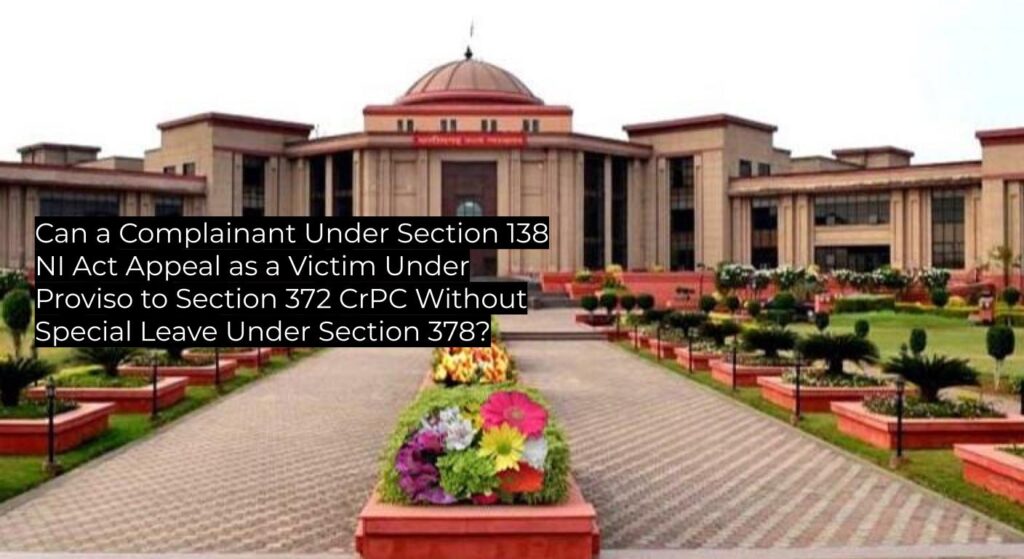
Yes – the Chhattisgarh High Court applies and affirms the Supreme Court’s Celestium Financial ruling that a complainant under Section 138 of the Negotiable Instruments Act qualifies as a victim under Section 2(wa) CrPC, entitling them to a direct appeal under the proviso to Section 372 CrPC. This decision upholds existing precedent and serves as binding authority for subordinate courts in Chhattisgarh and persuasive authority elsewhere.
Summary
| Category | Data |
|---|---|
| Case Name | ACQA/486/2018 of RAMESH KUMAR DEWANGAN Vs BRAJESH GAURHA |
| CNR | CGHC010395382018 |
| Date of Registration | 06-12-2018 |
| Decision Date | 02-09-2025 |
| Disposal Nature | DISPOSED OFF |
| Judgment Author | HON’BLE SHRI JUSTICE RADHAKISHAN AGRAWAL |
| Court | High Court of Chhattisgarh at Bilaspur |
| Bench | Single Judge |
| Precedent Value |
|
| Overrules / Affirms | Affirms the ratio in Celestium Financial v. A. Gnanasekaran (2025 INSC 804) |
| Type of Law | Criminal Procedure (CrPC) and Negotiable Instruments Act, 1881 |
| Questions of Law | Does a complainant under Section 138 NI Act qualify as a victim under Section 2(wa) CrPC and thereby have an unconditional right to appeal under the proviso to Section 372 CrPC without seeking special leave under Section 378(4) CrPC? |
| Ratio Decidendi | The High Court holds that a complainant under Section 138 NI Act is a “victim” within Section 2(wa) CrPC, and that the proviso to Section 372 CrPC grants victims an unqualified right to appeal against acquittals. Consequently, such victims need not seek special leave under Section 378(4) CrPC. The court grants the appellant liberty to withdraw the Sec 378 appeal and refile under Section 372 proviso. |
| Judgments Relied Upon | M/s. Celestium Financial v. A. Gnanasekaran Etc., 2025 INSC 804 |
| Logic / Jurisprudence / Authorities Relied Upon by Court |
|
| Facts as Summarised by the Court | ACQA 486/2018 is an appeal under Section 378(4) CrPC by a complainant against acquittal under Section 138 NI Act. Leave to appeal was granted on 04-12-2018. Following the Supreme Court’s Celestium Financial decision, the appellant sought to withdraw this appeal and refile under the proviso to Section 372 CrPC. The respondent did not oppose. |
| Citations | ACQA/486/2018; CNR CGHC010395382018; 2025 INSC 804 (paras 7.7–7.12) |
Practical Impact
| Category | Impact |
|---|---|
| Binding On | All subordinate courts under the Chhattisgarh High Court |
| Persuasive For | Other High Courts and trial courts hearing NI Act complaints |
| Follows | M/s. Celestium Financial v. A. Gnanasekaran Etc. (2025 INSC 804) |
What’s New / What Lawyers Should Note
- Confirms that a complainant under Section 138 NI Act is a “victim” under Section 2(wa) CrPC.
- Victims can file appeals under the proviso to Section 372 CrPC as of right, bypassing the special-leave requirement of Section 378(4) CrPC.
- Appellants may withdraw existing Section 378(4) leave appeals and refile before the Sessions Judge under Section 372 proviso.
- Sessions Judges are directed not to insist on limitation if the appeal is filed within 60 days of the High Court’s order.
Summary of Legal Reasoning
- The Supreme Court in Celestium Financial held that in Section 138 NI Act cases, the complainant suffers economic loss and is thus a “victim” under Section 2(wa) CrPC.
- Victims enjoy an absolute right to appeal under the proviso to Section 372 CrPC against acquittals, convictions for lesser offences, or inadequate compensation.
- Section 378(4) CrPC applies only to complainants who are not “victims,” requiring special leave for appeals against acquittals.
- A purposive interpretation of the 2009 amendment (proviso to Section 372) shows Parliament intended to grant victims an unfettered right to appeal.
- Application of these principles entitles the appellant to withdraw the Section 378 appeal and pursue relief under the proviso to Section 372 without leave.
Arguments by the Parties
Appellant / Complainant
- Leave under Section 378(4) CrPC was granted on 04-12-2018.
- Following Celestium Financial, the appellant qualifies as a victim and can appeal under the proviso to Section 372 CrPC.
- Seeks liberty to withdraw the present appeal and refile under Section 372 proviso.
Respondent
- Does not oppose the appellant’s submissions.
Factual Background
- The respondent was tried under Section 138 of the NI Act and acquitted by the JMFC, Champa, on 25-01-2018.
- The appellant obtained leave to appeal under Section 378(4) CrPC on 04-12-2018 (ACQA/486/2018).
- After the Supreme Court’s Celestium Financial decision, the appellant sought to withdraw the leave appeal and refile under the proviso to Section 372 CrPC.
- The respondent did not contest the withdrawal and refiling proposal.
Statutory Analysis
- Section 138, NI Act: Creates a deemed criminal offence on cheque dishonour; proceedings begin with a private complaint under Section 200 CrPC.
- Section 2(wa), CrPC: Defines “victim” to include persons who suffered direct loss or injury.
- Proviso to Section 372, CrPC: Grants victims an unconditional right to appeal against acquittal or inadequate compensation; effective from 31-12-2009.
- Section 378(4), CrPC: Requires special leave for complainants (non-victims) to appeal against acquittals; not applicable to victims filing under Section 372 proviso.
Procedural Innovations
- High Court permits withdrawal of a Section 378(4) leave appeal and grants liberty to refile under Section 372 proviso.
- Clarifies that Sessions Judges should waive limitation issues if the new appeal is filed within 60 days of this order.
Alert Indicators
- ✔ Precedent Followed – Affirms the Supreme Court’s Celestium Financial ruling.
- 📅 Time-Sensitive – 60-day window to refile the appeal under Section 372 proviso.
Citations
- High Court of Chhattisgarh at Bilaspur: ACQA/486/2018 (CNR CGHC010395382018), Judgment dated 02.09.2025.
- Supreme Court: M/s. Celestium Financial v. A. Gnanasekaran Etc., 2025 INSC 804 (paras 7.7–7.12).