


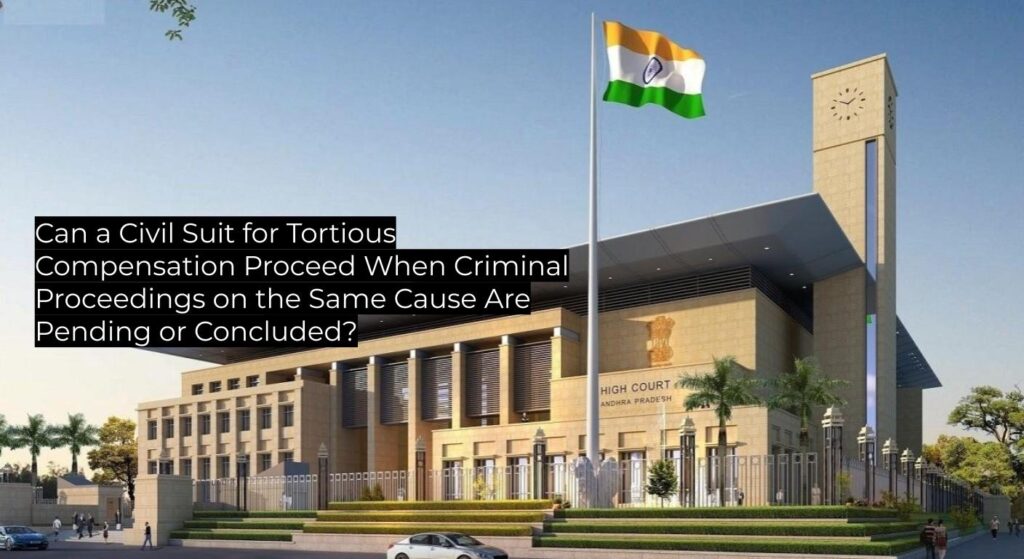
The Andhra Pradesh High Court affirms that a victim may simultaneously pursue a civil suit for damages for personal injuries and criminal proceedings for the same incident. There is no legal bar to the maintainability of a civil suit even when criminal proceedings have been initiated or concluded, provided that any compensation awarded under Section 357 CrPC by the criminal court is accounted for in the civil proceedings. This decision upholds established precedent and serves as binding authority for courts within the state.
Summary
| Category | Data |
|---|---|
| Case Name | AS/233/2016 of Dantla Subba Reddy Vs Bhavanam Chinna Venkata Reddy |
| CNR | APHC010266322016 |
| Date of Registration | 14-03-2016 |
| Decision Date | 10-09-2025 |
| Disposal Nature | PARTLY ALLOWED NO COSTS |
| Judgment Author | Maheswara Rao Kuncheam (per Justice Maheswara Rao Kuncheam) |
| Concurring or Dissenting Judges | RAVI NATH TILHARI, MAHESWARA RAO KUNCHEAM |
| Court | High Court of Andhra Pradesh |
| Bench | RAVI NATH TILHARI, MAHESWARA RAO KUNCHEAM |
| Precedent Value | Binding on all subordinate courts in Andhra Pradesh |
| Overrules / Affirms |
|
| Type of Law | Civil Tort Law, Compensation, Procedure (CPC, CrPC) |
| Questions of Law |
|
| Ratio Decidendi |
The court held that there is no bar on filing or maintaining a civil suit for compensation in tort, even when criminal proceedings regarding the same incident have been filed or concluded. Both civil and criminal proceedings may coexist for the same wrongful act. However, at the time of awarding compensation in a civil suit, the court must deduct any amount already granted as compensation under Section 357 CrPC. Since the criminal court in this case did not award compensation, the civil court had no adjustment to make. The judgment reaffirms the concurrent jurisdiction of civil and criminal courts and elaborates guidelines to prevent double recovery. The court also clarified methods for computing compensation, referencing multiplier method and meticulously assessing heads such as loss of income, medical expenses, pain and suffering, attendant charges, and impact on marital prospects. |
| Judgments Relied Upon |
|
| Logic / Jurisprudence / Authorities Relied Upon by the Court |
|
| Facts as Summarised by the Court | A property dispute escalated, resulting in a physical attack on the plaintiff by the defendants, causing grievous bodily injury and permanent disability. The plaintiff initiated both criminal proceedings (where one defendant was convicted) and a civil suit for compensation of Rs. 20,00,000. The trial court partially decreed the suit with damages of Rs. 4,04,000. Both parties appealed; the plaintiff for enhancement, the defendants for complete reversal. |
Practical Impact
| Category | Impact |
|---|---|
| Binding On | All subordinate courts in Andhra Pradesh |
| Persuasive For | Other High Courts, particularly in similar compensation/tortious liability disputes alongside criminal proceedings |
| Follows |
|
| Distinguishes | None specified in the judgment |
| Overrules | None specified in the judgment |
What’s New / What Lawyers Should Note
- Affirms that a civil suit for damages on account of personal injury is maintainable even where parallel or prior criminal proceedings have been initiated or concluded for the same incident.
- Civil courts are to consider, and deduct, any compensation paid under Section 357 CrPC in criminal proceedings to prevent double recovery for the same cause.
- If no compensation is awarded under Section 357 CrPC by the criminal court, the civil court is not required to make any deduction.
- The judgment explicitly applies the principles in D.Purushotama Reddy & Anr. v. K. Sateesh (SC) and Varghese v. Sasi & Ors. (Kerala HC) as binding precedent.
- Detailed reaffirmation of the multiplier method and scientific assessment of functional disability per Raj Kumar v. Ajay Kumar and related Supreme Court case law.
- Compensation heads elaborated: loss of earning capacity, medical expenses, pain and suffering, attendant charges, and loss of marital prospects, with explicit enhancement on appeal.
- Lawyers can cite this authority to counter objections raised about concurrent or subsequent maintainability of civil suits for compensation, even after criminal trial or conviction.
Summary of Legal Reasoning
- Maintainability of Civil Suit Despite Criminal Proceedings: The court thoroughly analyzed Section 357 CrPC, especially sub-sections (3) and (5), affirming that there is no statutory or procedural bar to pursuing a civil suit for damages even if criminal proceedings (including conviction or acquittal) have occurred for the same incident. The only caveat is that courts must avoid double recovery by accounting for any compensation under Section 357 CrPC.
- Precedent Relied Upon: The court relied heavily on the Supreme Court’s decision in D.Purushotama Reddy & Anr. v. K. Sateesh, holding that both civil and criminal actions can be maintained, and that compensations awarded in one forum should be considered in the other. Consistent interpretation from Varghese v. Sasi & Ors. (Kerala HC) was also cited.
- Factual Matrix & Application of Law: Upon evidence, the court found that no compensation had been awarded in the criminal trial, so the trial and appellate courts were free to adjudicate the civil claim without deduction.
- Compensation Principles: Assessment of quantum followed the multiplier method as per Sarla Verma, National Insurance Co. Ltd. v. Pranay Sethi, and Raj Kumar v. Ajay Kumar. The appellate court applied scientific evaluation of functional disability (corrected from 40% to 50%), reaffirming that percentage of disability and loss of income are not always the same and must be judicially assessed.
- Enhanced Damages: The appellate court enhanced damages, clarifying compensation under multiple heads, particularly recognizing “marital prospects” and care attendant charges as valid components, following recent Supreme Court authority.
- Final Orders and Application: The plaintiff’s appeal was partly allowed (increased damages and interest rates specified), and the defendants’ appeal dismissed.
Arguments by the Parties
Petitioner (Plaintiff/Appellant in AS 1025/2016):
- The trial court erred in not fully taking into account the Disability Certificate (Ex.A-22) and wrongly reduced the assessed disability from 70% to 40%.
- Plaintiff’s actual income was underestimated.
- Inadequate compensation was awarded for medical bills, marital prospects, attendant charges, and pain and suffering.
- The court should have awarded just and reasonable compensation in view of the seriousness of the injury.
Respondent (Defendants/Appellants in AS 233/2016):
- Filing a civil suit for compensation is without jurisdiction since criminal proceedings for the same incident were already initiated; entire civil suit should be set aside.
- Plaintiff was the aggressor; defendants exercised private defense and were themselves injured.
- The trial court granted excessive compensation.
- The plaintiff’s suit is not maintainable in law.
Factual Background
The dispute began with ongoing property issues between the parties, who are family members. On 01.04.2006, a physical altercation resulted in the plaintiff sustaining grievous injuries, including paralysis and severe disability, after being attacked by the first defendant with a knife. The plaintiff underwent prolonged treatment and claimed permanent disability. Criminal proceedings under Sections 307, 326 r/w 34 IPC were initiated against the defendants, resulting in conviction of the first defendant. The plaintiff also filed a civil suit seeking Rs. 20,00,000 in compensation. The trial court partially decreed Rs. 4,04,000. Cross-appeals followed: one by the plaintiff for enhancement, and one by the defendants for reversal of the decree.
Statutory Analysis
- Section 357, Criminal Procedure Code (CrPC): The court extracted and analyzed Section 357 CrPC in detail. It underscored that Section 357(3) empowers criminal courts to award compensation to crime victims, and Section 357(5) requires any civil court hearing subsequent claims to account for criminal compensation awarded, preventing “double benefit.”
- Civil Procedure Code (CPC): Appeals were under Section 96 read with Order XLI Rule 1 CPC.
- No procedural embargo: The court found no statutory provision barring civil suits when criminal proceedings exist, whether before, concurrent to, or after the civil action.
Dissenting / Concurring Opinion Summary
No dissenting or separate concurring opinion is recorded. Both judges (RAVI NATH TILHARI and MAHESWARA RAO KUNCHEAM) signed the common judgment.
Procedural Innovations
- The court issued a comprehensive common judgment for both cross-appeals, consolidating overlapping evidence and contentions.
- The court clarified the duty of trial and appellate courts to examine criminal compensation awarded (if any) before granting civil damages.
- The introduction of enhanced heads of damages (attendant charges, marital prospects) was methodically reasoned relying on the most recent Supreme Court jurisprudence.
Alert Indicators
- ✔ Precedent Followed – The judgment follows and affirms existing Supreme Court precedent and principle (notably D.Purushotama Reddy & Anr. v. K. Sateesh) regarding concurrent maintainability of civil and criminal proceedings for the same wrongful act and the mechanics of compensation adjustment.