


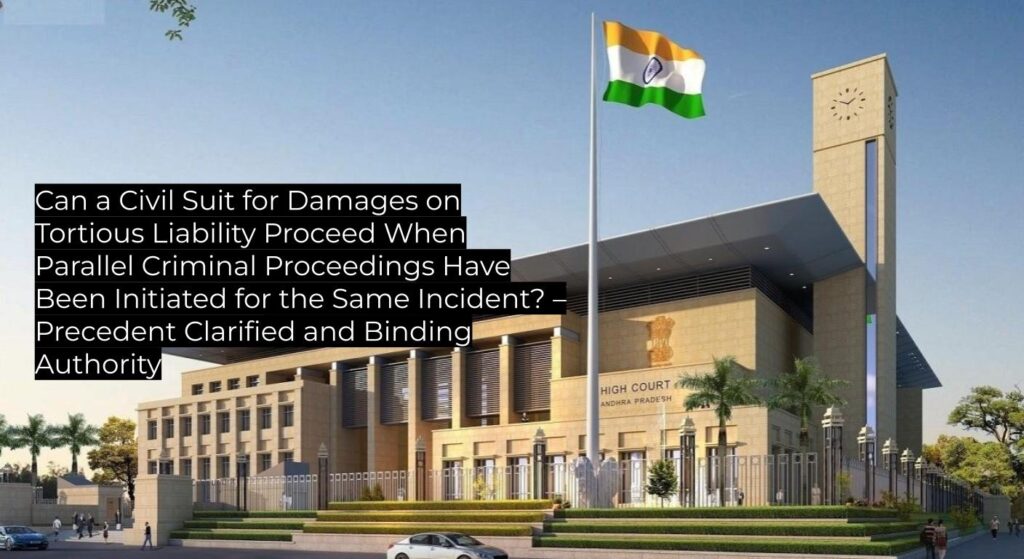
The Andhra Pradesh High Court has clarified that initiation of criminal proceedings does not bar a civil suit for compensation arising out of the same incident; both are maintainable concurrently, and section 357 CrPC ensures avoidance of double recovery. This judgment upholds Supreme Court and High Court precedent and serves as binding authority for all subordinate courts in Andhra Pradesh in matters involving personal injury compensation.
Summary
| Category | Data |
|---|---|
| Case Name | AS/1025/2016 of Bhavanam China Venkata Reddy Vs Dantla Subba Reddy, CNR APHC010619622016 |
| Date of Registration | 10-11-2016 |
| Decision Date | 10-09-2025 |
| Disposal Nature | PARTLY ALLOWED NO COSTS |
| Judgment Author | Justice Maheswara Rao Kuncheam |
| Concurring or Dissenting Judges | Justice Ravi Nath Tilhari |
| Court | High Court of Andhra Pradesh |
| Bench | Division Bench: Justice Ravi Nath Tilhari & Justice Maheswara Rao Kuncheam |
| Precedent Value | Binding authority for subordinate courts in Andhra Pradesh |
| Type of Law |
|
| Questions of Law |
|
| Ratio Decidendi |
The Court held that the pendency or previous initiation of criminal proceedings in respect of the same matter does not bar a civil suit seeking damages for injuries arising from tortious liability. Section 357 CrPC does not create a bar; instead, it provides that any compensation awarded in criminal proceedings must be considered in a civil suit to avoid double benefit. The powers of the criminal and civil court are concurrent in this respect. Citing Supreme Court and Kerala High Court precedent, the Court underscored that, to prevent unjust enrichment, courts deciding subsequent proceedings (civil or criminal) must give credit for compensation already awarded in the alternate proceedings. In the present case, since no compensation was awarded by the criminal court, there was no bar or adjustment required, and the plaintiff could pursue the civil suit for damages. |
| Judgments Relied Upon |
|
| Logic / Jurisprudence / Authorities Relied Upon by the Court | Interpreted Section 357(3) & (5) CrPC, applied concurrent jurisdiction and adjustment principle, relied on Supreme Court and High Court precedent. |
| Facts as Summarised by the Court | Plaintiff suffered grievous injuries following an alleged attack by defendants during a property dispute; both sides filed civil and criminal actions; plaintiff sought civil compensation despite prior criminal conviction of defendant with no compensation awarded. Substantial medical evidence was produced; trial court gave partial compensation, which was revised/enhanced by the High Court. |
Practical Impact
| Category | Impact |
|---|---|
| Binding On | All subordinate courts in Andhra Pradesh |
| Persuasive For | Other High Courts; can be cited as persuasive authority elsewhere in India |
| Follows |
|
What’s New / What Lawyers Should Note
- The Court has reaffirmed that civil suits for compensation are maintainable for the same incident even if criminal proceedings (including conviction) are or have been underway.
- No statutory bar exists under Section 357 CrPC or otherwise; both civil and criminal remedies are concurrent.
- At the time of awarding compensation in a civil suit, any compensation awarded in criminal proceedings under Section 357 must be considered – but if no compensation was awarded in criminal trial, civil damages are unaffected.
- Lawyers can cite this judgment to oppose objections regarding “double jeopardy” or bar to parallel civil claims where criminal proceedings exist or have culminated.
- The judgment provides a structured approach for determining disability, income, and compensation in personal injury tort claims, referencing multiplier methods and recent Supreme Court benchmarks.
Summary of Legal Reasoning
- Statutory Basis: The Court examined Section 357(3) and (5) CrPC and held they permit concurrent civil and criminal remedies for compensation. Section 357(5) specifically mandates that any compensation paid in criminal proceedings be adjusted in subsequent civil proceedings to prevent double benefit.
- Judicial Precedent: Cited D.Purushotama Reddy (Supreme Court), which clarified that civil suits for recovery of money or damages are maintainable even if criminal proceedings for the same cause also exist, and that compensation paid under Section 357 CrPC must be accounted for by civil courts.
- Kerala High Court Followed: Varghese v. Sasi & Ors confirmed the concurrent powers of civil and criminal courts and the need for mutual adjustment of compensation—but not the mutual exclusion of remedies.
- Facts Applied: In this case, the criminal court had not awarded compensation under Section 357 to the victim-plaintiff; thus, there was neither any bar to the civil suit nor need for adjustment.
- Quantum of Compensation: The Court discussed the standard for determining disability and loss of earning capacity, followed the multiplier method (Sarla Verma, Pranay Sethi, Atul Tiwari), reassessed disability based on reliable medical evidence (50% instead of trial Court’s 40%), and enhanced compensation accordingly under multiple heads.
- Conclusion: Both criminal and civil remedies can be pursued parallelly or sequentially. The plaintiff was entitled to enhanced damages independent of criminal conviction/fine, but with adjustments if compensation had been previously paid.
Arguments by the Parties
Petitioner (Plaintiff):
- Argued trial court erred by not considering Disability Certificate showing 70% disability.
- Contended trial court wrongly assessed income as lower than actual.
- Objected to inadequate compensation for medical bills, marital prospects, attendant charges, and pain/suffering.
- Urged for just and reasonable compensation in view of evidence.
Respondents (Defendants):
- Claimed that a civil suit is not maintainable if criminal proceedings have already been initiated for the same matter.
- Asserts that plaintiff was the aggressor and injuries sustained by plaintiff were in exercise of their right to private defense.
- Alleged that compensation granted by trial court was excessive and should be set aside.
Factual Background
The dispute arose from a long-standing property dispute between the plaintiff and his brothers (defendants). On 01.04.2006, both parties were involved in an altercation which resulted in the plaintiff suffering serious injuries after being attacked with a knife by defendant 1, leading to hospitalization and partial paralysis. The plaintiff initiated criminal proceedings under Sections 307 and 326 read with 34 IPC against the defendants; defendant 1 was convicted in the ensuing criminal trial, although no compensation was awarded. The plaintiff then filed a civil suit claiming Rs.20 lakhs as compensation for injuries, medical expenses, and loss of earning capacity. The trial court partially allowed the claim; both sides appealed.
Statutory Analysis
- The Court closely interpreted Section 357(3) and (5) of the Code of Criminal Procedure, 1973.
- Section 357(3): Permits criminal courts to award compensation to victims.
- Section 357(5): Mandates that compensation awarded under Section 357 CrPC in criminal proceedings must be considered by the civil court in any subsequent civil proceeding on the same matter (to prevent double recovery).
- The Court clarified that Section 357 does not bar a civil suit; it only ensures adjustment of compensation.
- No statutory/per se bar or procedural embargo was cited by defendants; none could be shown.
Dissenting / Concurring Opinion Summary
No separate dissenting or concurring opinion; judgment is a common, unanimous decision authored by Justice Maheswara Rao Kuncheam and concurred by Justice Ravi Nath Tilhari.
Procedural Innovations
No new procedural innovations or changes to evidence, locus standi, or guidelines were issued in this judgment. The court did, however, clarify the process for concurrent compensation awards under civil and criminal law in practical, case-specific terms, which aids future procedural clarity.
Alert Indicators
- ✔ Precedent Followed – Supreme Court and High Court precedent affirmed, statutory clarity brought to recurring legal question regarding concurrent civil and criminal remedies for compensation.