


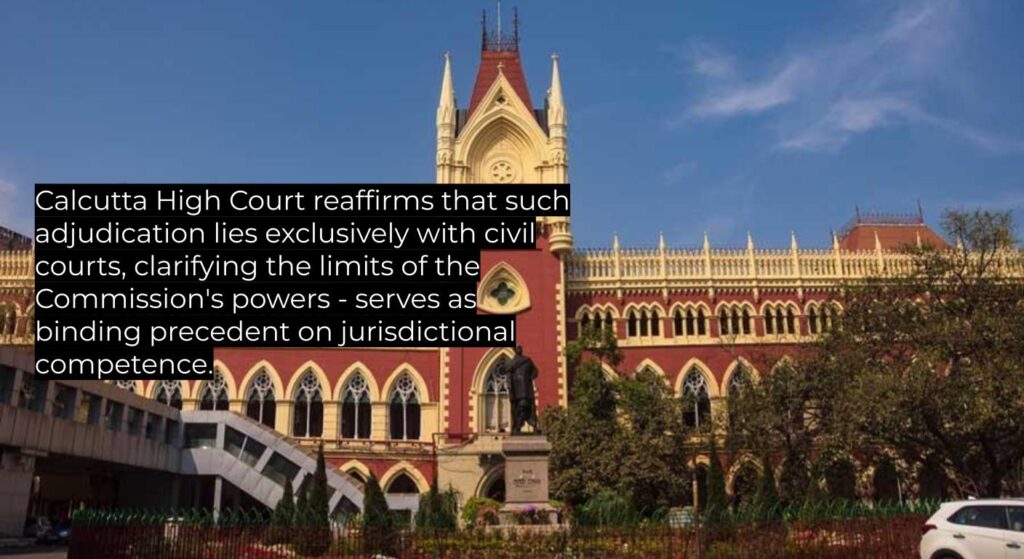
The Court has categorically held that the National Commission for Scheduled Tribes cannot entertain or decide private tenancy disputes or pass eviction orders, especially when such matters are already pending before a civil court. This decision affirms and clarifies established law, reinforcing that only competent civil forums may decide civil rights unrelated to atrocities under the SC/ST (Prevention of Atrocities) Act, 1989. Practically, the judgment provides binding authority within West Bengal and persuasive value elsewhere regarding the non-applicability of Commission jurisdiction in private tenancy disputes.
Summary
| Category | Data |
|---|---|
| Case Name | WPA/20150/2025 of MD. SAHABUDDIN Vs UNION OF INDIA AND ORS. CNR WBCHCA0399032025 |
| Date of Registration | 26-08-2025 |
| Decision Date | 31-10-2025 |
| Disposal Nature | DISPOSED |
| Judgment Author | HON’BLE JUSTICE AMRITA SINHA |
| Court | Calcutta High Court |
| Precedent Value | Binding on subordinate courts in West Bengal; persuasive elsewhere |
| Type of Law | Constitutional and statutory interpretation (jurisdiction of National Commission for STs) |
| Questions of Law | Does the National Commission for Scheduled Tribes have authority to resolve private tenancy disputes and pass eviction orders between individuals? |
| Ratio Decidendi |
The National Commission for Scheduled Tribes lacks statutory authority to adjudicate or pass eviction orders in private tenancy matters between individuals, especially when such disputes are pending before competent civil courts. The Commission’s mandate is limited to investigating complaints of atrocities or deprivation of rights of reserved category members, not adjudicating general civil disputes. Adjudication of civil rights (not touching the SC/ST Act) can only be made by the proper civil forum. In the present case, the Commission exceeded its jurisdiction by entertaining and deciding the tenancy dispute. Its order for eviction is impermissible and set aside. |
| Facts as Summarised by the Court |
The tenant-petitioner challenged a direction of the National Commission for Scheduled Tribes to vacate shop premises and deliver possession to the landlord (a scheduled caste member), enforced with police help. The petitioner had already sought protection of his tenancy rights before the civil court, which had passed an interim order restraining eviction without due process. The Commission’s order was passed ex parte, with no notice or hearing to the petitioner. The dispute pertained to a tenancy and was pending before a civil court. |
Practical Impact
| Category | Impact |
|---|---|
| Binding On | All subordinate courts in West Bengal |
| Persuasive For | Other High Courts, Supreme Court, and quasi-judicial authorities |
| Follows | Statutory framework limiting the Commission’s jurisdiction to matters under the SC/ST Act, 1989 |
What’s New / What Lawyers Should Note
- Reiterates that the National Commission for Scheduled Tribes lacks jurisdiction to adjudicate or issue eviction orders in private tenancy disputes between individuals.
- Clarifies that Commission cannot pass orders affecting civil rights when the dispute is pending before a competent civil court.
- Emphasizes that civil disputes unrelated to the SC/ST Act must be decided exclusively by civil courts.
- Lawyers can rely on this decision to challenge any overreach by Commissions or statutory bodies into private civil disputes.
Summary of Legal Reasoning
- The Court examined the scope of powers conferred upon the National Commission for Scheduled Tribes under the SC/ST (Prevention of Atrocities) Act, 1989.
- Noted that the Commission’s role is confined to the protection against exploitation, discrimination, and deprivation of rights of members of the scheduled communities.
- Explicitly held that the Commission cannot adjudicate private civil disputes, particularly those relating to tenancy, as these fall within the domain of civil courts.
- The Court highlighted that there was an existing civil suit regarding the same tenancy dispute, and the civil court had already passed a protective order.
- The Commission’s failure to provide notice or hearing to the petitioner before passing its order further vitiated the process.
- The direction by the Commission for eviction was found ultra vires and thus set aside.
- Parties were directed to address all issues related to possession and rights before the competent civil court.
Arguments by the Parties
Petitioner:
- The National Commission for Scheduled Tribes has no authority to pass eviction orders, especially as civil court protection exists.
- The Commission proceeded ex parte, with no notice or hearing for the petitioner.
- The dispute is a civil tenancy matter, not covered by the SC/ST (Prevention of Atrocities) Act.
Respondent (Private Respondent/Landlord):
- Petitioner voluntarily surrendered possession of the premises in the presence of police.
- Petitioner defaulted in rent payment and thus has no right to retain the premises.
Respondent Nos. 1 and 2 (Union of India Representatives):
- The petitioner should have appealed the Commission’s order before the designated appellate authority.
Factual Background
The dispute originated from a landlord–tenant relationship concerning a shop premises. The private respondent-landlord, a scheduled caste member, obtained a direction from the National Commission for Scheduled Tribes to evict the petitioner-tenant, with assistance from the police. The petitioner had already sought and obtained interim protection of tenancy rights from the competent civil court. The Commission’s eviction order was passed without notice to the petitioner, and the matter relating to tenancy was already sub judice before the civil forum. The petitioner subsequently vacated the premises under alleged police intervention but continued to assert his tenancy rights before the civil court.
Statutory Analysis
- The Court interpreted the provisions of the Scheduled Castes and Scheduled Tribes (Prevention of Atrocities) Act, 1989.
- It held that the Act and the National Commission are empowered to guard against exploitation, discrimination, and deprivation of rights of members of the reserved category only in the context of atrocities or rights conferred by the Act.
- The Act does not authorize the Commission to adjudicate general civil disputes, such as tenancy or eviction, between private parties.
- Civil rights disputes, unless directly implicating the Act, remain within the exclusive domain of civil courts.
Dissenting / Concurring Opinion Summary
No separate dissenting or concurring opinions are recorded in the judgment.
Procedural Innovations
The judgment does not specify any procedural innovations established by the Court.
Alert Indicators
- ✔ Precedent Followed – The decision upholds and clarifies existing boundaries of jurisdiction for the National Commission for Scheduled Tribes, reiterating that civil courts alone may adjudicate private tenancy disputes between individuals.