Can High Courts Quash FIRs Registered Pursuant to Magistrate Orders Under Section 156(3) CrPC When the Underlying Complaint Appears Mala Fide or Is an Abuse of Process?

High Court clarifies and reaffirms the guiding principles for quashing FIRs under Section 482 CrPC (now Section 528 BNSS) even where the FIR is registered upon a Magistrate’s direction under Section 156(3). Where allegations are prima facie frivolous, actuated by malice, or amount to abuse of process, quashing is justified. Judgment follows established Supreme Court […]
When Is Bail to Be Granted for Offences with a Civil-Commercial Backdrop? — Orissa High Court’s Clarification on Bail Discretion and Overlapping Civil and Criminal Proceedings

Court endorses that the pendency of related civil suits and completion of investigation weigh in favour of granting bail for offences under BNS involving fraud and forgery between individuals, unless specific flight risk or evidence tampering concerns arise. The decision upholds the Supreme Court’s precedents, clarifying that denial of bail is the exception, not the […]

Does Dismissal of a Writ Petition for Non-Prosecution Constitute a Precedent on Substantive Legal Questions?

The court dismissed the writ petition for non-prosecution without addressing the merits or any legal principle, vacating the interim order. Such procedural dismissal holds no precedential value on substantive legal issues and cannot be used as binding or persuasive authority in future cases.   Summary Category Data Case Name WPMS/854/2013 of DIRECTOR MAHARISHI VIDYA MANDIR […]

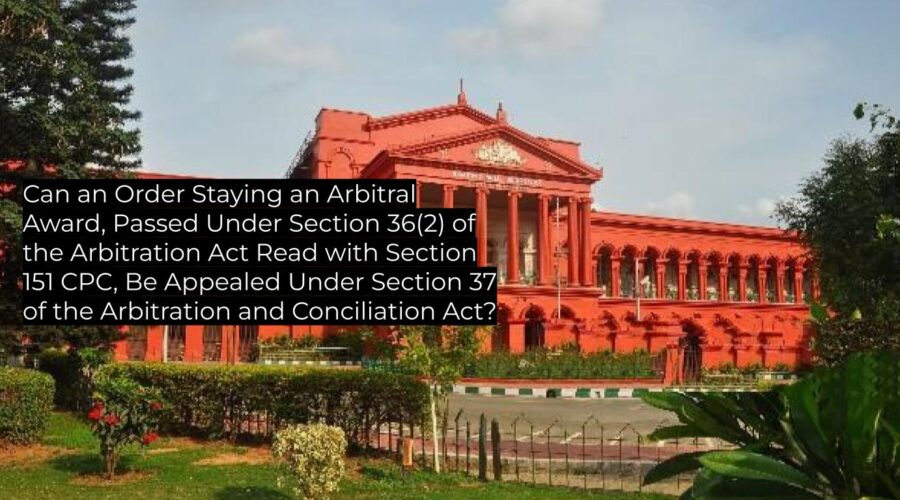
Can an Order Staying an Arbitral Award, Passed Under Section 36(2) of the Arbitration Act Read with Section 151 CPC, Be Appealed Under Section 37 of the Arbitration and Conciliation Act?

The Karnataka High Court reaffirmed that interim orders staying arbitral awards under Section 36(2) of the Arbitration and Conciliation Act, 1996 read with Section 151 CPC are not appealable under Section 37 of the Act and must instead be challenged via writ proceedings. This ruling upholds existing procedural precedent and is binding for all similar […]

When Can Bail Be Granted in Serious IPC Offences Involving Bodily Injury: Upholding Article 21 and Parity With Co-Accused?

Bail granted where the accused had been in prolonged custody, was not implicated in other cases, and co-accused had already been released—reaffirming established principles on bail, parity, and right to speedy trial; judgment serves as binding authority on similar bail petitions arising from protracted undertrial custody, especially for serious offences under the IPC.   Summary […]

Does Anticipatory Bail U/S 304/34 IPC Become Absolute Upon Compliance With Investigation, and What Are Its Limits Under BNSS? – Clarification and Application by Punjab & Haryana High Court

The High Court clarifies that once an accused joins the investigation and custodial interrogation is unnecessary, interim anticipatory bail can be made absolute, subject to statutory limits under Section 482(2) of the Bharatiya Nagarik Suraksha Sanhita, 2023 (BNSS). The decision upholds established law, reiterates non-blanket nature of bail, and preserves rights for recall/cancellation, thus providing […]

Does Acceptance of Ad Hoc Service for Retirement Benefits Require Judicial Orders Where the Employer Concedes the Claim?

When an employer, during contempt proceedings, concedes and accepts the petitioner’s claim for consideration of ad hoc service for retirement benefits, the High Court clarified that it is sufficient to direct release of consequential benefits within a set period, and no further orders are required. This judgment affirms the procedural precedent for summary disposal of […]

Can High Courts Interfere With First Appellate Court Findings Discarding Wills Based on Conjecture? (Binding, Clarifies Law on Appraisal of Suspicious Circumstances in Challenged Wills)

Where a First Appellate Court rejects a Will solely on conjecture, ignoring consistent attesting witness testimony and lacking material evidence of suspicion, the High Court can restore the Trial Court’s findings if due execution is proved in accordance with Section 63 of the Indian Succession Act and Section 68 of the Indian Evidence Act. This […]

From Which Date Does Entitlement to Revised Pay Scale Accrue for D.El.Ed-Trained Teachers? Calcutta High Court Upholds “Last Date of Examination” as Determinative Principle

The Calcutta High Court reconfirms that entitlement to the “A” category pay scale for D.El.Ed.-qualified teachers accrues from the day following the last date of the examination, not from the date of publication of results. This judgment upholds existing coordinate bench precedent and is binding on subordinate courts within West Bengal, serving as persuasive authority […]

Does a University Have the Right to De-affiliate a College Based Solely on a Civil Court Decree Amidst Pending Appeals and Section 47 CPC Proceedings?

The Calcutta High Court clarified that a civil court decree regarding college management remains operative unless stayed, and universities may act based on such decrees; however, orders granting procedural relief for students do not create rights or equities between rival management groups while judicial challenges to decrees are pending. This reasoning upholds established precedent and […]

Is Withdrawal of Writ Petitions With Liberty to File Afresh Permissible after Prior Adjudication under Related Precedents?

The High Court permitted the petitioner’s withdrawal of the writ petition with liberty to file afresh, after noting that similar issues had already been directed for consideration under binding precedents, and that no adjudicatory order was challenged. The order follows existing judicial standards on procedural liberty, impacts recovery disputes in public employment, and provides persuasive […]

Must a Revisional Authority First Decide on Condonation of Delay Before Hearing Land Record Revision Petitions Filed Beyond Limitation?

The Court has clarified that any challenge to the final Record of Rights (R.o.R) under Section 15(b) of the Odisha Survey and Settlement Act, 1958, filed beyond the statutory limitation period, cannot proceed on merits until the delay is first condoned by the Revisional Authority. This decision upholds existing legal procedure and is binding within […]