Is Termination of Daily Wage or Temporary Employees on Stigmatic Grounds Without Enquiry Permissible? High Court of Chhattisgarh Affirms Supreme Court Precedent Mandating Enquiry in Punitive Terminations

The High Court of Chhattisgarh reiterates that even in the case of daily wage or temporary employees, any stigmatic or punitive termination order must be preceded by a proper enquiry and opportunity of hearing, aligning with Supreme Court precedent. This decision upholds and applies established law, serving as a binding precedent for subordinate courts and […]
Can a Conviction for Murder Be Sustained Without Examination of the First Investigating Officer and Proper Admission of the Initial FIR and Related Evidence? Clarification and Restatement of Law by the Gauhati High Court

Conviction for murder under Section 302 IPC cannot stand when key prosecution lapses—such as non-examination of the first investigating officer, non-exhibition of initial police records (GD Entry, inquest papers), and failure to properly confront witnesses with inconsistencies—are present; and any sentence for conviction under Section 302 IPC must not be less than life imprisonment. Gauhati […]

Can Writ Jurisdiction under Article 226 Be Invoked to Decide Disputed Questions of Fact in Contractual Payment Disputes? – Precedent Affirmed and Scope Clarified by High Court

The High Court has reaffirmed that where the resolution of a dispute requires adjudication of disputed questions of fact arising out of contract claims, the remedy under Article 226 is not appropriate. Instead, such disputes should be relegated to the civil courts or other alternate forums as agreed in the contract. This judgment follows long-standing […]

Can Insurance Liability Be Fastened When No Valid Policy or Premium Receipt Exists? Upholding the Principle That Actual Risk Cannot Be Assumed Without Valid Insurance Contract

The Chhattisgarh High Court has reaffirmed that an insurer cannot be saddled with liability for compensation arising from a motor accident unless there is a valid contract of insurance in force, supported by actual receipt and acceptance of premium by an authorised officer. The judgment upholds existing statutory interpretation and precedent, clarifying obligations under Section […]

Can Conviction Be Based Solely on an Oral Dying Declaration By Related Witnesses? Gauhati High Court Narrows the Test for Exception 1 to Section 300 IPC and Clarifies Evidentiary Standards

The Gauhati High Court holds that conviction can rest on an oral dying declaration given to related witnesses if found voluntary, consistent, and trustworthy; applies Supreme Court precedent to clarify scrutiny standards, and reduces murder conviction to culpable homicide not amounting to murder (Section 304 Part I IPC) when grave and sudden provocation is established […]

Does Voluntary Departure of Minor from Lawful Guardianship Without Accused’s Active Inducement Attract the Offence of Kidnapping Under Section 363 IPC? — Precedent Affirmed and Clarified

The Chhattisgarh High Court affirms the established principle that mere accompanying or passive facilitation by the accused is insufficient for conviction under Section 363 IPC if the minor voluntarily leaves lawful guardianship without inducement or active participation by the accused; judgment follows Supreme Court precedent and serves as binding authority within the State, providing persuasive […]

Does Frequent Transfer of a Government Employee, Including During Pregnancy, Amount to Arbitrariness or Violate Constitutional Rights? — Principle Reaffirmed that Transfer Is an Incidence of Service

Reaffirming the established principle that government employees cannot insist on remaining at one posting on personal grounds, including pregnancy, unless orders are shown to be arbitrary, mala fide, or contrary to statutory rules; upholds precedent and confirms limited scope of judicial review in transfer matters for public sector/state service employees. Binding on subordinate courts within […]

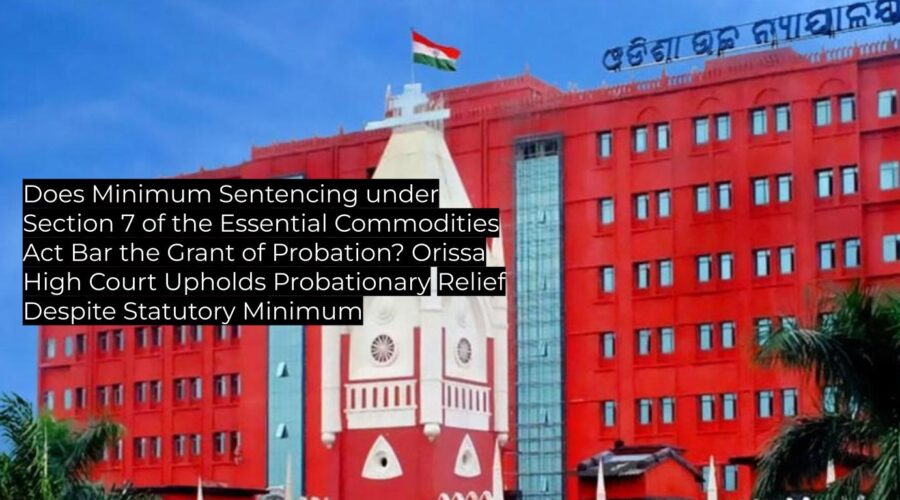
Can the Probation of Offenders Act Override Minimum Sentencing under Section 7 of the Essential Commodities Act?

The Orissa High Court confirms that courts may grant probation under the Probation of Offenders Act, 1958, to offenders convicted under Section 7 of the Essential Commodities Act, 1955, despite the provision for a minimum sentence. This judgment upholds Supreme Court authority and narrows the application of strict sentencing where the contravention is technical and […]

Can Prolonged Pre-Trial Incarceration Override Section 37 NDPS Bail Bar? Punjab & Haryana High Court Illuminates the Balance with Section 436A & Article 21

The High Court clarifies that, despite the rigours of Section 37 NDPS Act, long incarceration—especially when the trial is delayed and no prosecution witness has been examined—can weigh in favour of granting bail, aligning this principle with Section 436A CrPC and Article 21. The decision upholds existing precedent and is binding on subordinate courts within […]

When Can Accused in Commercial NDPS Offences Seek Bail on Grounds of Delay? – Punjab & Haryana High Court Reaffirms Twin Test for Bail and Warns Against Artificially Engineered Delays

The Punjab & Haryana High Court (2025) clarified that in prosecutions under the NDPS Act involving massive commercial quantities, bail on the ground of delay in trial due to right to speedy trial under Article 21 cannot be claimed if the delay is a result of intentional, collusive, or engineered tactics by co-accused. The judgment […]

Can FIRs Alleging Section 420/406 IPC and Section 24 of Immigration Act Be Quashed on Compromise Under Section 528 BNSS?

Reaffirming its prior Full Bench ruling and Supreme Court approval, the court held that criminal proceedings for offences under Sections 420, 406 IPC and Section 24 of the Immigration Act can be quashed based on a voluntary compromise between parties. This binding precedent strengthens the discretion of courts under Section 528 BNSS for quashing FIRs […]

Can a Haryana Police Officer Compulsorily Retired at Age 55 for ‘Doubtful Integrity’ in ACRs Challenge Such Retirement Without Contesting the Adverse Entries or Government Policy? – Rule 9.18(1)(c), Punjab Police Rules, 1934 Reaffirmed as Binding Precedent

A police officer’s compulsory retirement at age 55 based on adverse Annual Confidential Reports (ACRs) will not be set aside if the officer did not challenge either the adverse ACR entries or the underlying government instructions. The High Court reaffirms the binding nature of State instructions and the procedure for compulsory retirement under Rule 9.18(1)(c), […]