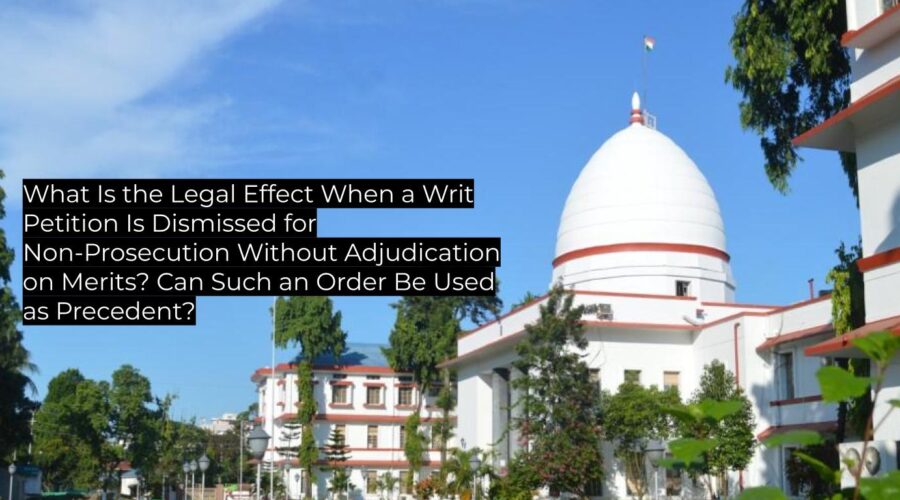
What Is the Legal Effect When a Writ Petition Is Dismissed for Non-Prosecution Without Adjudication on Merits? Can Such an Order Be Used as Precedent?

A writ petition was dismissed by the Gauhati High Court due to the petitioner’s failure to appear and take steps as directed, without any decision on the substantive legal issues. The judgment does not create new precedent or alter existing law, and its value as binding or persuasive authority for future cases is minimal.   […]
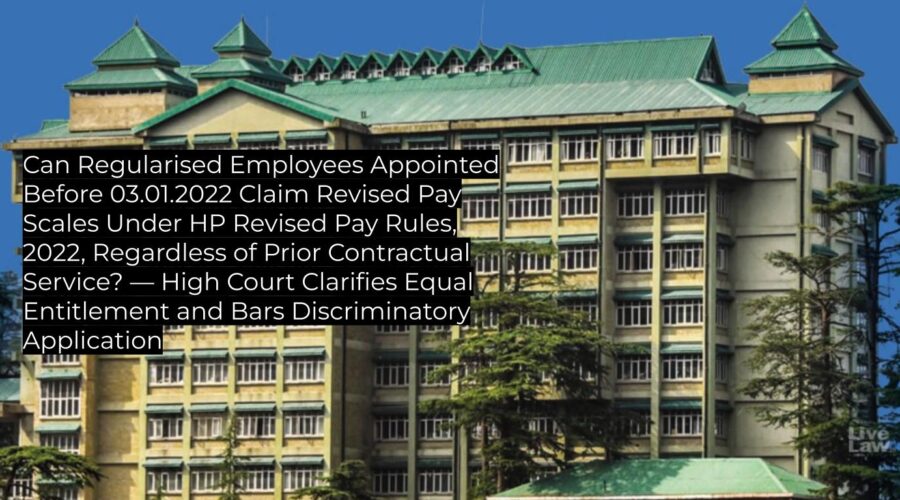
Can Regularised Employees Appointed Before 03.01.2022 Claim Revised Pay Scales Under HP Revised Pay Rules, 2022, Regardless of Prior Contractual Service? — High Court Clarifies Equal Entitlement and Bars Discriminatory Application

The High Court of Himachal Pradesh upholds and clarifies that, following Mohit Sharma, all employees appointed before 03.01.2022 and later regularised are entitled to the benefits of the Revised Pay Rules, 2022, including Rule 7(A), upon completing two years of regular service—irrespective of their prior contractual status. This decision reaffirms precedent and provides clear binding […]

Can a Writ Petition Be Withdrawn to Pursue Statutory Appeal After Rejection of Application for Building Approval Due to Development Control Regulation Requirements?

The Court clarified that when an application for building approval is rejected by an authority on regulatory grounds and a statutory appeal is available, the petitioner may withdraw the writ petition and pursue the alternative statutory remedy. The judgment thus upholds established procedural principles regarding exhaustion of remedies and affirms the precedential value of such […]

Does the Proximity of Trial Conclusion and Seriousness of Charges Justify Denial of Bail?

The Jharkhand High Court reaffirms the principle that bail may be refused when the trial is near completion and the accused faces grave charges (murder and conspiracy). The case upholds earlier judicial approaches, offering clear and binding precedent for subordinate courts in similarly situated sessions cases involving serious offences.   Summary Category Data Case Name […]

Does Completion of Eight Years’ Service Entitle an Employee to Work-Charge Status Under Law Upheld by the Supreme Court?

The High Court directs that cases for grant of work-charge status must be considered in light of the Supreme Court’s judgment in Surajmani (Civil Appeal No. 1595 of 2025). This reaffirms the precedential value of Surajmani for service matters involving the Jal Shakti Vibhag and similar departments, and establishes a binding approach for future cases […]

Does a Criminal Appeal Abate Automatically Upon the Appellant’s Death?—Reaffirmation of the Principle by Rajasthan High Court

The Rajasthan High Court has reaffirmed that upon the death of an appellant in a criminal appeal, the appeal stands abated. This judgment upholds existing precedent, confirming that subordinate courts must apply this rule, thereby providing binding authority for future cases involving deceased appellants.   Summary Category Data Case Name CRLA/501/1997 of SHIV CHARAN Vs […]

Can Punishment for Offences Under Sections 419, 420, 465, 467, 468, 471 & 120-B IPC Be Reduced to Period Already Undergone on Ground of Good Conduct and No Repeat Offence?

The Punjab and Haryana High Court affirms trial and appellate court convictions under serious cheating and forgery offences, but reduces sentence to period already undergone considering absence of prior or subsequent offences and demonstrated reformation. This ruling upholds existing precedent and serves as binding authority for sentencing discretion in similar cases, particularly in the absence […]

Can the High Court Direct Extension of Timings for Cultural Festivals Under Article 226? Reaffirming the Principle that Administrative Decisions on Event Timings Fall Within Executive Domain, Not Judicial Mandate—Binding Authority for Scope of Judicial Review

The High Court has held that it cannot issue directions under Article 226 to alter administrative decisions regarding the timing of cultural events, reaffirming that such matters are for local authorities. This judgment upholds established precedent on separation of powers and is binding on subordinate courts in Himachal Pradesh, providing clear limits on the judiciary’s […]

Can Bail Be Granted to Accused Mothers in Cases Alleging Concealment and Abortion of Sexual Assault Victims Under the B.N.S., 2023? — High Court of Jharkhand Upholds Stringent Bail Approach in Serious POCSO-Linked Offences

Jharkhand High Court reaffirms the high threshold for bail in cases involving grave allegations such as concealment and forced abortion of a rape victim under the B.N.S., 2023, especially where the accused is the victim’s immediate relative; maintains continuity with existing judicial rigor in similar POCSO-related matters; serves as binding authority on bail discretion in […]

When Can Criminal Proceedings Be Quashed Amidst Parallel Civil Disputes? High Court Affirms Restraint and Upholds Precedent on Section 482 CrPC Powers

The High Court of Himachal Pradesh reaffirms that the existence of a civil dispute does not warrant quashing of FIR or charge sheet where allegations in the FIR disclose cognizable offences; the court follows Supreme Court precedent requiring that the FIR contents be taken at face value at the Section 482 stage. This judgment strengthens […]

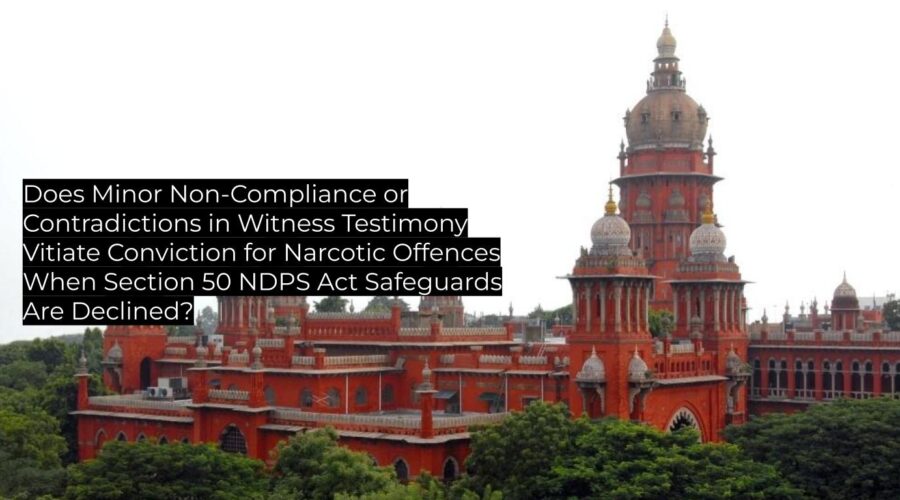
Does Minor Non-Compliance or Contradictions in Witness Testimony Vitiate Conviction for Narcotic Offences When Section 50 NDPS Act Safeguards Are Declined?

The Madras High Court conclusively held that as long as an accused person is duly informed of their right under Section 50(1) of the NDPS Act and declines the offer, subsequent minor contradictions or procedural lapses in witness statements do not undermine the prosecution’s case or warrant acquittal. This judgment follows and applies existing Supreme […]

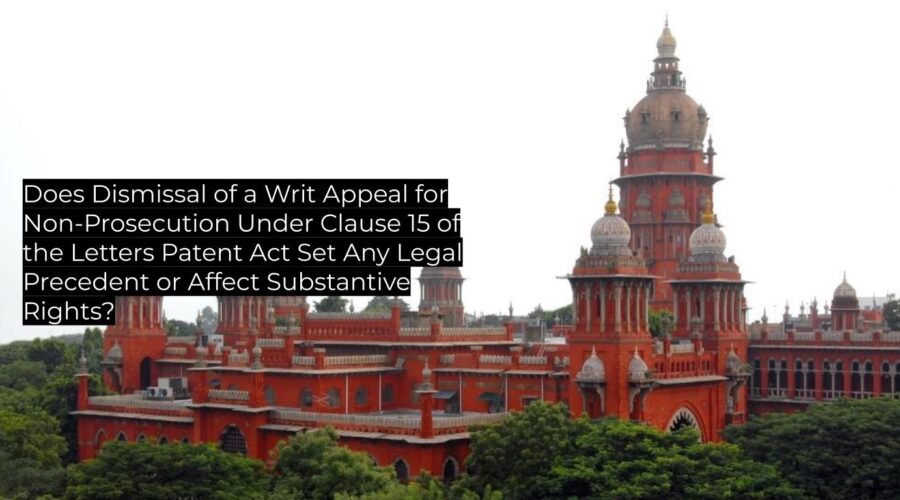
Does Dismissal of a Writ Appeal for Non-Prosecution Under Clause 15 of the Letters Patent Act Set Any Legal Precedent or Affect Substantive Rights?

A writ appeal dismissed by the Madras High Court for non-prosecution, with no decision on merits, neither overrules nor clarifies substantive law. Such procedural dismissals do not have binding or persuasive precedential value and do not affect the underlying legal rights of parties.   Summary Category Data Case Name WA(MD)/170/2023 of Roothammal @ Loorthammal Vs […]