Can High Courts Entertain Writ Petitions Under Article 226 When an Efficacious Statutory Remedy Exists Under the Cooperative Societies Act?

The court reaffirmed that the writ jurisdiction under Article 226 should not be exercised when an adequate and efficacious statutory remedy, such as under Section 55(2) of the Chhattisgarh Cooperative Societies Act, 1960, is available. This judgment follows and applies established Supreme Court precedents, strengthening the bar on writ maintainability in such cases. It is […]
Does Regularization of Contingency Employees Entitle Them to Retrospective Seniority and Pay Scale? High Court Reaffirms Prospective Operation and Policy Discretion

The Chhattisgarh High Court held that regularization of ad-hoc/contingency employees is to operate prospectively, not retrospectively, and refusal to grant seniority or pay scale from the initial date of appointment does not violate constitutional rights when supported by policy or administrative rationales. This judgment upholds long-standing Supreme Court precedent and reinforces limited judicial interference in […]

When Is Compliance With Section 25F of the Industrial Disputes Act, 1947 Mandatory in Cases of Closure, Retrenchment, and Transfer? (Clarified by Gauhati High Court, 2025)

Gauhati High Court affirms that strict compliance with Section 25F is mandatory for valid retrenchment or closure under Sections 25F, 25FF, and 25FFF of the Industrial Disputes Act, 1947. The Court clarifies that non-compliance with these provisions renders termination orders void ab initio, and directs monetary compensation instead of reinstatement where closure is complete. This […]

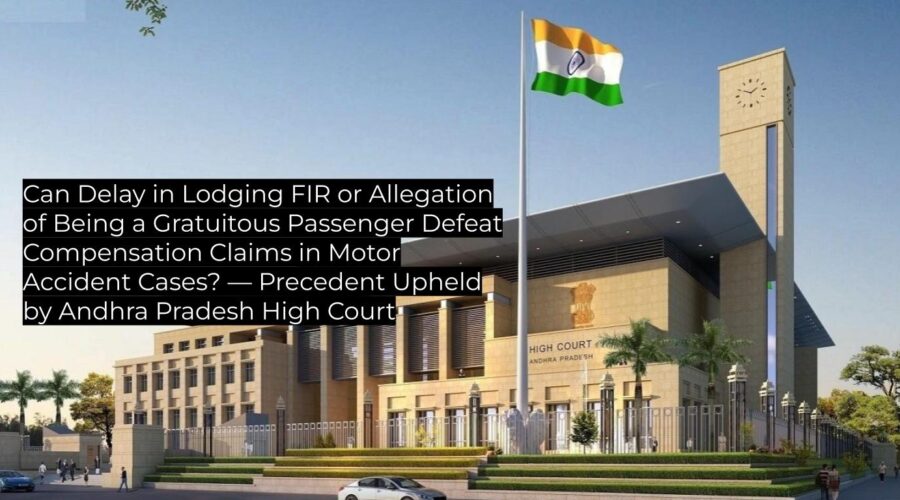
Can Delay in Lodging FIR or Allegation of Being a Gratuitous Passenger Defeat Compensation Claims in Motor Accident Cases? — Precedent Upheld by Andhra Pradesh High Court

The Andhra Pradesh High Court reaffirmed that delay in lodging an FIR does not inherently defeat a motor accident compensation claim, and that the insurer bears the burden of proving gratuitous passenger status. The judgment upholds existing Supreme Court precedent and serves as binding authority for subordinate courts in Andhra Pradesh on these issues. It […]

Can Seized Vehicles Alleged in Mines and Minerals Act Offences Be Released on Supurdnama Pending Trial? — Chhattisgarh High Court Reaffirms Supreme Court Precedents

Chhattisgarh High Court upholds the established Supreme Court position that seized vehicles should not be kept in police custody for extended periods and may be released on supurdnama to registered owners, subject to safeguards. Clarifies that lower courts should follow binding authority laid down in Sunderbhai Ambalal Desai and Multani Hanifbhai Kalubhai, reinforcing their precedential […]

Can Conviction for POCSO and Related Offences Be Sustained Without Clear Proof of Minority or Reliable Evidence of Force? — Precedential Limits on Presumptions and Sole Testimony in Sexual Offence Cases

The Chhattisgarh High Court re-examines the threshold for establishing the victim’s minority under the POCSO Act and clarifies that vague, contradictory, or unsupported testimony of the victim alone—when not corroborated by other material evidence—cannot sustain conviction for kidnapping or sexual offences. The judgment affirms Supreme Court precedent, narrows the scope for drawing presumptions from unreliable […]

Does Compliance with a Single Judge’s Direction for Consideration of Regularization Moot a Subsequent Intra-Court Appeal?

Where an authority complies with the High Court’s directive to consider an employee’s claim, and issues a speaking order, the subsequent intra-court appeal cannot be pursued on the merits of the original writ petition. The judgment upholds established principles, notes the appellant’s liberty to pursue remedies against the new order, and carries binding value for […]

Does a Writ Appeal Become Infructuous If the Grievance Raised Is Redressed During Pendency? Clarification on the Court’s Powers to Dispose as Infructuous

The High Court clarifies that once the underlying grievance—here, the issuance of a community certificate—is redressed during the pendency of the writ appeal, the matter is rendered infructuous and should be dismissed as such. The decision reaffirms existing procedure and is binding authority within the Andhra Pradesh High Court’s jurisdiction.   Summary Category Data Case […]

Is Prescribing Graduation as a Mandatory Qualification for Promotion to Superintendent under Assam Secretariat Service Rules, 2019 Constitutionally Valid?

The Gauhati High Court has affirmed the constitutional validity of the proviso to Rule 5(5) of the Assam Secretariat Service Rules, 2019, holding that prescribing a graduation degree as a prerequisite for promotion to Superintendent is a reasonable classification. The decision upholds precedent on educational qualifications as a basis for classification and is binding on […]

When Can a High Court Interfere with an Order of Acquittal? Scope of Appellate Review under Section 378 CrPC Reaffirmed

The High Court of Andhra Pradesh reiterates that interference with a trial court’s acquittal is justified only where the findings are manifestly perverse, unreasonable, or based on clear misapplication of law, and not merely because an alternate view is possible. This judgment upholds settled Supreme Court precedent and serves as binding authority on all subordinate […]

Can Courts Impose Exemplary Costs on Petitioners Who Suppress Material Facts in Writ Petitions Seeking Fee Exemption Amidst COVID-19? – Clarification and Application of Existing Precedent

The Chhattisgarh High Court reaffirms that suppression of material facts by a litigant justifies dismissal of writ petitions and imposition of exemplary costs, drawing on Supreme Court precedent. However, costs may be reconsidered in cases motivated by bona fide concerns for minors. This ruling upholds existing precedent and serves as binding authority for subordinate courts […]

Can Regularization of Casual/Daily-Wage Employees Be Ordered Retrospectively? Chhattisgarh High Court Reaffirms Prospective Regularization as Judicial Policy

Regularization of service can only be prospective and not retrospective; the court upholds established Supreme Court precedent restricting retrospective seniority and pay benefits for regularized employees. This decision affirms prior precedent, binding on subordinate courts within Chhattisgarh, and clarifies the legal position for public sector and government service employment disputes.   Summary Category Data Case […]