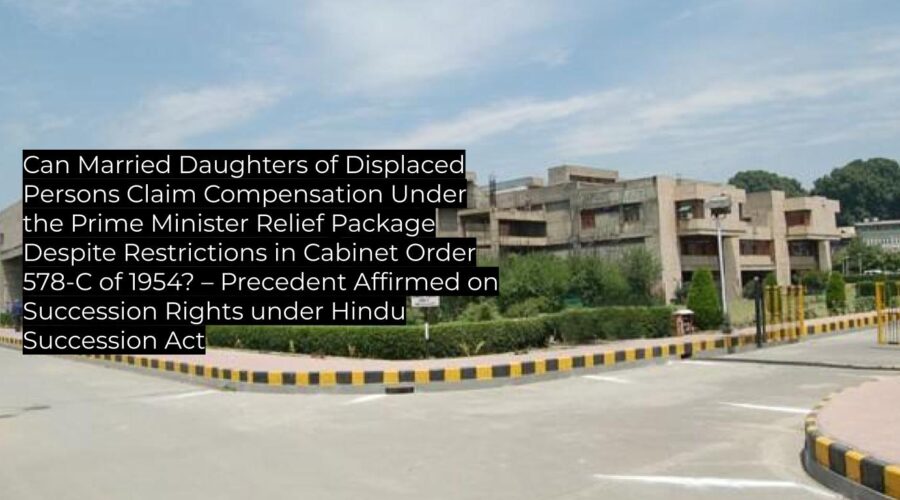
Can Married Daughters of Displaced Persons Claim Compensation Under the Prime Minister Relief Package Despite Restrictions in Cabinet Order 578-C of 1954? – Precedent Affirmed on Succession Rights under Hindu Succession Act

The High Court clarifies that the Prime Minister Relief Package compensation for displaced families of POK is governed by the Hindu Succession Act, 1956, and not limited by Cabinet Order 578-C of 1954’s restrictions on married daughters. The judgment upholds existing precedent, providing binding authority for future disputes regarding entitlement of married daughters to compensation. […]

Can Landless Persons Displaced by Land Acquisition Choose Between Employment and Monetary Compensation When Government Policy Changes? — Precedential Clarification on Options and Priority

The Himachal Pradesh High Court clarified that eligible landless persons may opt either for employment when available or for an alternative monetary compensation package under the updated policy, but not both. The judgment affirms the existing policy’s scope and establishes the priority mechanism among eligible applicants. Precedent is binding for future administrative actions concerning displaced […]

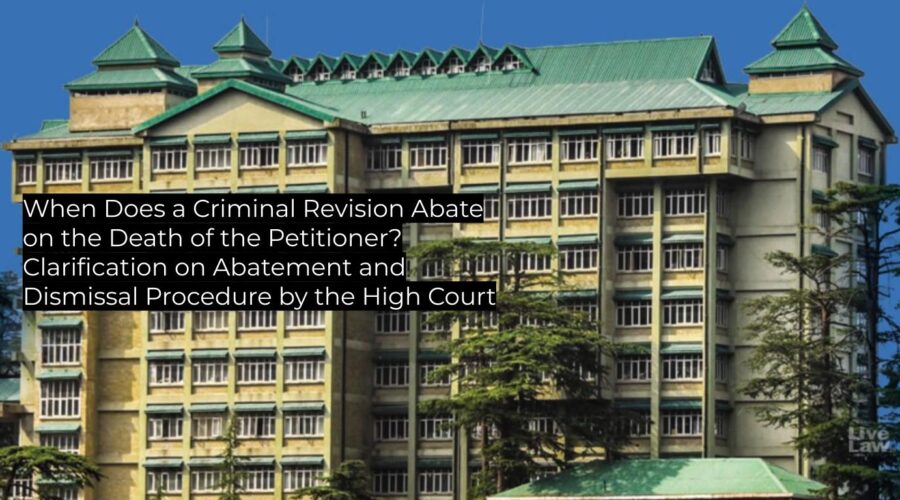
When Does a Criminal Revision Abate on the Death of the Petitioner? Clarification on Abatement and Dismissal Procedure by the High Court

The High Court holds that a criminal revision abates upon the death of the petitioner and must be dismissed accordingly; affirms established procedural law and does not overrule or modify any precedent; practical utility is limited as the order is not approved for reporting.   Summary Category Data Case Name CR.R/73/2015 of SHAMBU DAYAL SIDHU […]

Does Mere Simplicity of Injury Preclude Conviction under Section 307 IPC? — Chhattisgarh High Court Affirms and Clarifies Assessing Intention Over Injury Severity

The Chhattisgarh High Court reaffirms that under Section 307 IPC (attempt to murder), it is not necessary for the inflicted injury to be fatal or grievous—conviction can be based on intention and surrounding circumstances rather than the seriousness of injuries alone. This judgment follows established Supreme Court precedents and serves as binding authority within Chhattisgarh, […]

Does the Compensation under Conventional Heads in Motor Accident Claims Require Mandatory Upward Revision as per Pranay Sethi?

The High Court clarified that, following *Pranay Sethi*, amounts awarded under ‘conventional heads’ (such as loss of consortium, loss of estate, and funeral expenses) in motor accident compensation must be enhanced by 10% every three years from 2017 onward. This judgment upholds and applies the Supreme Court’s direction, ensuring consistency in future awards by Chhattisgarh […]

Can Seized Vehicles Allegedly Used for Illegal Mining Be Released on Supurdnama Pending Trial? — Affirmation of Supreme Court Precedent as Binding Authority

The High Court reiterates that seized vehicles, even in cases of alleged illegal sand transportation, should not be left to deteriorate in police custody, and directs their release on interim custody (Supurdnama) to the registered owner, provided adequate safeguards are ensured. This judgment strictly follows Supreme Court precedent and is binding on subordinate courts within […]

Does Acquittal for Dowry Death and Cruelty Stand When Key Prosecution Witnesses Negate Dowry Demand and Harassment Allegations?

The High Court of Chhattisgarh upheld the acquittal of the accused in a dowry death case, reaffirming that the absence of reliable evidence on dowry demand or harassment — especially when crucial prosecution witnesses refute such allegations — is fatal to the prosecution. This judgment follows established legal principles without overruling or narrowing existing law, […]

Does Absence of Specific Allegations Regarding Dowry Demand or Injury Preclude Conviction Under Section 304-B/34 IPC?

The Chhattisgarh High Court reaffirmed that, in prosecutions under Section 304-B/34 IPC (dowry death with common intention), conviction cannot be sustained if initial reports and evidence lack specific allegations about dowry demand or observable injuries. The Court upheld existing precedent requiring clear, consistent, and timely accusations directly connecting the accused to cruelty or dowry demand. […]

Does the Principle of Res Judicata Apply to Proceedings Before Foreigners Tribunals? Gauhati High Court Reaffirms and Clarifies the Scope of Judicial Review under Certiorari

The Gauhati High Court confirms that the principle of res judicata is applicable in Foreigners Tribunal proceedings, following Supreme Court precedents, but holds that its application depends on proof of identity in subsequent proceedings. The Court also clarifies that in writ jurisdiction under Article 226 (certiorari), it cannot engage in original fact-finding where such determination […]

When Is the Principle of Constructive Res Judicata Inapplicable to Challenges Against Selection Process Irregularities in Government Appointments?

The Gauhati High Court clarifies that when selection committee marks are re-visited and new irregularities or violations of governing guidelines are alleged and left unanswered, the principle of constructive res judicata does not bar fresh judicial review. The judgment upholds the ability of aggrieved applicants to seek re-examination on substantive new grounds and affirms the […]

Can Conviction Under POCSO Be Sustained Solely on Victim’s Testimony When DNA Evidence Contradicts Her Claim?

The court held that where DNA evidence conclusively disproves the accused’s paternity and foundational facts are unproved, conviction based solely on the prosecutrix’s allegations is unsafe. This judgment upholds existing Supreme Court and High Court precedent, clarifies POCSO Section 29’s presumption, and is binding precedent for Assam, Nagaland, Mizoram, and Arunachal Pradesh.   Summary Category […]

Can the High Court Grant or Refuse Child Custody in Habeas Corpus Petitions Solely on Pleadings Without Full Evidentiary Inquiry?

The Andhra Pradesh High Court reiterated that, while the child’s best interests are paramount, final custody cannot be granted in habeas corpus jurisdiction based on mere pleadings without a full trial. The judgment leaves the matter open for appropriate forums to determine custody after recording evidence, reaffirming settled law on the scope of habeas corpus […]