Does Prolonged Pre-Trial Incarceration Justify Grant of Bail in Commercial Quantity NDPS Cases Despite Section 37—When Trial Delay Dilutes Statutory Bar?

The Court holds that undue delay in trial, leading to significant undertrial incarceration, can override the rigour of Section 37 NDPS Act, upholding the right to speedy trial under Article 21. This judgment affirms and applies recent Supreme Court precedent, reaffirming the principle’s binding value in NDPS matters, and is authoritative for lower courts in […]
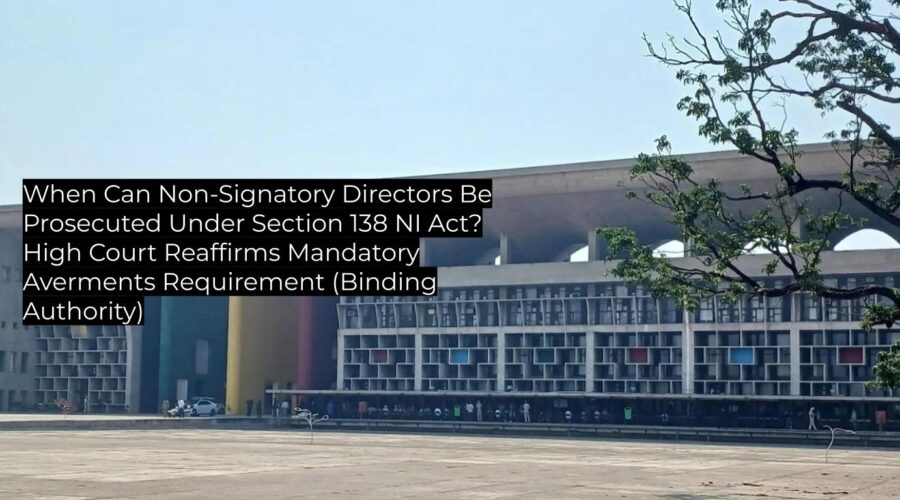
Does a Complaint under Section 138 of the Negotiable Instruments Act Require Specific Averments Regarding Directors’ Responsibility? Clarification and Binding Authority on the Scope of Section 141 NI Act (Directors’ Criminal Liability) by the Punjab & Haryana High Court

The Punjab & Haryana High Court has reaffirmed that, in prosecutions under Section 138 read with Section 141 of the Negotiable Instruments Act, it is mandatory for the complaint to include specific averments that Directors were in charge of and responsible for the conduct of the company’s business. The absence of such averments warrants quashing […]

When Can Non-Signatory Directors Be Prosecuted Under Section 138 NI Act? High Court Reaffirms Mandatory Averments Requirement (Binding Authority)

Directors who are not signatories of a dishonoured cheque cannot be prosecuted under Section 138 read with Section 141(1) of the Negotiable Instruments Act unless the complaint specifically avers that they were “in charge of and responsible for” the conduct of the company’s business; reaffirmed as binding precedent following Supreme Court judgments, binding on subordinate […]

Can Fresh Pleas Raised in Written Statements Be Preserved for Adjudication After Withdrawal of a Rent Revision Petition?

The High Court clarified that withdrawal of a rent revision petition—where related pleas are also in the written statement—does not preclude the petitioners from pressing those pleas during trial. The Rent Controller must adjudicate such pleas independently of previous interlocutory orders. This order affirms established procedure in rent control matters; it is binding precedent within […]

Precedent Affirmed: Anticipory bail cannot be denied solely because nothing incriminating was discovered or no recovery was made if the accused has duly joined and cooperated in the investigation. Binding on subordinate courts for interpreting ‘cooperation’ in custodial interrogation requests.

The High Court clarified that “cooperation in investigation” means making oneself available and responding to lawful queries—not necessarily yielding discovery or recovery. Existing Supreme Court and High Court jurisprudence is upheld; custodial interrogation cannot be insisted on absent compelling grounds. This decision carries binding precedent value within Punjab & Haryana, guiding future anticipatory bail matters. […]

Can High Courts Exercise Writ Jurisdiction Under Article 226 Against SARFAESI Proceedings When Statutory Alternative Remedies Exist? — Reaffirmation of Complete Code Doctrine

Reaffirming Supreme Court precedent, the High Court clarifies that intervention under Article 226 in matters under the SARFAESI Act is to be avoided when the statutory remedies before DRT/DRAT have not been exhausted. This decision upholds the binding nature of settled law and guides all subordinate courts on the principle of relegation to alternative remedies […]

Can High Courts Interfere in SARFAESI Proceedings via Article 226 When Statutory Remedies Exist? — Precedent Reaffirmed and Its Binding Authority

The Punjab and Haryana High Court, reiterating Supreme Court precedent, held that High Courts must refrain from exercising their writ jurisdiction under Article 226 in cases governed by the SARFAESI Act where effective statutory remedies before DRT/DRAT exist; this position upholds existing law and is binding for subordinate courts in SARFAESI matters.   Summary Category […]

Clarifies Approach on Bail Where Parties Settle and No Objection is Raised by Complainant—Precedent for Discretionary Bail in Rajasthan High Court

Rajasthan High Court allows bail under Section 483 BNSS in a case involving serious IPC offences on the basis of compromise, despite objections from Public Prosecutor; affirms flexible judicial discretion and sets a binding precedent for subordinate courts in similar factual situations.   Summary Category Data Case Name CRLMB/13593/2025 of RAVI @ BALLI SON OF […]

Does the Presence of a Senior Citizen Litigant Necessitate Expeditious Disposal of Property Disputes?

The High Court applied Supreme Court precedent to require prompt trial-court disposal of property suits involving senior citizen parties, reaffirming the legal obligation to prioritize such cases for early hearing. These directions clarify procedural priorities for lower courts across civil disputes involving the elderly and stand as binding authority within the State.   Summary Category […]

Is a Posthumously Filed Income Tax Return Admissible in Computing “Just Compensation” for Motor Accident Claims? High Court Reaffirms Multiplier Selection Principles and Upholds Tribunal Findings

The Uttarakhand High Court affirms that a posthumously filed income tax return may be relied upon in computing compensation under the Motor Vehicles Act when corroborated by evidence, and further reasserts that the multiplier must correspond to the nearest completed age as clarified by the Supreme Court. This judgment upholds settled precedents, confirming the law […]

Does Pending Deposit Under New Pension Scheme Bar Accountant General from Processing Authorization under Old Pension Scheme Where Finality Certificate Is Submitted?

The Himachal Pradesh High Court confirms that the Accountant General must process authorization for pensionary benefits under the Old Pension Scheme upon submission of finality certificate, regardless of whether the employee has deposited the amount received under the New Pension Scheme. However, the State may defer the release of benefits until such deposit is made. […]

Can Bail be Granted in Alleged Honour Killing Cases Involving Section 302 IPC? High Court of Jharkhand Reaffirms Stringent Approach

The High Court of Jharkhand, reaffirming existing precedent, has refused bail in a murder case involving allegations of a father killing his child based on suspicions regarding legitimacy. The judgment upholds a strict interpretation of bail jurisprudence in grave offences under Section 302 IPC, reinforcing that the seriousness of allegations takes precedence. This decision serves […]