Does Subsequent Cancellation of an Impugned Transfer Order Render a Pending Writ Petition Infructuous? — High Court Reaffirms Existing Precedent

The High Court reiterates that if the administrative order under challenge is withdrawn or cancelled by the authority after filing of the writ, the writ petition is liable to be dismissed as infructuous. This is a reaffirmation of settled law with binding effect for similar future cases involving administrative transfers.   Summary Category Data Case […]
Can Service Matters of Employees of Private Affiliated Colleges Be Challenged in Writ Jurisdiction? — Existing Precedent on Maintainability Reaffirmed by the Patna High Court

The Patna High Court has reaffirmed that matters related to the affairs or service conditions of employees in private affiliated colleges, including removal by the managing committee, cannot be agitated in writ jurisdiction unless specific statutory guidelines exist. This judgment upholds binding precedent set by earlier Division Bench authority, clarifies the role of subsequent administrative […]

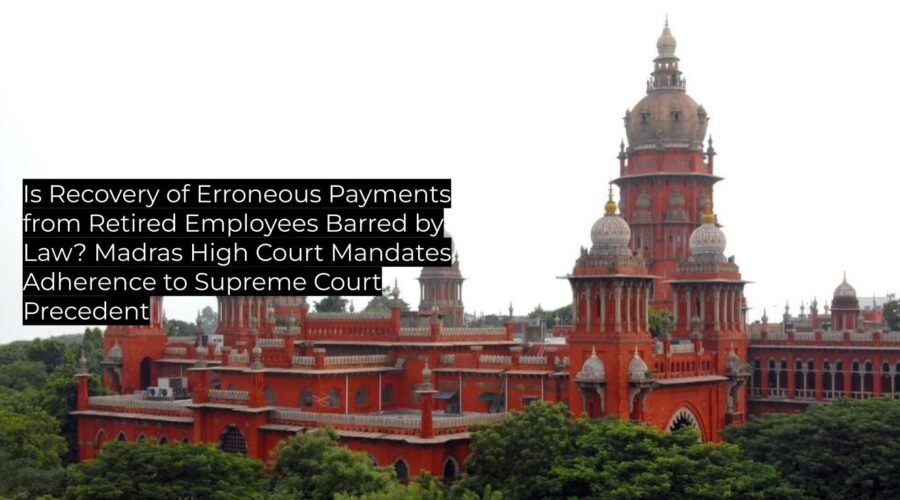
Is Recovery of Erroneous Payments from Retired Employees Barred by Law? Madras High Court Mandates Adherence to Supreme Court Precedent

Retired employees or those due to retire within a year cannot be subjected to recovery of excess payments, even if made erroneously; judgment strictly affirms and applies the Supreme Court’s ruling in Rafiq Masih (2015) 4 SCC 334. Serves as binding authority on subordinate courts in Tamil Nadu and persuasive across India in public service […]

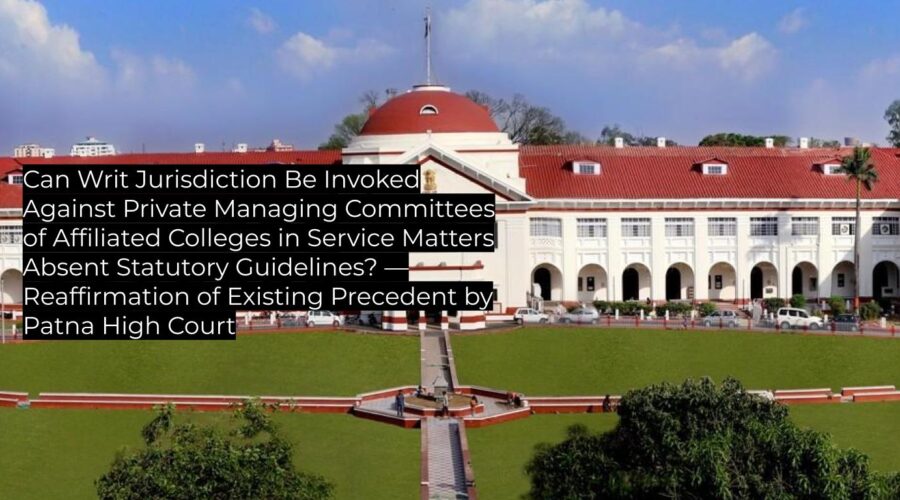
Can Writ Jurisdiction Be Invoked Against Private Managing Committees of Affiliated Colleges in Service Matters Absent Statutory Guidelines? — Reaffirmation of Existing Precedent by Patna High Court

The Patna High Court affirms that in the absence of statutory guidelines or regulations, disputes relating to service conditions governed by private managing committees of affiliated colleges are not amenable to writ jurisdiction, reiterating the binding authority of its earlier Division Bench decision; thus upholding existing precedent and reinforcing the limitation on writ remedies in […]

Does Non-Compliance with Mandatory Notice Period under Section 82 CrPC Vitiate Proclamation Proceedings?

Proclamation proceedings under Section 82 CrPC must strictly adhere to the statutory requirements—including a clear 30-day notice period from the date of publication; non-compliance vitiates both the proclamation and subsequent proceedings. This case upholds and crystallizes settled law, confirming binding authority for all Punjab & Haryana trial courts when declaring accused persons as proclaimed offenders. […]

When Can an Insurance Company Escape Liability for Compensation Under the Motor Vehicles Act?—High Court Reaffirms Supreme Court Precedent on “Light Motor Vehicle” Licensing and Employer Liability

Enhanced Compensation: Court Clarifies the Application of Future Prospects and Appropriate Multipliers in Fatal Motor Accident Claims   Summary Category Data Case Name FAO/1778/2004 of BABLI DEVI AND ORS Vs RAM PAL ANDORS CNR PHHC010456582004 Date of Registration 06-04-2004 Decision Date 30-10-2025 Disposal Nature DISPOSED OF Judgment Author MR. JUSTICE DEEPAK GUPTA Court High Court […]

Can Bail Be Denied Solely on the Ground of Criminal Antecedents? High Court Clarifies Under Bharatiya Nagarik Suraksha Sanhita, 2023

Bail cannot be refused solely due to criminal antecedents if other bail considerations support release; High Court applies Supreme Court precedent and reaffirms existing law under BNSS, 2023 – binding on subordinate courts in Punjab & Haryana.   Summary Category Data Case Name CRM-M/58083/2025 of PARAMJIT SINGH ALIAS PAMMA Vs STATE OF PUNJAB CNR PHHC011622502025 […]

Can Criminal Proceedings Arising from Non-Compoundable Offences of Predominantly Civil Nature Be Quashed Due to Compromise Between Parties?

The court reaffirms that High Courts have wide inherent powers under Section 528 of Bharatiya Nyaya Sanhita, 2023 to quash criminal proceedings even for non-compoundable offences, if the matter is overwhelmingly of civil character and parties have genuinely compromised. This judgment upholds previous Supreme Court precedent and sets out the applicable parameters; it will serve […]

Can Conviction Under Section 498A IPC Be Set Aside on the Basis of Compromise Between Husband and Wife? — Jharkhand High Court Reaffirms Supreme Court Precedent

Where spouses have amicably settled matrimonial disputes and resumed cohabitation, courts may set aside convictions under Section 498A IPC based on compromise, following Supreme Court rulings. This judgment reaffirms binding precedent and clarifies the approach for subordinate courts handling similar cases.   Summary Category Data Case Name Cr.Rev./184/2025 of GANGA THAKUR Vs THE STATE OF […]

Can a Co-sharer Lawfully Transfer a Specific Portion of Joint, Undivided Property? High Court Reaffirms Bar on Alienation Absent Partition

Court reaffirms that no co-sharer can alienate or claim exclusive possession of a specific part of unpartitioned, joint property; mandatory injunctions for restoration of possession can be sought without separately pleading recovery of possession. Follows settled Supreme Court precedent and is binding on subordinate courts for property and civil litigation involving co-sharers.   Summary Category […]

Does Withdrawal of a Tender Notification Render Pending Writ Petitions Infructuous?

The High Court of Uttarakhand held that withdrawal of the impugned tender notification by the State renders any writ petition challenging such notification infructuous. This approach upholds existing precedent and will serve as practical binding authority for future cases involving withdrawal of administrative actions, especially in tender and government contract matters.   Summary Category Data […]

Does Dismissal of a Criminal Writ Petition as Infructuous Due to Filing of Final Report Amount to a Pronouncement on the Merits or Set New Precedent?

The High Court of Uttarakhand clarifies that when the State files a final report exonerating some petitioners, dismissal of the writ petition as infructuous does not create new law, amount to a decision on merits, or set binding precedent. This ruling upholds existing procedural principles and is of limited precedential value for future quashing matters. […]