Does a Civil Appeal Abate Upon Death of the Sole Appellant When No Legal Representative Seeks Substitution?

The court reaffirmed the settled principle that, where a sole appellant dies during the pendency of a Regular Second Appeal and no legal representative comes forward to be substituted, the appeal abates by operation of law. This approach is consistent with established procedural law and holds binding value for courts dealing with abatement of appeals […]
Can a Writ Petition Be Withdrawn With Liberty to Challenge a Subsequent Order Without Bar of “Same Cause of Action”? — Position Affirmed by Rajasthan High Court

The Rajasthan High Court reaffirms that withdrawal of a writ petition due to a subsequent order does not require formal liberty for assailing the new order, as any challenge would not arise from the “same cause of action.” This order follows existing precedent and holds persuasive value for future litigation in administrative and public law […]

When Can Bail Be Granted to Juveniles in Serious Offence Cases? Orissa High Court Clarifies the Primacy of Section 12 of the JJ Act and the Fundamental Right to Speedy Trial

The Orissa High Court has reaffirmed that bail to a child in conflict with law (CICL) cannot be refused merely on the nature of the alleged serious offence unless statutory exceptions under Section 12 of the Juvenile Justice Act are satisfied. The Court set aside an order denying bail due to prolonged detention and non-consideration […]

Does Dismissal of a Writ Petition for Non-Prosecution Amount to a Decision on Merits?

The court reiterated that a petition dismissed for non-prosecution does not decide the substantive legal issues on merit. This decision upholds established procedural precedent, underscoring the necessity for parties to appear and prosecute their cases diligently. The order is binding as authority on the limits of decisions by default, particularly in the context of writ […]

Can the High Court Entertain a Writ Petition Involving Disputed Questions of Fact Having a Predominantly Civil Character?

The Calcutta High Court, on dismissal for default, reiterates that writ jurisdiction is not the proper forum to adjudicate matters involving disputed facts of civil nature. This decision upholds the established precedent, confirming that such controversies must be resolved through appropriate civil proceedings, and serves as binding authority for lower courts in similar contexts.   […]

Does the Passage of Time Render Pending Writ Petitions in Tender Matters Infructuous?

Calcutta High Court holds that a writ petition concerning a 2016 tender process is rendered infructuous by the mere passage of time. The decision upholds the principle that courts may dismiss writs as infructuous without adjudication on merits when circumstances have overtaken the dispute. The judgment serves as binding authority for subordinate courts on similar […]

Does Dismissal of a Writ Petition for Default Amount to an Adjudication on Merits Under Law?

The Calcutta High Court confirmed that dismissal of a writ petition for default, in the absence of the petitioner, amounts only to a procedural disposal and does not determine any legal question or the merits of the case. This judgment follows existing precedent rather than setting new law, and is of procedural relevance for practitioners […]

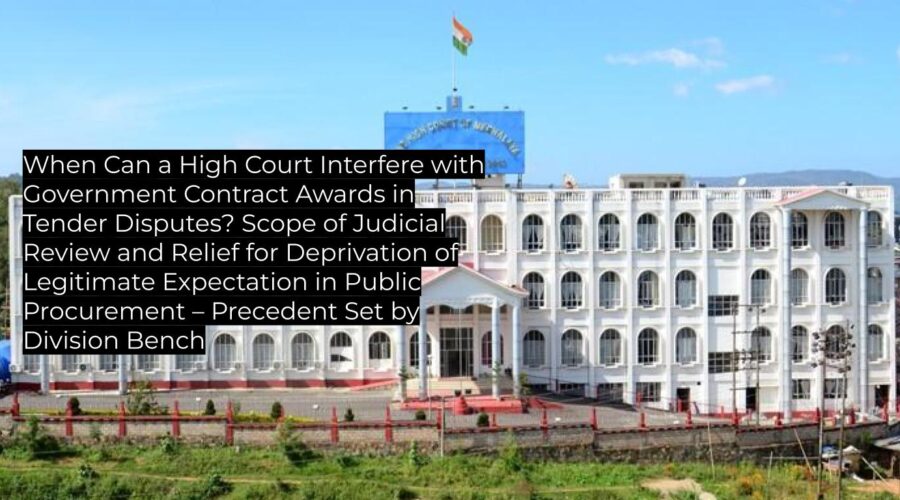
When Can a High Court Interfere with Government Contract Awards in Tender Disputes? Scope of Judicial Review and Relief for Deprivation of Legitimate Expectation in Public Procurement – Precedent Set by Division Bench

A Division Bench of the High Court of Meghalaya clarified that while judicial review in tender matters is circumscribed, limited procedural shortcomings alone do not vitiate contract awards absent clear illegality or mala fides. Upholding the award in favour of one bidder, the Court awarded compensation to a rival for deprivation of legitimate expectation. This […]

When Can Tenancy of “Open Land” Be Terminated for Erection of New Building under Section 13(1)(I) of the Bombay Rent Act?

The Court held that eviction under Section 13(1)(I) is maintainable where the premises were originally let as “open land” and later constructions by the tenant, without the landlord’s permission or municipal approval, do not change its character. The case upholds existing precedent on open land versus constructed premises and clarifies that revisional jurisdiction does not […]

Whether Sole Entrustment and Exclusive Benefit by a Bank Employee, Supported by Forged Documents and Telex Messages, Justifies Sustaining Convictions for Criminal Breach of Trust, Cheating, Forgery, and Corruption under IPC and PC Act?

Clear reaffirmation that a bank official can be singularly convicted where evidence shows sole entrustment, exclusive pecuniary benefit, and authorship of forged documents, even if procedural lapses of other officials exist. The court upholds earlier precedent, providing binding guidance on Section 120-B, 406, 420, 468, 471, 477A, 381, 201 IPC and Section 13(1)(d) r/w 13(2) […]

Does an Arbitration Clause in a Booking Form Survive a Subsequent Mutual Agreement Cancelling the Original Contract?

The High Court of Jharkhand affirms that an arbitration clause originally contained in a Booking Form remains valid and enforceable, even after the main contract is mutually cancelled and superseded by subsequent agreements, provided the parties continue acting upon the underlying transactional terms. This judgment adds to binding precedent on the interpretation of arbitration clauses, […]

When Is the Grant of Ad Interim Injunction Justified in Property Disputes? Calcutta High Court Reaffirms Threefold Legal Tests and Limits Inherent Jurisdiction Under Section 151 CPC

The Calcutta High Court affirms settled precedents: Ad interim injunctions will not be granted unless the plaintiff establishes a prima facie case, balance of convenience, and irreparable injury, irrespective of alleged prior injunction violations. The judgment distinguishes binding authorities, upholding the primacy of core injunction tests in property matters, and clarifies the scope of inherent […]