Does Mere Ownership of a Vehicle Implicated in Illegal Mining Constitute Sufficient Ground for Anticipatory Bail? High Court of Jharkhand Clarifies Precedent Value for Anticipatory Bail Applications Involving Fake Number Plates and Alleged Mining Offences

Jharkhand High Court reaffirms that serious allegations, including fraudulent use of vehicle documents and misuse of registration plates for illegal mining, justify rejection of anticipatory bail; existing principles on anticipatory bail are followed and strengthened with specific guidance for mining-related offences. This judgment stands as binding authority within Jharkhand for anticipatory bail applications where fraudulent […]
Can Anticipatory Bail Be Granted for Recovery of Narcotic Drugs from Accused’s House Under NDPS Act? — Jharkhand High Court Reaffirms Strict Approach

Jharkhand High Court reiterates that the recovery of narcotic drugs from an accused’s house is a strong ground to deny anticipatory bail, particularly under Sections 18/27/29 of the NDPS Act; existing principles are upheld, solidifying this position as binding precedent for subordinate courts in Jharkhand.   Summary Category Data Case Name A.B.A./4944/2025 of SATYENDRA GANJHU […]

Can Anticipatory Bail Be Granted for Recovery of Narcotic Drugs from Accused’s House Under NDPS Act? — Jharkhand High Court Reaffirms Strict Approach

Jharkhand High Court reiterates that the recovery of narcotic drugs from an accused’s house is a strong ground to deny anticipatory bail, particularly under Sections 18/27/29 of the NDPS Act; existing principles are upheld, solidifying this position as binding precedent for subordinate courts in Jharkhand.   Summary Category Data Case Name A.B.A./4944/2025 of SATYENDRA GANJHU […]

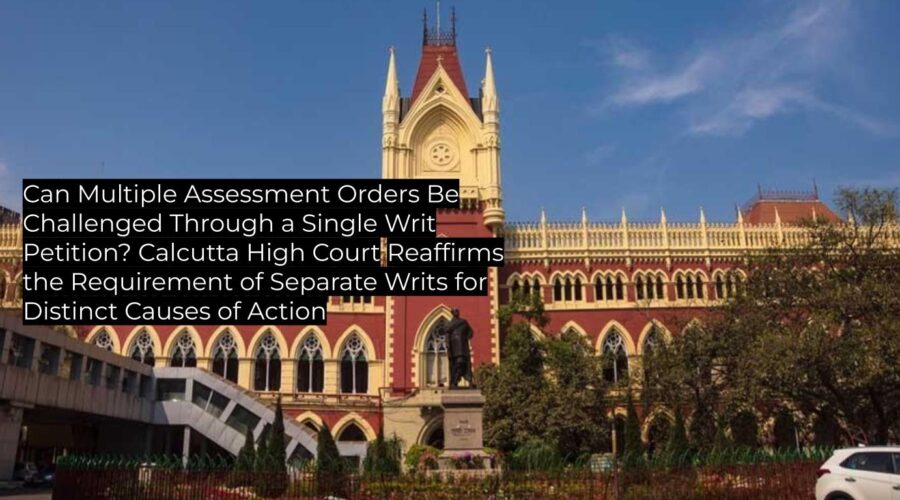
When Is a Single Writ Petition Challenging Multiple Separate Assessment Orders Maintainable?

A writ petition consolidating challenges to three separate assessment orders is not maintainable; the court reaffirmed the requirement for separate proceedings in such cases. The decision upholds existing precedent and provides binding authority on writ petition maintainability before the Calcutta High Court, especially in cases involving utility assessments.   Summary Category Data Case Name WPA/20192/2025 […]

When Does a Writ Petition Challenging a Section 144 CrPC Order Become Infructuous? Reaffirmation of Judicial Discretion on Dismissal of Obsolete Petitions

The Court held that a writ petition challenging a Section 144 CrPC order can be dismissed as infructuous due to passage of time. This affirms existing precedent regarding the discretionary power of courts to dismiss obsolete matters and has binding value within its jurisdiction for similar procedural circumstances.   Summary Category Data Case Name WPA/1651/2020 […]

Is Writ Jurisdiction Available Against Administrative Orders When Alternative Remedy Exists under the West Bengal Land Reforms Act? (Precedent Upheld – Practical Implications for Challenging Land Notices)

The Calcutta High Court affirms that writ petitions challenging administrative actions under Section 50(1)(f) of the West Bengal Land Reforms Act, 1955, are not maintainable if an efficacious alternative remedy exists. This judgment reiterates established precedent and will bind subordinate courts, emphasizing that High Court intervention under Article 226 should be sparingly used.   Summary […]

Does the Dismissal of a Writ Petition for Default Involve Determination of Substantive Legal Rights or Clarification of Precedent?

When the Calcutta High Court dismisses a writ petition for default without examining merits, no question of law is adjudicated and no substantive legal precedent is set; such an order does not clarify, overrule, or affirm existing law, and is not binding or persuasive for future cases.   Summary Category Data Case Name WPA/3308/2020 of […]

When Can a High Court Withhold Pensionary Benefits Pending Disputed Matrimonial Claims?

The High Court reiterated that, absent a legal mandate and with the beneficiary alive, pensionary benefits cannot be withheld in favour of matrimonial claimants based solely on disputed facts. The writ petition was withdrawn, allowing recourse to civil remedies. This case does not overrule or modify any prior precedent, and its value is circumscribed to […]

Does a Beneficial Government Circular Extending Promotion or Financial Benefits to Employees Apply Retrospectively, Even for Those Retired Before Its Issue? (Binding Authority — Reaffirms Supreme Court Precedent)

The Orissa High Court clarified that a beneficial/clarificatory government instruction regarding career progression (MACP) must be applied retrospectively, including to employees who retired before its date, in cases where denial of opportunity was due to the employer’s omission, not employee fault. This ruling reaffirms the retrospective effect of benevolent circulars established by the Supreme Court […]

Can Police Refuse to Register an FIR for a Cognizable Offence If the Complainant Withdraws Their Request for Registration? — Calcutta High Court Clarifies Binding Duty of Police under Section 154 CrPC

Calcutta High Court holds that once a complaint discloses a cognizable offence, the police cannot decline to register a First Information Report (FIR) solely because the complainant seeks to withdraw or does not desire registration. This judgment reaffirms binding precedent, clarifies the police’s statutory obligation, and is controlling in all criminal law matters involving FIR […]

Can the Secretary of the West Bengal Central School Service Commission Decide Teacher Transfer Applications When Directed by Court for Chairman’s Decision? | Precedent on Authority, Delegation, and Proper Decision-Making in Service Matters

The Calcutta High Court sets aside orders issued by the Secretary and Secretary-in-Charge of the Commission, holding that only the Chairman was authorised to decide the petitioner’s transfer application as per prior court order. This judgment reaffirms the importance of following explicit judicial and statutory directions on decision-making authority in public employment and will serve […]

When Can an Appeal Be Dismissed by the High Court for Non-Prosecution?

The High Court for the State of Telangana has reaffirmed that an appeal may be dismissed for non-prosecution when the appellant fails to appear and take necessary procedural steps. This judgment upholds existing precedent on procedural discipline in appellate proceedings and serves as binding authority on managing appellate dockets for courts in the State.   […]