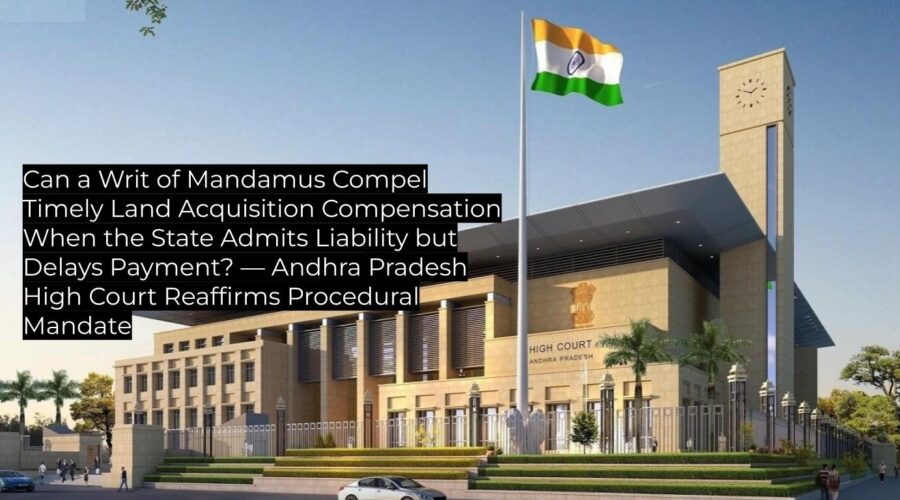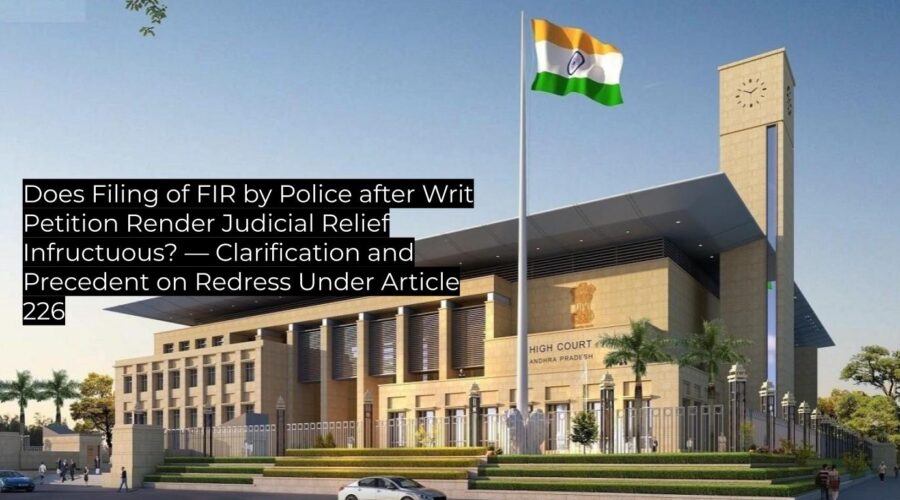
Whether the High Court May Allow a Criminal Appeal by Setting Aside Conviction Without Costs Despite Pending Prosecution — Reaffirmation of Appellate Powers under the Code of Criminal Procedure as Binding Authority

The High Court clarified its authority under the Criminal Procedure Code to allow criminal appeals by setting aside convictions, even when the prosecution is still pending, and disposed of the matter with no order as to costs; this reaffirms existing precedent and stands as binding authority for subordinate courts in Andhra Pradesh.   Summary Category […]

Is Bail to Be Granted Where Accused Is Implicated in a Large-Scale Counterfeit Currency Conspiracy Based Principally on Co-Accused’s Statements and Supplementary Charge-Sheet?

The High Court clarifies that at the bail stage—especially in cases involving grave economic offences such as counterfeit currency rackets—courts must not meticulously dissect evidentiary worth, but should be guided by the gravity of the offence, the prima facie material collected during investigation (even if primarily based on co-accused’s statements), and the accused’s antecedents. The […]

Can a Complainant Under Section 138 of the Negotiable Instruments Act File a “Victim Appeal” Under Proviso to Section 372 CrPC After Dismissal for Non-Prosecution? — Binding Clarification by High Court Following Supreme Court

The High Court affirms the Supreme Court’s recent ruling that a complainant in a Section 138 NI Act case qualifies as a “victim” under Section 2(wa) CrPC, thus enabling such complainants to appeal under the proviso to Section 372 CrPC. This judgment upholds Supreme Court precedent in M/s. Celestium Financial v. A. Gnanasekaran and clarifies […]

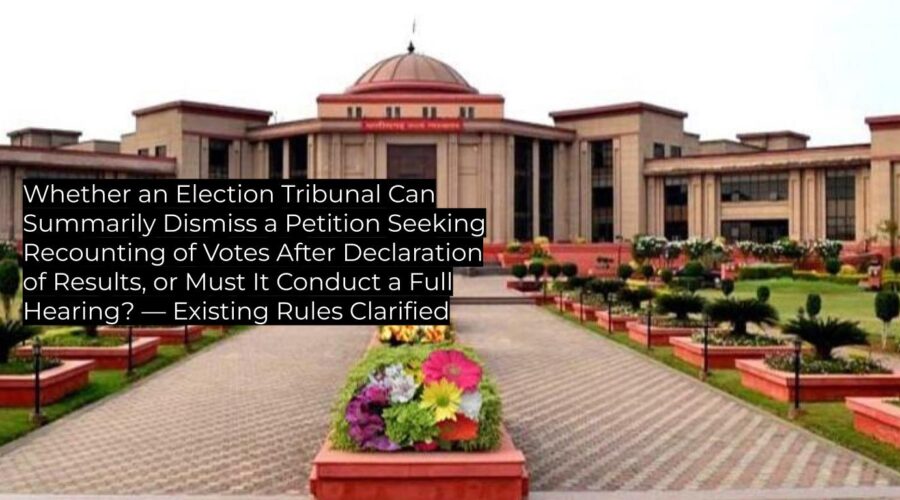
Can an Employer Challenge a Compensation Award on Grounds of Denial of Opportunity When Multiple Chances to Adduce Evidence Were Given? Clarification and Affirmation of Procedural Law: Chhattisgarh High Court Upholds Existing Precedent on Fair Opportunity and Dismissal of Appeals Where Ample Chances Were Provided—Binding Authority for Claims under the Employee’s Compensation Act.

The court held that when an employer is given successive opportunities—including clear “last opportunity” warnings—to adduce evidence but fails to do so, claims of denial of fair hearing are unsustainable. The judgment affirms the established principle requiring diligence and is binding on subordinate courts in Employee’s Compensation Act matters.   Summary Category Data Case Name […]

Does A Motor Accident Claims Tribunal Have To Assess Compensation Using Minimum Wages For Semi-Skilled Labour When Documentary Proof of Income Is Absent? – Reaffirmation of Supreme Court Precedent

The Chhattisgarh High Court reaffirmed that, in the absence of proof of actual income, minimum wages applicable to the category of employment (here, semi-skilled labour) must be used for compensation calculation under the Motor Vehicles Act. This position, following Supreme Court authority, is now binding precedent for all tribunals and subordinate courts within Chhattisgarh dealing […]

When Can an Appellate Court Interfere With a Trial Court’s Acquittal? Reaffirming the Principle of Non-Interference in Absence of Cogent Evidence

The High Court reaffirmed that an appellate court should not interfere with a trial court’s acquittal unless the acquittal is manifestly unreasonable or unsupported by the evidence. This decision upholds existing precedent and serves as binding authority in criminal appeals involving similar evidentiary issues, particularly when prosecution evidence is contradictory or unreliable.   Summary Category […]

Can a High Court in Revision Alter a Sentence of Imprisonment to Only Fine for Attempt to Commit Rape?

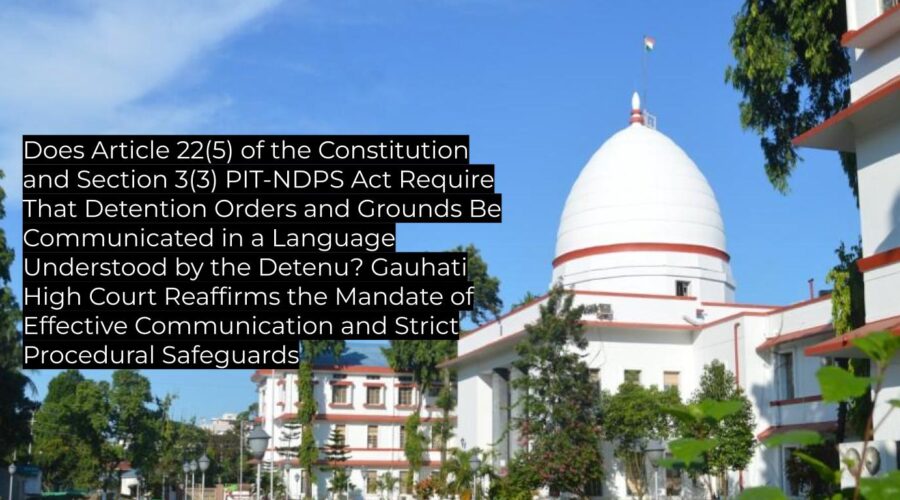
The Gauhati High Court has upheld its limited but significant power of revision under Section 401 CrPC—including the authority to alter sentences handed down by subordinate courts—by reducing a sentence of imprisonment to only a fine for the offence of attempt to commit rape. The judgment affirms existing Supreme Court and statutory principles, clarifies that […]

Can “Preference” Clauses for Local Candidates Override Superior Merit in Public Appointments? Gauhati High Court Clarifies the Law for Selection of College Principals

Preference for local (BTR) candidates under an appointment advertisement cannot be invoked where other candidates have superior merit; such preference applies only when candidates are otherwise equal in all respects. Judgment upholds existing Supreme Court precedent and acts as binding authority for similar education sector selections.   Summary Category Data Case Name WP(C)/598/2024 of PRAMOD […]

Does the Satisfaction of Demand Notices Render a PIL Infructuous When Relief Sought Has Been Fully Addressed by Government Action? Reaffirms that once public interest grievances are remedied during proceedings, continuing the PIL serves no practical purpose — Judgment as Binding Authority on Disposal of Redundant PILs.

Where departmental action during PIL pendency leads to complete satisfaction of relief sought (including resolution by payment or relevant party’s demise), the High Court closes the petition as nothing survives. This reinforces existing precedent on the disposability of infructuous PILs, with sectoral implications for mining revenue disputes and similar regulatory enforcement cases.   Summary Category […]

When Is a Writ Petition Dismissed as Infructuous Due to Lapse of Time? Clarifying the Precedent Value and Practical Implications for Future Filings

The High Court reaffirmed that a writ petition seeking an administrative action (such as the allotment of a transformer) may be disposed of as infructuous if, by the hearing date, the relief sought is no longer relevant or sustainable. This clarifies that such dismissals do not address the merits, and do not create binding precedents—making […]

Does the High Court’s Dismissal of a Writ Petition for Want of Prosecution Clarify the Precedential Value and Scope of Such Dismissals?

The High Court of Chhattisgarh reaffirmed that a writ petition may be dismissed where the petitioner repeatedly fails to appear, and such dismissal is for want of prosecution rather than on merits. This order holds binding value only for the parties but does not set a substantive precedent on merits for future writ petitions.   […]

When Must Daughters Be Made Necessary Parties in Hindu Succession Suits After the 2005 Amendment? Chhattisgarh High Court Reaffirms the Principle and Sets Aside Decree Passed Without Impleading Coparcener Daughters

The High Court held that, following the 2005 amendment to Section 6 of the Hindu Succession Act and Supreme Court precedent, daughters are necessary parties to suits involving ancestral property of the Mitakshara Joint Family. Any decree passed without impleading coparcener daughters is liable to be set aside. This judgment upholds existing Supreme Court precedent […]