Does Correction of Revenue Records Prove Tenancy for Exemption from Pre-emption? Punjab & Haryana High Court’s Clarification on Section 17-AA of Punjab Security of Land Tenure Act

The High Court reaffirms that mere correction of revenue records, even if made after due notice and with official corroboration, is sufficient to establish tenancy for exemption under Section 17-AA of the Punjab Security of Land Tenure Act; absence of a recital in the sale deed does not outweigh consistent official entries. This judgment upholds […]
Can Criminal Proceedings Under Sections 323, 506, 34, and 308 IPC Be Quashed On the Basis of a Compromise Between the Parties? — Affirming Precedent on Inherent Powers to Quash in Compoundable and Certain Non-Compoundable Offences

The High Court reaffirms the principles that criminal cases of a personal nature, including those involving Section 308 IPC, may be quashed under inherent powers if a genuine compromise is reached between the parties; follows the established precedents of Kulwinder Singh (P&H) and Gian Singh (SC). The precedent remains binding for future similar cases in […]

When Can a Second Appeal Be Dismissed Solely for Non-Prosecution? Reaffirmation of Court’s Discretion to Dismiss for Want of Prosecution as Binding Precedent

The Punjab & Haryana High Court confirmed that if an appellant is duly served but fails to pursue their second appeal for a prolonged period, the court may dismiss the appeal for non-prosecution. This approach upholds established precedent and reiterates the binding authority of the court to dismiss for want of prosecution in civil appellate […]

Does Declaration as Proclaimed Person Require Strict Compliance with All Modes of Publication Under Section 84(2) BNSS? Judgment Reaffirms Mandatory Nature of Publication Steps as Conjunctive, Not Disjunctive; Serves as Binding Authority for Magistrates in Quashing Proclamation Orders Passed Without Due Procedure

The High Court clarified that for a valid declaration as a proclaimed person under Section 84(2) of the BNSS (pari materia with Section 82(2) CrPC), all three prescribed modes of publication must be strictly followed in a conjunctive manner. The judgment upholds existing precedent and is binding on subordinate courts dealing with similar procedural challenges […]

Can High Courts Quash FIRs Involving Non-Compoundable Offences Based on Settlement? — Reaffirmation of Discretionary Inherent Powers Under Section 528 B.N.S.S.

Punjab & Haryana High Court underscores the High Court’s wide inherent powers to quash criminal proceedings, even for non-compoundable offences, if the dispute is primarily private/civil in nature and has been fully settled between the parties — reaffirming settled Supreme Court precedent and providing binding guidance for future quashing petitions under Section 528 B.N.S.S.   […]

When is Anticipatory Bail Confirmed After Interim Protection and Completion of Investigation? Clarification, Not New Law; Confirmed Precedent Value

The High Court reaffirmed that anticipatory (interim) bail can be made absolute once the accused has joined investigation and is no longer required for custodial interrogation. The ruling upholds existing precedent regarding the confirmation of interim bail in cognizable, non-bailable offences and is binding on subordinate courts in Punjab and Haryana.   Summary Category Data […]

Does Relief for Interest on Delayed Gratuity Payment Survive After Principal Amount Is Paid?

Where the main grievance underlying a writ petition is redressed by payment of dues during the pendency of the petition, such petitions are liable to be disposed of as infructuous without going into merits. Affirms the standard approach followed by the Punjab & Haryana High Court; binding precedent for government dues and service law matters. […]

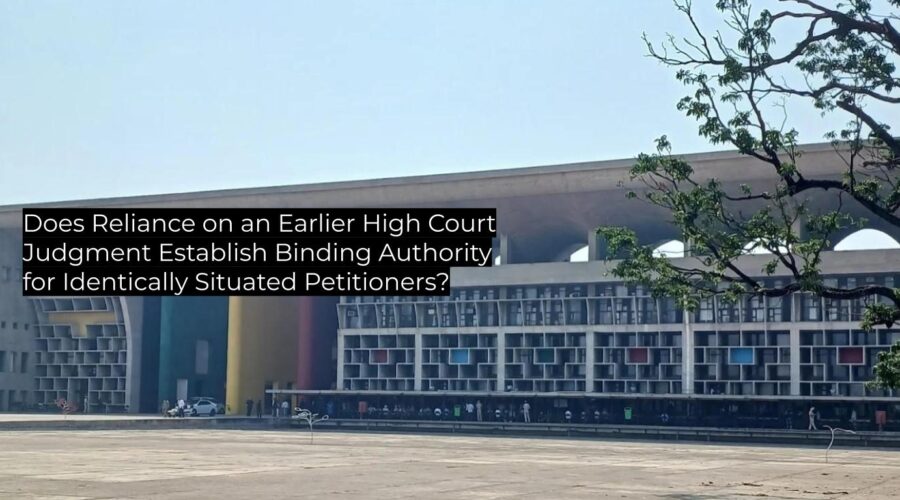
Does Reliance on an Earlier High Court Judgment Establish Binding Authority for Identically Situated Petitioners?

The High Court of Punjab and Haryana summarily disposed of the petition by applying its prior decision in Sandeep Kumar and others v. State of Haryana and others (CWP No.24483 of 2025, decided 04.09.2025), with no opposition from the State; the ruling upholds the binding nature of coordinate bench decisions within the court’s jurisdiction and […]

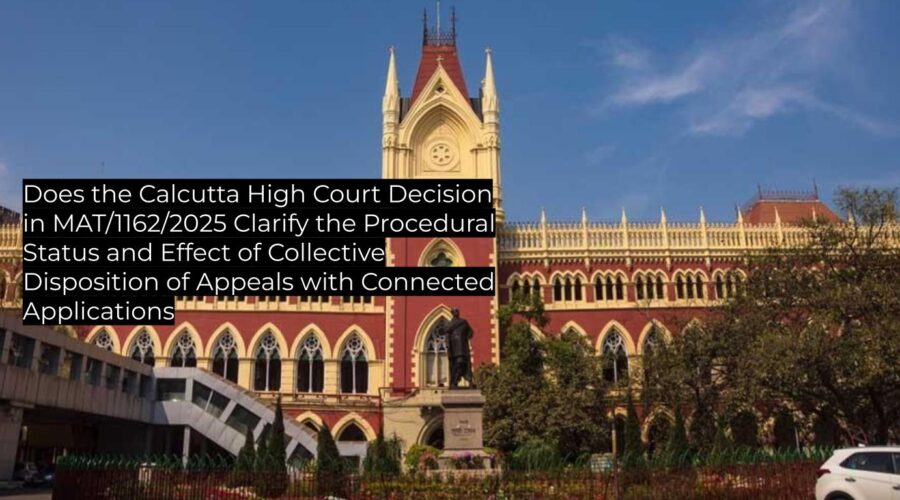
Does the Calcutta High Court Decision in MAT/1162/2025 Clarify the Procedural Status and Effect of Collective Disposition of Appeals with Connected Applications

The court expressly disposed of all linked appeals and applications together, providing formal clarity on the status of each proceeding and confirming the absence of cost orders. This judgment upholds procedural regularity and reinforces clarity for practitioners regarding omnibus orders in similar matters. The ruling has binding precedential value for cases on procedural finality before […]

Does a Writ Petition Challenging Debarment Become Infructuous Once the Period of Debarment Expires?

The Madras High Court has reaffirmed that when the period of debarment/cancellation in an administrative order has already expired by the time of hearing, a writ petition seeking relief against such order becomes infructuous. This order is consistent with established jurisprudence and has binding value for similar writs concerning expired prohibitions, particularly in government contracting […]

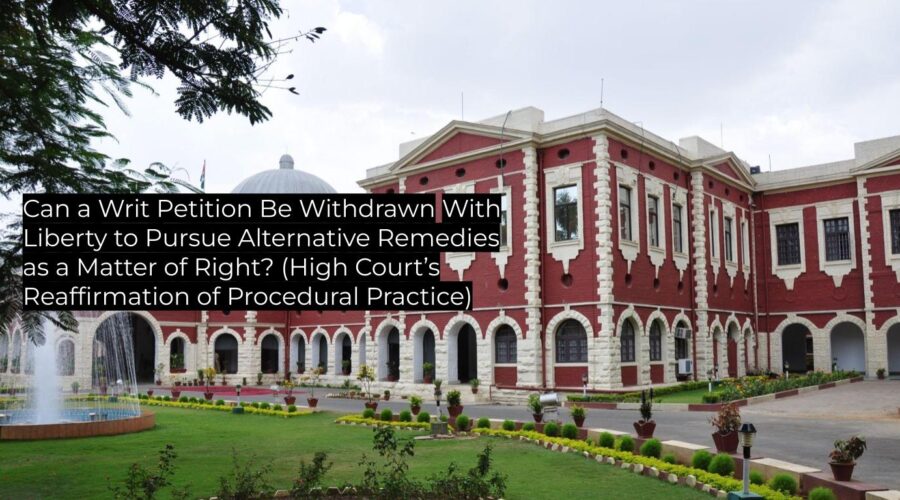
Can a Writ Petition Be Withdrawn With Liberty to Pursue Alternative Remedies as a Matter of Right? (High Court’s Reaffirmation of Procedural Practice)

The Jharkhand High Court upholds existing precedent by permitting the withdrawal of a writ petition with liberty to seek remedies under law, reaffirming the established procedural practice for litigants before subordinate and High Courts.   Summary Category Data Case Name WPC/2980/2024 of PHOOL KUMARI Vs STATE OF JHARKHAND CNR JHHC010164892024 Date of Registration 14-05-2024 Decision […]

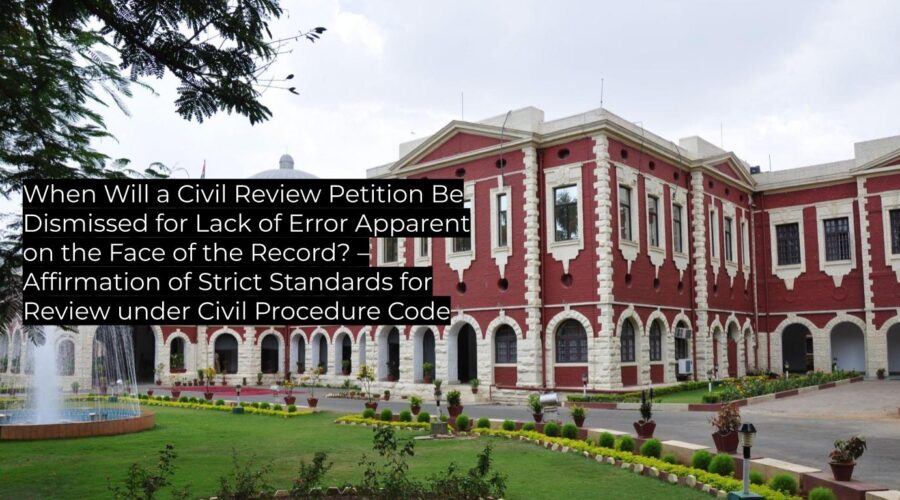
When Will a Civil Review Petition Be Dismissed for Lack of Error Apparent on the Face of the Record? – Affirmation of Strict Standards for Review under Civil Procedure Code

The Jharkhand High Court reaffirms that civil review petitions must demonstrate an “error apparent on the face of the record” for interference; mere disagreement with the earlier judgment is insufficient. The court upholds the stringent threshold required under Order XLVII Rule 1 CPC, maintaining alignment with existing precedent. This remains binding authority for all subordinate […]