Can a Bank Classify a Cash Credit Account as NPA Solely for Low Turnover? Orissa High Court Reaffirms the Primacy of RBI’s 90-Day “Out of Order” Norm—Binding Authority for Asset Classification Disputes

Orissa High Court holds that banks cannot classify a borrower’s cash credit account as a Non-Performing Asset (NPA) based purely on low turnover unless the objective 90-day “out of order” criteria under RBI guidelines are satisfied. This decision upholds established RBI norms, clarifies the limits of bank discretion, and is binding on all subordinate courts […]

When, if Ever, Can the Sub-Registrar or State Authorities Determine the Scheduled Caste or Scheduled Tribe Status of a Caste Not Expressly Included in the Presidential Notification? — Orissa High Court Reaffirms the Finality of Presidential Orders as Binding Authority

High Court clarifies that the determination of whether a caste or sub-caste falls within the Scheduled Caste or Scheduled Tribe category is exclusively within the domain of the Presidential notification; neither State authorities nor Courts may alter, add to, or interpret beyond those notifications. The judgment affirms and applies long-standing precedent, providing binding authority on […]

Does Prolonged Detention of a Seized Vehicle Under the Odisha Minor Minerals Concession Rules Without Timely Initiation of Confiscation or Penalty Proceedings Violate Constitutional and Statutory Rights?

The Orissa High Court clarified that, while seizure by a duly authorized police officer under Rule 51 of the OMMC Rules is valid, prolonged detention of vehicles without expeditious penalty assessment or initiation of confiscation proceedings violates the right to property and livelihood. The judgment affirms Supreme Court precedents and provides binding authority within Odisha, […]

Does the Orissa High Court Judgment in FAO No. 141 of 2020 Clarify or Modify Compensation Principles in Railway Accident Claims, and Can It Be Cited as Binding Authority for Similar Matters?

The Orissa High Court held in FAO No. 141 of 2020 that the appellant is entitled to compensation and specified the quantum and the rate of interest, directing the respondent Railways to deposit the awarded amount. As a High Court decision, this case reaffirms applicable compensation principles and serves as binding authority within the jurisdiction […]

Does the Mere Disposal of Multiple Writ Petitions Without Detailed Orders Create a Binding Legal Precedent Under Indian Law? [Precedent Followed, No New Legal Principle Laid Down]

The Orissa High Court, through a brief oral order, disposed of a batch of writ petitions without prescribing new legal principles or addressing substantive legal issues. This judgment upholds existing judicial practice regarding summary disposals and does not alter or clarify prevailing law. It carries no binding or persuasive value for future cases.   Summary […]

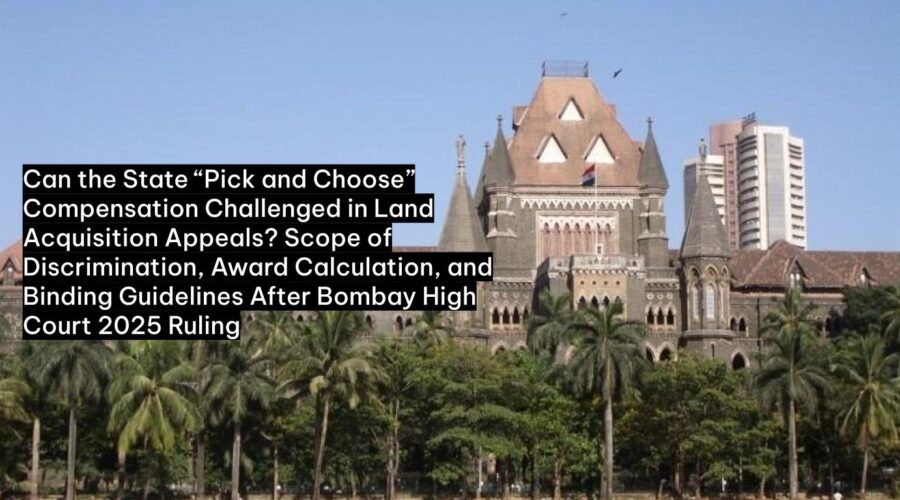
Can the State Adopt a “Pick and Choose” Approach in Land Acquisition Appeals? Bombay High Court Reiterates Equal Treatment Principle and Clarifies Compensation for Dry and Irrigated Lands

State authorities cannot challenge enhancement of compensation for some landowners while acquiescing in awards for others in comparable circumstances. The judgment upholds the Supreme Court’s bar on “pick and choose” tactics, reinforces uniformity in compensation under land acquisition law, affirms established precedent, and serves as binding authority for subordinate courts in Maharashtra.   Summary Category […]

When Are Acquiring Authorities Barred From “Pick and Choose” Appeals in Land Acquisition Matters? – Precedential Limits on Discriminatory Challenges to Compensation Awards

Bombay High Court upholds bar on State adopting a discriminatory “pick and choose” approach in challenging compensation awards under the Land Acquisition Act, in line with latest Supreme Court guidance—clarifying that if compensation is accepted for some claimants, selective appeals against others on identical facts are impermissible. Judgment reaffirmed as binding precedent for land acquisition […]

Can the State “Pick and Choose” Compensation Challenged in Land Acquisition Appeals? Scope of Discrimination, Award Calculation, and Binding Guidelines After Bombay High Court 2025 Ruling

The Bombay High Court has affirmed that once the State or its agency accepts a compensation award for some landholders, it cannot contest similar awards for others arising from the same acquisition; such selective appeals are discriminatory. The Court has clarified the compensation methodology for dry versus irrigated land and valuation of trees, upholding Supreme […]

Can High Courts Quash Non-Compoundable Offences under Section 482 CrPC Based on Settlement? Clarification and Application of Supreme Court Guidelines

High Court clarifies and affirms, following Supreme Court precedent, that inherent powers under Section 482 CrPC may be exercised to quash even non-compoundable offences on the basis of a settlement, except in cases of heinous crimes or offences affecting society at large. The judgment upholds existing precedent and serves as binding authority for subordinate courts […]

Does Section 143(3) of the NI Act Mandate Expedited Trial Timelines in Cheque Bounce Cases?

The High Court of Uttarakhand expressly directs trial courts to conclude Section 138 Negotiable Instruments Act (NI Act) cases as early as possible—preferably within one year—reaffirming the statutory mandate for speedy trials under Section 143(3) of the NI Act, especially when cases have suffered undue delays. This serves as binding precedent for subordinate courts in […]

Can High Courts Direct Subordinate Courts to Expedite Long-Pending Section 138 NI Act Trials Beyond Statutory Timelines? (Clarification and Reaffirmation of Section 143(3) NI Act’s Mandate)

High Court affirms its power to direct expeditious trial of Section 138 NI Act cases pending beyond six months, reinforcing the statutory mandate of Section 143(3) and requiring subordinate courts to conclude such trials within one year from the order; this serves as a binding clarification for all subordinate courts handling Negotiable Instruments Act prosecutions. […]

Does Compliance With Court’s Direction in Service Matters Obliterate Contempt Liability Even After Delay? — Himachal Pradesh High Court Clarifies Applicability and Scope

The Himachal Pradesh High Court held that once governmental authorities comply with the court’s mandate in a service matter—even if compliance follows a contempt petition—no contumacious conduct remains, and contempt proceedings should be closed. This judgment affirms settled principles regarding the scope and closure of contempt when compliance is established and serves as binding precedent […]