What Is the Effect of Non-Appearance or Non-Representation by the Petitioner in High Court Writ Proceedings? When Does the High Court Dismiss a Writ Petition for Default, and Does Such Dismissal Affect the Merits of the Case? Binding Authority: Existing Procedural Principles Reaffirmed

The High Court reaffirmed that where the petitioner and their counsel repeatedly fail to appear or make alternative arrangements, the Court may dismiss the writ petition for default. This judgment upholds established procedural law and serves as binding authority for the handling of non-prosecution in writ proceedings across Karnataka courts.   Summary Category Data Case […]
Does an Appeal Automatically Abate If No Steps Are Taken After Death of a Party? — Reaffirming Procedure Under the Motor Vehicles Act

Madras High Court reaffirms that a Civil Miscellaneous Appeal under Section 173 of the Motor Vehicles Act abates when no steps are taken upon the death of a party. The dismissal follows settled procedural law, serving as binding precedent within its jurisdiction for abatement due to non-substitution.   Summary Category Data Case Name CMA(MD)/1950/2013 of […]

Does Regularization Entitle Previously Contractual Employees to Revised Pay Scale Benefits Under the 2022 Rules in Himachal Pradesh? — Precedent Affirmed and Clarified

The High Court of Himachal Pradesh has reaffirmed that once contractual or temporary employees are regularized, they are entitled to the benefits of the Revised Pay Scale Rules, 2022, akin to their counterparts, and denial of such benefits is discriminatory. The judgment applies the principle established in Mohit Sharma v. State of H.P., upholds existing […]

Can Denial of ACP/MACP Benefits Solely on “Non-confirmation” of Service be Sustained When Full Retiral Benefits Have Been Paid?

The Jharkhand High Court reaffirms that long-serving government employees, post-superannuation, cannot be denied ACP/MACP benefits merely because their services were not “confirmed,” especially when all post-retiral benefits have been disbursed and pension is being received. This judgment strengthens employee rights in service law and stands as binding precedent within Jharkhand.   Summary Category Data Case […]
Is A Writ Petition Maintainable for Challenging Rent Fixation Without Exhausting Statutory Remedies Under the Jharkhand Building (Lease, Rent and Eviction) Control Act, 2011? – Scope of Judicial Review and Procedural Prerequisites Upheld

The High Court reaffirmed that when an alternative remedy exists under the Jharkhand Building (Lease, Rent and Eviction) Control Act, 2011, writ jurisdiction should not ordinarily be invoked, and parties must pursue statutory remedies first; the decision upholds established precedent and acts as binding authority on subordinate courts in Jharkhand.   Summary Category Data Case […]
Can Conviction under Section 302 IPC Be Altered to Section 304 Part II in the Absence of Evidence of Intent to Cause Death?

The Jharkhand High Court reaffirmed that where the prosecution fails to establish intent or knowledge requisite for “murder” under Section 300 IPC, conviction under Section 302 IPC must be modified to Section 304 Part II IPC. The decision upholds the established judicial test for distinguishing murder from culpable homicide and is binding on all subordinate […]

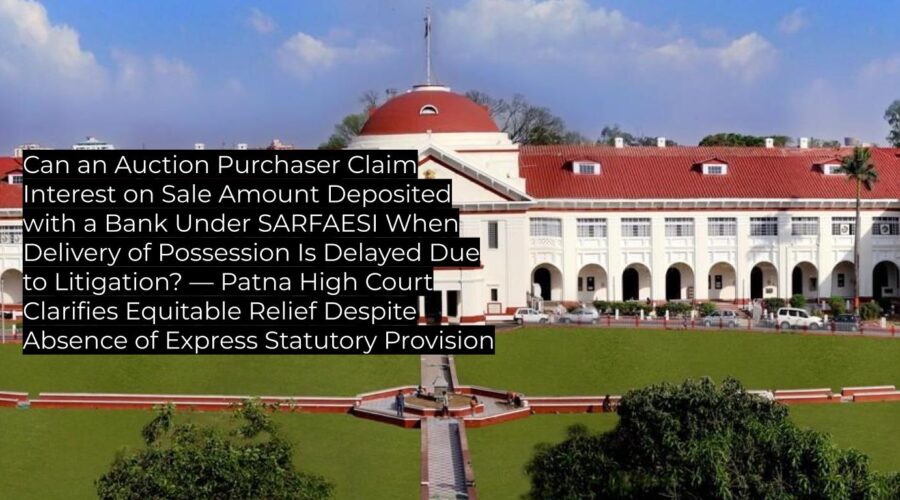
Can an Auction Purchaser Claim Interest on Sale Amount Deposited with a Bank Under SARFAESI When Delivery of Possession Is Delayed Due to Litigation? — Patna High Court Clarifies Equitable Relief Despite Absence of Express Statutory Provision

The Patna High Court holds that, where a bank delays handing over possession of a mortgaged property purchased in a SARFAESI auction, the bona fide purchaser is entitled to interest for the period of unjustified retention of funds, except for a reasonable processing period. This judgment sets a new precedent, correcting the earlier refusal to […]

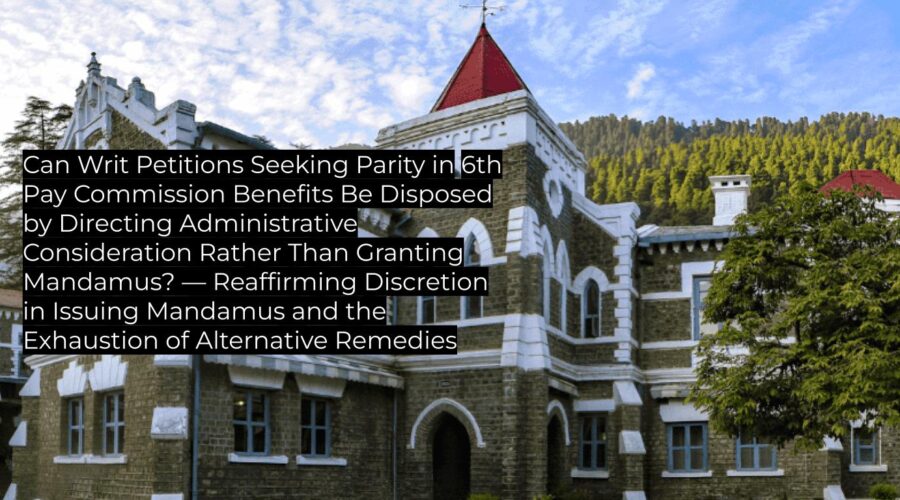
Can Writ Petitions Seeking Parity in 6th Pay Commission Benefits Be Disposed by Directing Administrative Consideration Rather Than Granting Mandamus? — Reaffirming Discretion in Issuing Mandamus and the Exhaustion of Alternative Remedies

The High Court of Uttarakhand clarified that writ petitions seeking service benefits, such as parity in implementation of Pay Commission recommendations, may be disposed of by directing petitioners to pursue administrative representation, with time-bound consideration by authorities, rather than issuing a direct mandamus. This approach reaffirms existing precedent and provides guidance for similarly situated public […]

Does a Writ Petition Become Infructuous Simply by Efflux of Time? – Clarification by High Court of Uttarakhand

The court held that when the petitioners themselves declare their writ petitions infructuous due to passage of time, such petitions shall be dismissed as infructuous; this order is a straightforward application of established procedural law and does not overrule, modify, or clarify any substantive principle. The judgment serves as a practical reaffirmation of standard court […]

Can a Writ Petition Be Dismissed as Infructuous Upon the Petitioner’s Statement of Loss of Live Controversy? – Precedent on the Impact of Efflux of Time on Pending Writs

The High Court clarified that where petitioners acknowledge that the cause of action is no longer subsisting due to the passage of time, the writ petition may be dismissed as infructuous upon their statement. The decision affirms existing precedent; lawyers can cite it for procedural disposal of matters rendered academic by efflux of time. Applies […]

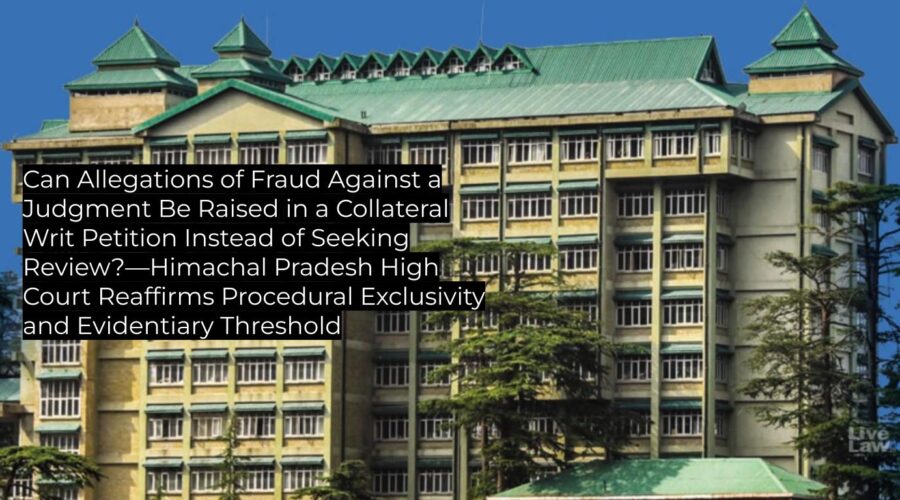
Can Allegations of Fraud Against a Judgment Be Raised in a Collateral Writ Petition Instead of Seeking Review?—Himachal Pradesh High Court Reaffirms Procedural Exclusivity and Evidentiary Threshold

The Himachal Pradesh High Court reiterates that claims of fraud in procuring a judgment must be pursued through review proceedings, not a separate writ petition, and mere bald allegations without material evidence are insufficient. This judgment affirms existing legal precedent and has binding authority for all subordinate courts in Himachal Pradesh.   Summary Category Data […]

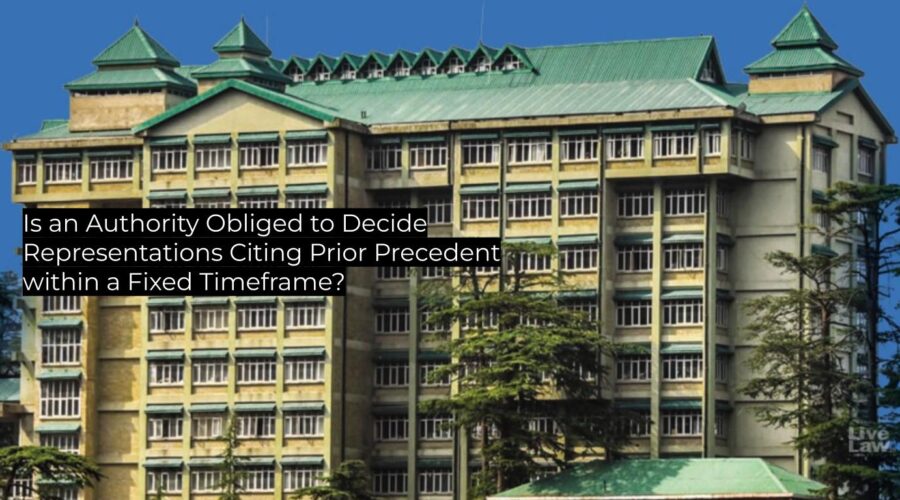
Is an Authority Obliged to Decide Representations Citing Prior Precedent within a Fixed Timeframe?

The Himachal Pradesh High Court reaffirmed that authorities must consider and decide pending representations—especially where claimants rely on earlier binding judgments—within a specified period, but without examining the merits or granting substantive relief. This approach upholds existing precedent and only provides limited procedural guidance for future similar writ petitions.   Summary Category Data Case Name […]