


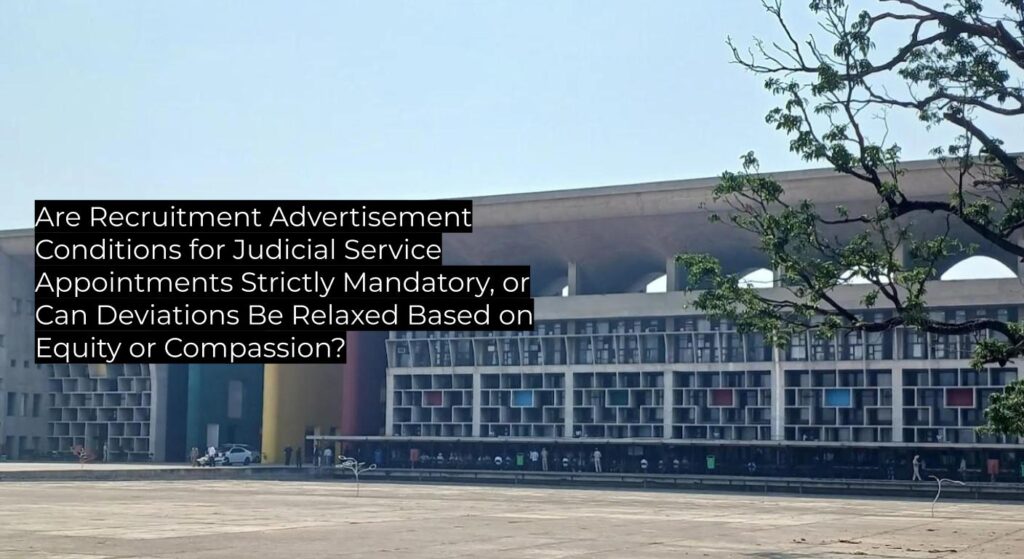
The High Court restates that terms of recruitment advertisements, such as mandatory signature requirements on each page of application forms, are sacrosanct and strictly enforceable; courts cannot relax them based on sympathy or individual hardship. This approach directly affirms established Supreme Court precedent and applies to all judicial and public service recruitment processes.
Summary
| Category | Data |
|---|---|
| Case Name | CWP/25933/2025 of ANUJ DAHIYA Vs STATE OF HARYANA AND ANOTHER |
| CNR | PHHC011402942025 |
| Date of Registration | 30-08-2025 |
| Decision Date | 02-09-2025 |
| Disposal Nature | DISMISSED |
| Judgment Author | Sheel Nagu, Chief Justice (Oral) |
| Concurring or Dissenting Judges | Yashvir Singh Rathor, Judge (concurring) |
| Court | High Court of Punjab and Haryana |
| Bench | Division Bench: Chief Justice Sheel Nagu and Justice Yashvir Singh Rathor |
| Precedent Value | Binding on subordinate courts in the Punjab & Haryana jurisdiction |
| Overrules / Affirms | Affirms Supreme Court decisions on recruitment process rigor |
| Type of Law | Public Service Recruitment, Administrative Law |
| Questions of Law | Whether courts can relax strict compliance requirements of recruitment advertisements on grounds of equity or compassion |
| Ratio Decidendi |
Terms stated in the advertisement, such as the requirement to sign every page of the application, are mandatory and must be complied with strictly. Deviation from these mandatory terms cannot be permitted, even on grounds of sympathy or compassion. The use of explicit, emphasized language in recruitment clauses further underscores their mandatory character. Judicial interference is unwarranted when the exclusion is neither arbitrary nor unlawful, and the advertisement terms are clear and unambiguous. The rationale aligns with Supreme Court directives that recruitment procedures cannot be diluted by courts in individual cases. |
| Judgments Relied Upon |
|
| Logic / Jurisprudence / Authorities Relied Upon by the Court | Strict adherence to advertisement terms in public service recruitment; recruitment conditions are sacrosanct; no relaxation permissible even on equitable grounds |
| Facts as Summarised by the Court | Petitioner applied for the post of Additional District & Sessions Judge (25% direct quota for Bar) in Haryana. The advertised conditions required a signature on each page of the application. Petitioner’s application was rejected for not signing every page. The High Court held this was consistent with the clear advertisement condition. |
| Citations |
|
Practical Impact
| Category | Impact |
|---|---|
| Binding On | All subordinate courts in Punjab and Haryana |
| Persuasive For | Other High Courts, recruitment bodies across India |
| Follows |
|
What’s New / What Lawyers Should Note
- Reiterates that explicit application requirements in public service recruitment (such as signing every page) are strictly mandatory; non-compliance results in summary rejection.
- No relaxation of clear advertisement conditions is possible on grounds of sympathy or exceptional circumstances.
- Reliance on Supreme Court precedent is clear and unambiguous—lawyers challenging recruitment rejections on sympathetic grounds will find courts bound by this standard.
- Applications not meeting all specified criteria, regardless of merit or intent, are liable to be summarily rejected without judicial interference.
Summary of Legal Reasoning
- The court found that advertisement Clause 10.9, requiring a signature on “each page” of the application form, was expressed in clear and mandatory terms (emphasized in bold).
- Citing Supreme Court decisions including N.T. Devin Katti v. Karnataka Public Service Commission, State of Bihar v. Madhu Kant Ranjan, and Suresh Kumar Lalit Kumar Patel v. State of Gujarat, the court underscored that courts are not empowered to relax eligibility or procedural norms of recruitment processes based on compassion or hardship.
- The judiciary’s role is limited to ensuring that such conditions are not arbitrary or unlawful; if conditions are clear and justified, strict adherence is required.
- The court declined to interfere with the rejection as it was in compliance with mandatory criteria, upholding the sanctity of the recruitment advertisement.
- No arbitrariness or illegality was found in the rejection decision.
Arguments by the Parties
Petitioner:
- Sought judicial interference with the rejection of his application for not signing each page, as required.
- Argued for relaxation or waiver of procedural non-compliance.
Respondent (State of Haryana / Recruitment Authority):
- Defended the rejection, relying on the explicit requirement in Clause 10.9.
- Asserted that the application could not be entertained in violation of the clear and mandatory condition.
- Supported strict compliance as per binding judicial authorities.
Factual Background
The petitioner, an aspirant for the post of Additional District & Sessions Judge in Haryana under the 25% quota reserved for advocates, applied pursuant to a specific recruitment advertisement. The advertisement demanded that each page of the application be signed, a condition stated prominently in Clause 10.9. The petitioner failed to sign every page, resulting in rejection of his application. He challenged this rejection, seeking judicial review.
Statutory Analysis
The judgment focused on interpretation of administratively set advertisement clauses in public service recruitment—specifically, Clause 10.9. The court gave a literal reading to the clear, bolded language “on each page,” refusing to dilute or read down the requirement. There was no question of constitutional interpretation or expansive construction; the mandate was applied strictly as written.
Dissenting / Concurring Opinion Summary
No dissenting or separate concurring opinions; both judges agreed with the reasoning and outcome.
Procedural Innovations
None noted; the judgment follows established procedure in recruitment writ petitions.
Alert Indicators
- ✔ Precedent Followed – Judgment affirms and applies Supreme Court precedent on strict compliance in recruitment conditions.
Citations
- N.T. Devin Katti and others v. Karnataka Public Service Commission, (1990) 3 SCC 157 (Para 11)
- State of Bihar and others v. Madhu Kant Ranjan and another, (2021) 17 SCC 141 (Para 11)
- Suresh Kumar Lalit Kumar Patel and others v. State of Gujarat and others, (2023) 19 SCC 596 (Paras 23 & 24)