


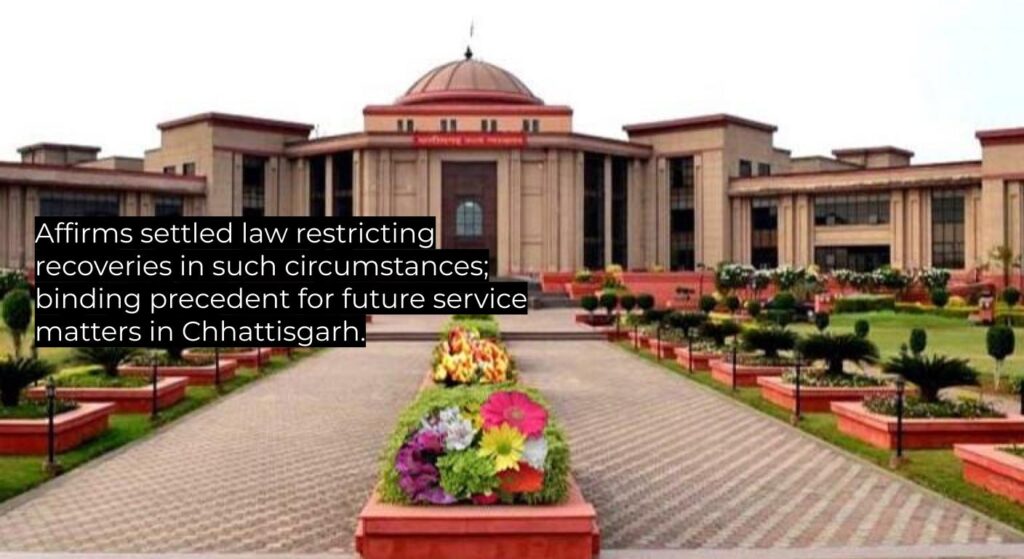
Reaffirming the legal bar on recovery of excess salary where the employee is not at fault, this judgment applies and consolidates Supreme Court and High Court precedents, holding any such recovery before retirement or for amounts paid over five years ago as impermissible. The ruling is binding on all subordinate courts in Chhattisgarh and persuasive elsewhere, constituting a significant safeguard for public servants against arbitrary financial liability at the end of service.
Summary
| Case Name | WPS/8960/2023 of SMT. SUSHILA TEKAM Vs STATE OF CHHATTISGARH |
|---|---|
| CNR | CGHC010374822023 |
| Date of Registration | 08-11-2023 |
| Decision Date | 30-10-2025 |
| Disposal Nature | ALLOWED |
| Judgment Author | HON’BLE SHRI JUSTICE AMITENDRA KISHORE PRASAD |
| Court | High Court of Chhattisgarh at Bilaspur |
| Bench | Single Bench – HON’BLE SHRI JUSTICE AMITENDRA KISHORE PRASAD |
| Precedent Value | Binding within Chhattisgarh; persuasive authority for other jurisdictions |
| Overrules / Affirms | Affirms existing Supreme Court and High Court precedents |
| Type of Law | Service Law; Recovery of Excess Payment; Principles of Natural Justice |
| Questions of Law |
|
| Ratio Decidendi |
The Court held that recovery of excess payment made due to a departmental error, without any misrepresentation or fault by the employee, is arbitrary and unsustainable. It reaffirmed that such recovery is impermissible:
The principles of natural justice require proper consideration of reply to show cause notices, not a mechanical process. The impugned recovery, issued more than thirteen years after the original payment and near retirement, stands quashed. The Court directed refund of any amounts already recovered. |
| Judgments Relied Upon |
|
| Logic / Jurisprudence / Authorities Relied Upon by the Court | Recovery of salary entails civil consequences, attracting principles of natural justice; recovery not permissible without employee’s misrepresentation or fault and where time limitations laid down by the Supreme Court are triggered. |
| Facts as Summarised by the Court | The petitioner, a Deputy Superintendent of Police, was issued a recovery order for excess salary allegedly paid from 2010 due to a pay fixation mistake by the department. The petitioner had no role in the error or any misrepresentation. The disputed recovery was initiated near her retirement date and pertained to payments over a decade old. |
Practical Impact
| Binding On | All subordinate courts within Chhattisgarh |
|---|---|
| Persuasive For | Other High Courts; Supreme Court |
| Follows |
|
What’s New / What Lawyers Should Note
- Reaffirms that recovery of excess salary is barred where the employee is due to retire within one year or when the payment pertains to a period older than five years.
- Departmental error, absent employee misrepresentation or fault, cannot justify financial recovery.
- Principles of natural justice mandate genuine consideration of employee’s objection, not a mere formality.
- The decision mandates refund of any such recoveries, adding enforceable remedial protection for affected employees.
- Lawyers can cite this authority to forestall delayed recoveries against retiring or superannuated public servants.
Summary of Legal Reasoning
- The Court examined established Supreme Court authority (Rafiq Masih, Thomas Daniel, Bhagwan Shukla), finding that where excess payments have been made due to errors by the department, not the employee, recoveries are subject to strict limitations.
- Specifically, recovery cannot occur (i) from employees about to retire within a year, or (ii) when the overpayment is from more than five years prior.
- Even when show cause notice is issued, the response of the employee must be meaningfully considered; passing an order on the same day as receiving the reply, without real adjudication, renders the process a “mere formality” and violates natural justice.
- The principle that orders having civil consequences cannot be passed without hearing and fair procedure was stressed, drawing upon Bhagwan Shukla v. Union of India.
- On facts, the petitioner’s lack of fault or misrepresentation, the prolonged period since the excess payment, and the proximity to retirement brought the case squarely within the Supreme Court’s protective limitations.
Arguments by the Parties
Petitioner
- No fault or misrepresentation in pay fixation by the petitioner.
- Recovery contrary to Supreme Court guidelines (Rafiq Masih, Thomas Daniel) and Chhattisgarh High Court precedents.
- Payment in question pertained to a period exceeding 13 years prior, and the petitioner had already retired.
- The departmental error, not any action by the petitioner, caused the excess payment.
Respondent (State)
- Concurred with the legal position set out by petitioner.
- Did not dispute impermissibility of recovery under the Supreme Court’s law and relevant High Court orders.
Factual Background
The petitioner, serving as Deputy Superintendent of Police, was issued a show cause notice and recovery order for Rs. 4,25,586/- on the basis of alleged excess salary paid from July 2010 due to a pay fixation mistake entirely attributable to departmental error. The reply submitted by the petitioner, denying any misrepresentation or fault, was summarily dismissed. The contested recovery process was initiated just before her retirement date, raising issues as to limitation and employee protection.
Statutory Analysis
- The Court applied and interpreted the principles laid down by the Supreme Court concerning recovery of excess payments in service law.
- Sections related to service conditions and civil consequences were considered, with an emphasis on adherence to principles of natural justice as a statutory and constitutional requirement.
- No specific statute was interpreted narrowly or expansively, but key constitutional and procedural norms were enforced.
Dissenting / Concurring Opinion Summary
No dissenting or concurring opinions are recorded in the judgment.
Procedural Innovations
No new procedural innovations or directions beyond established precedent are identified in the judgment.
Alert Indicators
- ✔ Precedent Followed – When existing law is affirmed.