


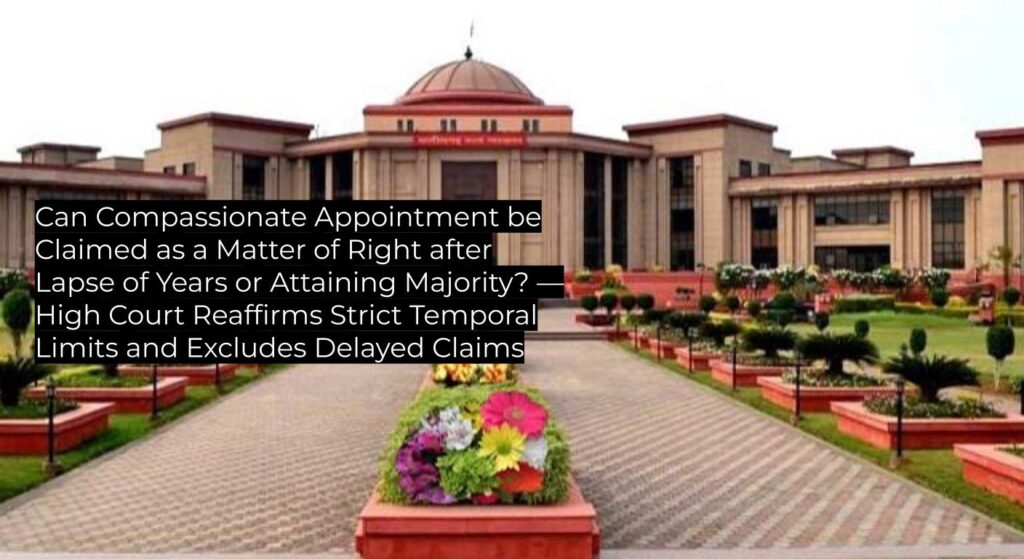
The High Court of Chhattisgarh, in 2025, has reaffirmed the longstanding judicial position that compassionate appointments cannot be claimed after a significant lapse of time from the employee’s death, regardless of when the dependent attains majority. The judgment upholds Supreme Court precedents, reinforcing that such employment is an exception for immediate financial distress and not a vested right, and is binding on all subordinate courts within its jurisdiction.
Summary
| Category | Data |
|---|---|
| Case Name | WA/786/2025 of ANKIT KUMAR NAVIK Vs STATE OF CHHATTISGARH |
| CNR | CGHC010435392025 |
| Date of Registration | 30-10-2025 |
| Decision Date | 03-11-2025 |
| Disposal Nature | DISMISSED |
| Judgment Author | HON’BLE THE CHIEF JUSTICE (Ramesh Sinha) |
| Concurring or Dissenting Judges | HON’BLE SHRI JUSTICE BIBHU DATTA GURU (Concurring) |
| Court | High Court of Chhattisgarh, Bilaspur Bench |
| Bench | Division Bench: Chief Justice Ramesh Sinha, Justice Bibhu Datta Guru |
| Precedent Value | Binding within Chhattisgarh; persuasive elsewhere |
| Overrules / Affirms | Affirms and meticulously follows Supreme Court precedent |
| Type of Law | Service Law / Administrative Law / Public Employment |
| Questions of Law | Whether delayed applications for compassionate appointment, made after attaining majority by the dependent, are maintainable when not filed within a reasonable time from employee’s death. |
| Ratio Decidendi |
The Court held that compassionate appointment is not a vested right, but an exception to enable families to meet sudden financial hardship caused by the death of a government employee. Application after a considerable period from the date of death defeats the object of the scheme. The fact that the dependent was a minor at the time of death does not override the requirement of immediacy. Where another family member has employment/pension, the claim is further diluted. The department’s obligation to provide forms/guidance does not confer entitlement after undue delay. Supreme Court precedents strictly limit delayed claims. |
| Judgments Relied Upon |
|
| Logic / Jurisprudence / Authorities Relied Upon by the Court | The Court emphasized that compassionate appointment is not a hereditary entitlement or a means for sustained employment but a humanitarian concession restricted by immediate necessity. Precedents stress the scheme’s objective, narrow scope, and prohibition of delayed claims. |
| Facts as Summarised by the Court | Appellant’s father, a government employee, died in harness on 07.11.2011. The appellant was a minor aged 15 years 8 months, and his mother was already a government employee receiving pension. The appellant first applied for compassionate appointment on 20.01.2015 (after attaining majority), but it was rejected owing to delay. A subsequent application in 2018 was also rejected. The department had not, according to the appellant, provided the requisite forms/guidance after death. The Single Judge also dismissed the claim as time-barred. |
Practical Impact
| Category | Impact |
|---|---|
| Binding On | All subordinate courts within the territorial jurisdiction of the High Court of Chhattisgarh |
| Persuasive For | Other High Courts, particularly in service matters involving delayed compassionate appointment claims; may be referenced in Supreme Court arguments |
| Follows |
|
What’s New / What Lawyers Should Note
- High Court reiterates that neither minority at the time of employee’s death nor supposed failure of the department to provide application forms extend the outer limit for seeking compassionate appointment.
- Strict adherence to the immediacy principle in compassionate appointment cases; significant delay, even if applicant was a minor, is fatal.
- Presence of another earning member (including pension) in the family can justify rejection of compassionate appointment.
- The employer’s procedural breach in not guiding dependents does not amount to a positive right to compassionate employment after undue delay.
- All applications must be scrutinized as per the policy prevailing at the date of death, but the inherent bar against stale claims is absolute.
- The judgment can be used to resist late-stage compassionate appointment petitions and fortifies the position of public employers on timelines.
Summary of Legal Reasoning
- The Division Bench examined the core requirement and objective behind compassionate appointments—immediacy of relief for a bereaved family facing sudden penury.
- Citing prolific Supreme Court precedents (including Punjab State Power Corporation Ltd. v. Nirval Singh, Indian Bank v. Promila, Fertilizers and Chemicals Travancore Ltd. v. Anusree), it reaffirmed that such appointments are an exception and not a matter of right, and delayed claims fall foul of the rationale.
- The Court highlighted that Supreme Court authorities have unambiguously held that compassionate appointment cannot be claimed after a substantial lapse of time; reasoned that even if the dependent was a minor at the time of death, the object is not to create hereditary employment claims.
- The Bench noted that departmental lapses (in providing forms/guidance) or the absence of a positive bar in the policy do not override the need for immediacy and cannot justify late claims.
- The existence of another earning member or pensioner in the family further strengthens the ground for rejection, drawing authority from Supreme Court cases (State of H.P. v. Rajesh Kumar; SAIL v. Awadesh Singh).
- The judgment underscored that courts cannot substitute, modify, or add to the scheme in exercise of judicial review, and no writ can issue for delayed claims.
- Ultimately, the Bench found no error in the Single Judge’s order and dismissed the appeal for want of merit.
Arguments by the Parties
Petitioner (Appellant):
- The appellant was a minor at the time of his father’s death and could not have applied earlier; applied immediately on attaining majority.
- The department failed to perform its mandated duty under government guidelines to provide forms and guidance within one month after the employee’s death.
- No clear limitation period existed under the policy at the time of death (10.06.2003); benefit of policy and minority status ought to be extended.
- Departmental inaction should not prejudice the applicant’s claim; rejection solely on technical delay is arbitrary.
- Relied on Supreme Court judgments: Balbir Kaur v. SAIL (2000) 6 SCC 493 and Bheemesh v. State of Karnataka (2021) 20 SCC 707, regarding interpretation of policies beneficially and as per rules in force at the date of death.
- Action is violative of Articles 14 and 21 of the Constitution.
Respondent (State & Authorities):
- The father died in 2011; application only in 2015 is belated, violating the compassionate appointment policy.
- Rejection is justified as the claim suffers from delay and laches and no sympathy can override settled legal principles.
- Even as per 2013 policy (not applicable here), mother of petitioner was already in service and receiving pension, thus further disqualifying the claim.
- Supporting authorities did consider the application as per prevailing rules at the time of death.
- Order of the Single Judge is well-reasoned and sustainable.
Factual Background
The appellant lost his father, a government radiographer, on 07.11.2011 while he was still a minor aged 15 years and 8 months; at that time, his mother was employed and receiving a government pension. The appellant only applied for compassionate appointment on 20.01.2015 after attaining the requisite age and qualifications. The application was rejected on grounds of delay on 27.06.2015, with his and his mother’s successive representations also failing. The appellant thereafter approached the writ court, leading to dismissal of his petition due to inordinate delay—an action challenged in the present appeal.
Statutory Analysis
- The judgment interprets government policies on compassionate appointment, specifically the obligations of the employer (policies dated 10.06.2003 and 14.06.2013), but concludes that no positive right accrues for delayed applications.
- Cites and follows the law laid down under Article 14 and 21 of the Constitution in the context of compassionate appointments.
- No “reading down” or “reading in” exercises noted; the decision strictly relies on judicial precedent regarding delayed applications.
Dissenting / Concurring Opinion Summary
No dissenting opinion; both judges concurred fully in dismissing the writ appeal and upholding the principles emphasized by the Single Judge and Supreme Court.
Procedural Innovations
No new procedural directions, changes to evidence requirements, or suo motu guidelines were issued; the judgment is firmly rooted in established procedural and legal standards for writ appeals in service matters.
Alert Indicators
- ✔ Precedent Followed – The judgment faithfully follows and applies settled Supreme Court precedent regarding compassionate appointment, timelines, and eligibility.