


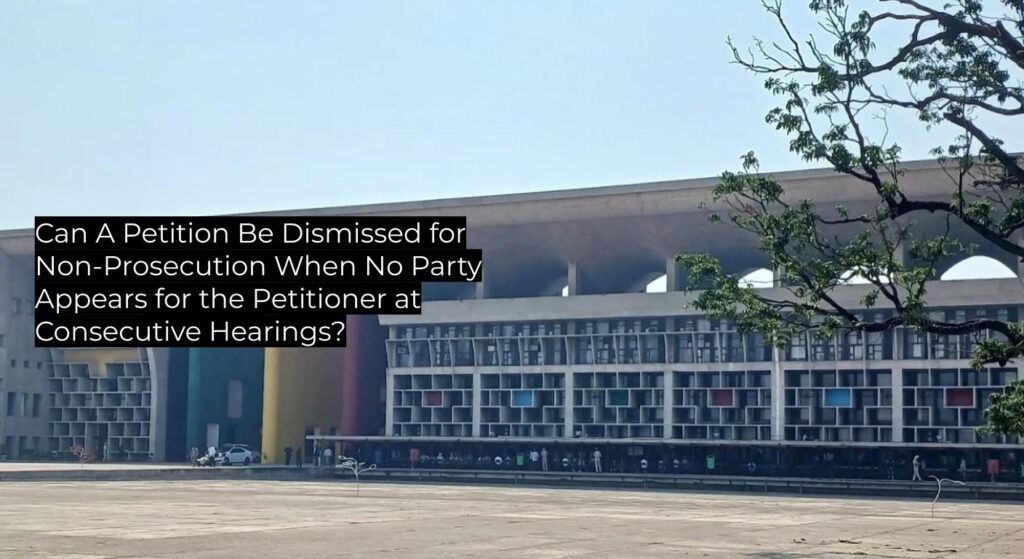
The High Court reaffirmed that petitions may be dismissed for non-prosecution if the petitioner repeatedly fails to appear. This judgment follows settled law, confirming the court’s powers in such instances; remains binding on subordinate courts, with direct relevance to all practitioners handling writs and similar proceedings.
Summary
| Category | Data |
|---|---|
| Case Name | CWP/32688/2024 of UNION OF INDIA Vs EX SPR DEVA NAND AND ANOTHER |
| CNR | PHHC011680182024 |
| Date of Registration | 03-12-2024 |
| Decision Date | 31-10-2025 |
| Disposal Nature | DISMISSED |
| Judgment Author | MR. JUSTICE HARSIMRAN SINGH SETHI |
| Concurring or Dissenting Judges | MR. JUSTICE VIKAS SURI |
| Court | High Court of Punjab and Haryana |
| Bench | Division Bench: MR. JUSTICE HARSIMRAN SINGH SETHI, MR. JUSTICE VIKAS SURI |
| Precedent Value | Binding on subordinate courts within the jurisdiction |
| Type of Law | Procedural Law |
| Ratio Decidendi |
The court confirmed that when no one appears for the petitioner on successive hearings, the writ petition can be dismissed for non-prosecution. Dismissal for non-prosecution serves as a procedural control to ensure prompt adjudication and avoid undue delay. The order stands as a procedural safeguard against parties neglecting their cases before the court. The judgment does not consider the merits of the underlying dispute, focusing solely on the procedural aspect of appearance and prosecution. |
| Facts as Summarised by the Court |
No one appeared on behalf of the petitioner on the previous date of hearing. At the next hearing as well, there was no appearance for the petitioner. The court accordingly dismissed the petition for non-prosecution. |
Practical Impact
| Category | Impact |
|---|---|
| Binding On | All subordinate courts within the jurisdiction of the Punjab and Haryana High Court |
| Persuasive For | Other High Courts and Tribunals considering similar procedural defaults |
What’s New / What Lawyers Should Note
- Emphasizes the binding nature of procedural rules requiring diligent prosecution of one’s case.
- Affirms that repeated non-appearance by a petitioner is sufficient ground for dismissal of the petition for non-prosecution.
- Reinforces that courts will not consider the merits if procedural requirements such as appearance are ignored.
Summary of Legal Reasoning
- The court noted lack of appearance by the petitioner on the last date of hearing.
- Upon repeated absence even on the subsequent listing, the Division Bench concluded that no cause was shown to excuse the default.
- Based solely on this procedural lapse, the court dismissed the writ petition for non-prosecution, exercising its inherent powers to control its docket and discourage unnecessary delay.
Arguments by the Parties
Petitioner:
- No arguments were presented as no one appeared for the petitioner on the date of hearing.
Respondent:
- None recorded in the judgment before the court dismissed the petition.
Factual Background
The writ petition was filed by the Union of India. On the last date of hearing, no one appeared for the petitioner. At the next date of hearing, again there was no appearance or representation from the petitioner’s side. The court, taking note of continued non-prosecution, dismissed the petition accordingly.
Statutory Analysis
- The judgment deals with the court’s inherent procedural power to dismiss cases for non-prosecution. No specific statutory provision is cited or interpreted in the order.
Dissenting / Concurring Opinion Summary
- The decision was concurred by both MR. JUSTICE HARSIMRAN SINGH SETHI and MR. JUSTICE VIKAS SURI. No dissent or separate concurring opinion is recorded.
Procedural Innovations
- No new procedural innovations or directions were issued; the judgment follows standard procedure regarding non-prosecution.
Alert Indicators
- ✔ Precedent Followed – The court reaffirmed established procedural law regarding dismissal for non-prosecution due to absence of the petitioner.