


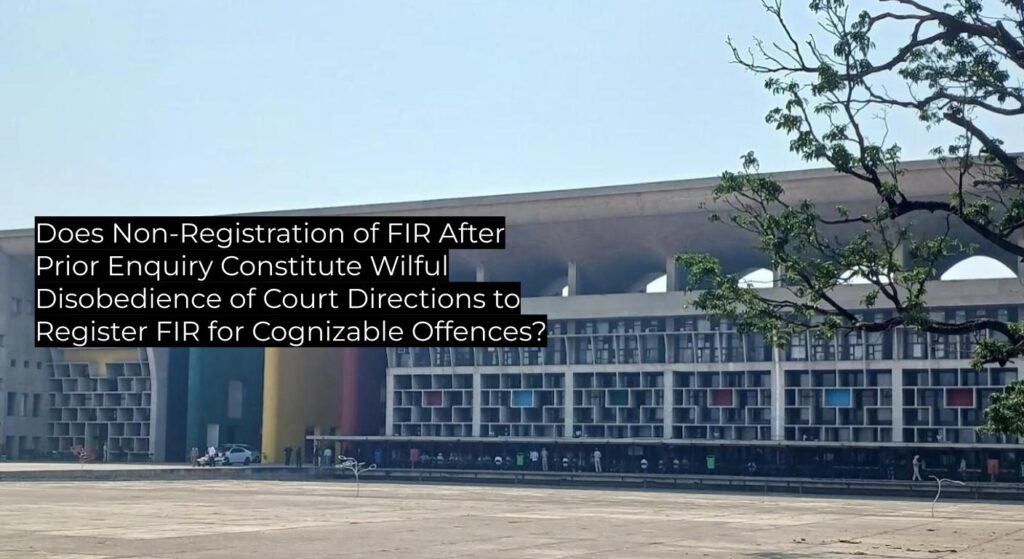
The High Court holds that where police conduct due enquiry in accordance with prior directions and civil suits on the same cause have been dismissed, contempt is not made out for non-registration of FIR. Reaffirms adherence to Supreme Court precedent (Lalita Kumari), clarifies limits of contempt in such scenarios, and serves as binding authority within Punjab & Haryana jurisdiction for similar contempt petitions alleging non-registration of FIR.
Summary
| Category | Data |
|---|---|
| Case Name | COCP/1322/2025 of Jaswinder Kaur Vs Kuldeep Chahal |
| CNR | PHHC010397912025 |
| Date of Registration | 12-03-2025 |
| Decision Date | 31-10-2025 |
| Disposal Nature | DISPOSED OF |
| Judgment Author | Mrs. Justice SudeepTI Sharma |
| Court | High Court of Punjab and Haryana |
| Precedent Value | Binding within Punjab & Haryana High Court jurisdiction |
| Type of Law |
|
| Questions of Law | Whether compliance with prior investigation and civil proceeding outcomes bars contempt for non-registration of FIR under prior directions? |
| Ratio Decidendi |
The High Court examined whether its earlier order directing registration of FIR as per Lalita Kumari was disobeyed. The police submitted a compliance affidavit detailing previous enquiries, civil litigation history, and reasons for not registering a fresh FIR, including dismissals of related civil suits and prohibition of multiple enquiries. The Court held that the order was substantially complied with, as directed enquiries were made and civil disputes on identical claims had failed. Consequently, contempt was not established and rule was discharged. |
| Judgments Relied Upon |
|
| Logic / Jurisprudence / Authorities Relied Upon by the Court |
|
| Facts as Summarised by the Court |
Compliance affidavit by police showed prior enquiry and attached reports. Related civil suits filed by petitioner’s mother-in-law on the same subject were dismissed in default. Police had already investigated previous complaints and determined that the matter was concluded. The petitioner proceeded with contempt alleging willful disobedience, which the court found not substantiated. |
Practical Impact
| Category | Impact |
|---|---|
| Binding On | All subordinate courts and authorities within the jurisdiction of the Punjab & Haryana High Court |
| Persuasive For | Other High Courts facing contempt petitions on similar facts or procedural history |
| Follows | Lalita Kumari (Supreme Court) |
| Distinguishes | National Anti-Crime and Human Rights Protection of India vs State of Punjab and Others (distinguished on facts) |
What’s New / What Lawyers Should Note
- Clarifies that where police conduct proper enquiry and related civil litigation has been disposed of, contempt for non-registration of FIR based on prior directions is not made out.
- Affirms the binding force of standing orders against multiple enquiries on the same set of facts.
- Demonstrates the High Court’s adherence to the Supreme Court’s Lalita Kumari framework, while factoring in completed civil and administrative processes.
- Lawyers should ensure all previous actions (enquiries, litigation outcomes) are disclosed and analysed before moving for contempt alleging disobedience of judicial directions to register FIR.
Summary of Legal Reasoning
- The Court first considered its prior order directing State authorities, per Lalita Kumari, to register FIR where complaints disclose cognizable offences.
- The police filed a detailed compliance affidavit stating previous enquiries on the same cause had already been concluded by competent authorities, and administrative standing orders precluded fresh enquiry or FIR on identical facts.
- Dismissals of two civil suits by the petitioner’s mother-in-law on the same factual allegations were noted, reinforcing that the matter had been litigated and not pursued.
- The Court distinguished its prior order in National Anti-Crime and Human Rights Protection of India vs State of Punjab and Others as inapplicable to these facts.
- After reviewing affidavits and annexures, the Court found the original order had been complied with, and explicit willful disobedience was not established.
- The contempt was declared purged, and proceedings disposed.
Arguments by the Parties
Petitioner
- Alleged deliberate and intentional disobedience of previous High Court order to register FIR as per Lalita Kumari.
- Claimed police failed to comply with statutory orders.
Respondent/State
- Submitted detailed compliance affidavit showing prior enquiries and investigation on the same subject matter.
- Emphasised civil suits filed by the petitioner’s mother-in-law on identical issues had been dismissed.
- Pointed to standing orders prohibiting multiple enquiries/FIRs on the same cause.
- Contended no willful disobedience, and disputed applicability of prior orders cited by petitioner.
Factual Background
The petitioner initiated contempt proceedings alleging disobedience of a High Court order that required registration of FIR per Lalita Kumari’s directions. Police had previously conducted enquiries into complaints made by the petitioner and her mother-in-law regarding a property dispute. Civil suits on the same subject filed by the petitioner’s mother-in-law had been dismissed in default. The police refused to register a new FIR, citing these enquiries, the litigation history, and administrative prohibitions against repetitive investigation, prompting the present contempt petition.
Statutory Analysis
- The Court referenced the Pre-Conception and Pre-Natal Diagnostic Techniques Act, 1994, as part of its earlier directions for compliance “in letter and spirit,” but primary focus was on the procedure for FIR registration per Section 154 CrPC, interpreted with reference to Lalita Kumari.
- The standing orders of the DGP, Punjab, against multiple enquiries and FIRs for the same cause of action were given judicial weight.
- No narrow or expansive reinterpretation was reported; rather, principles were affirmed and applied to the resolved facts.
Alert Indicators
- ✔ Precedent Followed – The judgment affirms binding precedent (Lalita Kumari) and applies it to a scenario involving prior administrative and civil proceedings.