


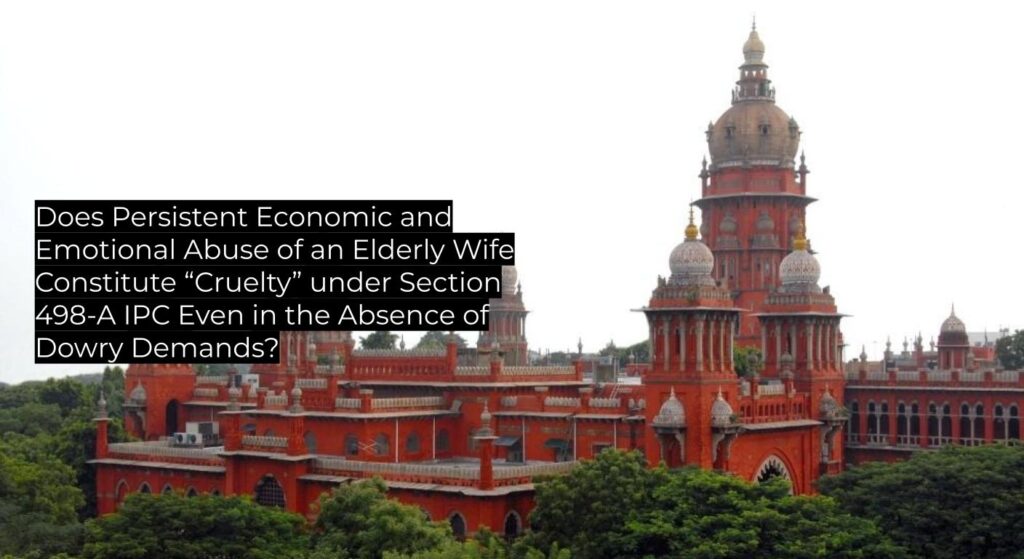
The Madras High Court clarifies that sustained economic and emotional abuse—such as deprivation, humiliation, isolation, and financial coercion—amounts to “cruelty” under Section 498-A IPC, regardless of dowry demand, especially when impacting elderly wives. The Court overrules the appellate acquittal, reaffirming that expectations of independent eyewitnesses are unrealistic in domestic settings and that the credible testimony of the victim, supported by circumstances, suffices. This ruling reaffirms and applies Supreme Court precedents, serving as binding authority for all subordinate courts and persuasive for similar future disputes, particularly involving protection of vulnerable senior women under criminal and domestic violence law.
Summary
| Category | Data |
|---|---|
| Case Name | CRL A(MD)/17/2018 of INDIRA, Vs DANASEELAN MUDALIYAR, CNR HCMD010759792018 |
| Date of Registration | 09-01-2018 |
| Decision Date | 31-10-2025 |
| Disposal Nature | ALLOWED |
| Judgment Author | HONOURABLE MRS JUSTICE L.VICTORIA GOWRI |
| Court | Madras High Court (Madurai Bench) |
| Bench | Single Judge (HONOURABLE MRS JUSTICE L.VICTORIA GOWRI) |
| Precedent Value | Binding authority on subordinate courts; persuasive for other High Courts |
| Overrules / Affirms | Overrules first appellate acquittal; affirms Supreme Court and High Court precedent |
| Type of Law | Criminal Law & Protection of Women from Domestic Violence Act, 2005 |
| Questions of Law |
|
| Ratio Decidendi | The Court held that “cruelty” under Section 498-A IPC encompasses persistent economic and emotional abuse, including isolation, deprivation of basic necessities, enforced dependence, humiliation of faith, and coercion to mobilise money, not merely physical violence or dowry demand. The credible testimony of the victim, corroborated by circumstances and supported by conduct (such as police-recorded compromise), is sufficient; insistence on independent eyewitnesses is unrealistic for domestic offences. The delay in seeking relief is immaterial where economic abuse is a continuing wrong, and maintenance can be granted based on realistic assessment of parties’ means. Age of the accused does not sanctify cruelty nor justify acquittal. |
| Judgments Relied Upon | Chandrappa v. State of Karnataka (2007) 4 SCC 415; Ghurey Lal v. State of U.P. (2008) 10 SCC 450; State of H.P. v. Raghubir Singh (1993) 2 SCC 622; Kalyan Kumar Gogoi v. Ashutosh Agnihotri (AIR 2011 SC 760); Krishna Bhattacharjee v. Sarathi Choudhury (2016) 2 SCC 705; Indra Sarma v. V.K.V. Sarma (2013) 15 SCC 755; Rajnesh v. Neha (2021) 2 SCC 324; V.D. Bhanot v. Savita Bhanot (2012) 3 SCC 183; S.R. Batra v. Taruna Batra (2007) 3 SCC 169. |
| Logic / Jurisprudence / Authorities Relied Upon by the Court | Principles regarding the scope of cruelty under Section 498-A IPC; unnecessity of corroboration by independent eyewitnesses in domestic cruelty; economic abuse as continuing offence under the D.V. Act; maintenance to be realistic and consistent with parties’ status; interpretation of “aggrieved person” and “continuing cause of action.” |
| Facts as Summarised by the Court | Octogenarian wife suffered decades of mental and economic cruelty from her husband, including isolation, deprivation, humiliation, and coercion to fetch money. Trial court convicted husband under Section 498-A IPC; appellate court acquitted him on grounds of lack of independent eyewitnesses and absence of dowry demand. Judgment also addresses related D.V. Act proceedings—maintenance to the wife fixed at Rs.20,000/month in light of husband’s substantial income. |
Practical Impact
| Category | Impact |
|---|---|
| Binding On | All subordinate courts within Tamil Nadu (including Madurai Bench); directly binding on subordinate judiciary. |
| Persuasive For | Other High Courts, and potentially the Supreme Court, especially on issues of marital cruelty, maintenance for elderly wives, and economic abuse under Section 498-A IPC and D.V. Act. |
| Overrules | Overrules the acquittal by the Additional District and Sessions Judge (Fast Track Court, Paramakudi) dated 23.08.2017 in Crl.A.No.16 of 2016. |
| Distinguishes | Distinguishes cases treating dowry demand as sine qua non for Section 498-A IPC, and those requiring independent eyewitnesses for domestic cruelty offences. |
| Follows | Applies Supreme Court precedents: Chandrappa v. State of Karnataka; Ghurey Lal v. State of U.P.; State of H.P. v. Raghubir Singh; Krishna Bhattacharjee v. Sarathi Choudhury; Rajnesh v. Neha; Indra Sarma v. V.K.V. Sarma, etc. |
What’s New / What Lawyers Should Note
- Clarifies that “cruelty” under Section 498-A IPC is not confined to dowry-related harassment; sustained economic and emotional abuse (including denial of food, isolation, humiliation, deprivation, and enforced dependence) against wives—especially elderly—falls squarely within Explanation (a).
- Firmly holds that insistence on independent eyewitnesses is unrealistic in domestic cruelty cases; credible testimony of the victim, supported by surrounding circumstances or conduct admissions (like police-recorded compromise), is sufficient to convict.
- Economic and emotional abuse, continuing after separation, can be a basis for maintenance and “aggrieved person” status under the D.V. Act, with limitation not applying due to continuing wrongs.
- Legal practitioners can cite this as binding precedent to counter arguments demanding dowry-linkage or independent corroboration in Section 498-A prosecutions and D.V. Act proceedings.
- Restores conviction and affirms maintenance relief even in advanced age of the parties, signalling that age does not shield liability for cruelty.
Summary of Legal Reasoning
- Scope of Appellate Interference: Reappreciated under Supreme Court principles (Chandrappa, Ghurey Lal); acquittal may be overturned if perverse or based on misapplication of law/material evidence.
- Interpretation of “Cruelty” under Section 498-A IPC: Dowry demand is not essential (per Supreme Court). Explanation (a) includes wilful conduct causing grave mental injury; this includes persistent economic and emotional abuse.
- Evidentiary Standards: Credible victim testimony suffices in absence of independent witnesses in domestic cruelty cases (State of H.P. v. Raghubir Singh); corroboration is a matter of prudence, not law. Hearsay rule is nuanced in family settings.
- Application to Facts: Accused’s conduct—denial of food/maintenance, enforced isolation, religious humiliation, financial domination, and coercion for money—proved by victim and corroborated by witnesses, police-brokered compromise, and uncontested on cross-examination.
- Illicit Relationship: Such conduct, when combined with other abusive acts, can amount to mental cruelty.
- Benefit of Doubt Extended Properly: Acquittals on Section 506(ii) (criminal intimidation) and to other accused sustained due to lack of proof.
- Maintenance and D.V. Act Issues: Cited Krishna Bhattacharjee, Indra Sarma, Rajnesh v. Neha; economic abuse and deprivation of maintenance are continuing offences, not barred by limitation.
- Quantum of Maintenance: Assessed with reference to parties’ means as independently established by Advocate Commissioner and confirmed to be reasonable.
- Final Order: Conviction under Section 498-A restored; sentence of six months S.I. and fine affirmed; maintenance order under D.V. Act of Rs.20,000/month upheld.
Arguments by the Parties
Petitioner (Victim/Wife):
- First Appellate Court wrongly reversed trial court’s well-reasoned conviction.
- Unrealistic to expect independent eyewitnesses in domestic cruelty; victim testimony consistent and credible.
- Section 498-A applies to cruelty beyond dowry-related harassment, including mental and economic deprivation.
- Compromise before police confirmed the truth of allegations; reversal was based on factual and legal errors.
- Trial court’s sentence already lenient considering accused’s age.
Respondent (Husband):
- Prosecution witnesses (other than P.W.1) are hearsay; no contemporaneous medical or physical evidence.
- Complaint arose after property/civil disputes; criminal case motivated by collateral considerations.
- No independent corroboration of serious allegations of knife or poison threats; absence of dowry demand.
- Acquittal is a possible view, especially on appeal; age and health of accused makes further imprisonment unjustified.
- For maintenance: wife not an “aggrieved person,” left matrimonial home long ago; proceedings barred by limitation; no continuing domestic violence or financial capability.
Factual Background
The case concerns an elderly married couple. The octogenarian wife alleged decades of mental and economic cruelty by her husband, including isolation, deprivation, humiliation, and coercion to obtain money from her relatives, following his alleged illicit relationship with a family member. In 2007, a complaint under Section 498-A IPC was filed after a specific incident of isolation. The trial court convicted the husband; the appellate court acquitted him, holding absence of eyewitnesses and dowry demand fatal. Relatedly, in proceedings under the Domestic Violence Act, the wife sought maintenance and protection orders, and the trial and appellate courts awarded her maintenance at Rs.20,000/month based on the husband’s substantial income. The husband challenged these orders, raising issues of maintainability and limitation.
Statutory Analysis
- Section 498-A IPC: Interpreted to include persistent emotional and economic abuse within “cruelty,” not limited to dowry-linked harassment. Explanation (a) (wilful conduct likely to cause grave injury or mental harm) interpreted broadly.
- Section 372, 378 CrPC: Right to victim to appeal against acquittal, exercised herein.
- Section 2(a) & Section 3, Protection of Women from Domestic Violence Act, 2005: “Aggrieved person” includes those suffering ongoing economic abuse; deprivation of maintenance is a continuing offence.
- Section 468 CrPC (Limitation): Deprivation of maintenance is a recurring/continuous wrong, not barred by limitation.
- Section 397, 401 CrPC: Grounds for revision discussed; interference requires perversity or miscarriage of justice, which court did not find in D.V. Act orders.
Procedural Innovations
- Suo motu impleadment: Court suo motu impleaded the couple’s son as respondent in the D.V. Act revision proceedings to ensure effective implementation of maintenance order, reflecting pragmatic attention to enforcement in family law matters.
- Use of Advocate Commissioner: The High Court appointed an Advocate Commissioner to independently assess parties’ financial status, properties, and living arrangements, and heavily relied on the commissioner’s findings; this underscores increased judicial preference for fact verification in maintenance determinations.
Alert Indicators
- ✔ Precedent Followed – Supreme Court law on Section 498-A IPC and D.V. Act upheld and clarified; existing principles reaffirmed and directly applied.