


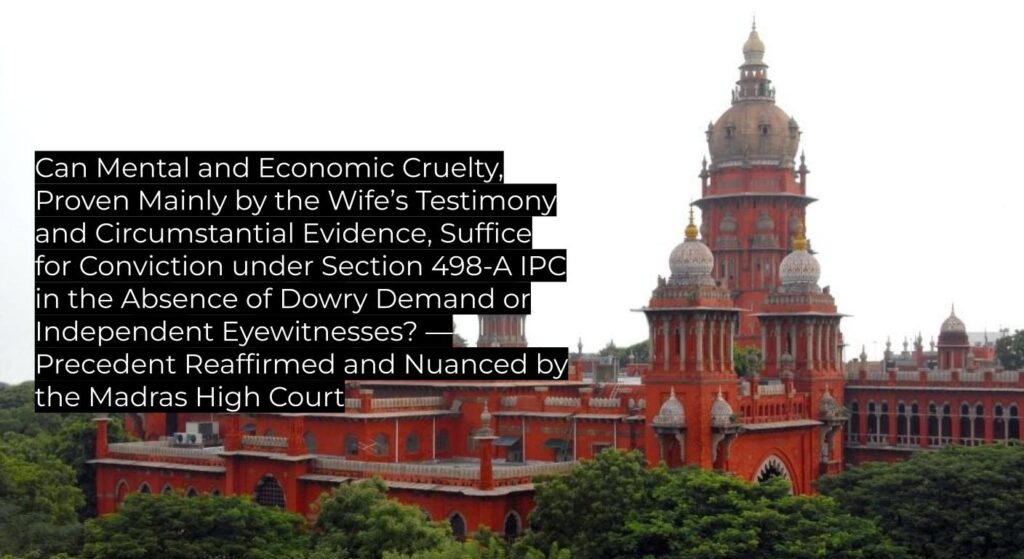
The Madras High Court has clarified and reinforced that dowry demand is not mandatory for conviction under Section 498-A IPC; continuous mental and economic abuse established primarily through the wife’s credible testimony and surrounding circumstances can suffice. The judgment expressly overrules restrictive evidentiary expectations in domestic cruelty cases and affirms maintenance for elderly women under the Domestic Violence Act, setting a binding precedent for subordinate courts in Tamil Nadu and carrying strong persuasive value nationally.
Summary
| Category | Data |
|---|---|
| Case Name | CRL A(MD)/17/2018 of INDIRA, Vs DANASEELAN MUDALIYAR, CNR HCMD010759792018 |
| Date of Registration | 09-01-2018 |
| Decision Date | 31-10-2025 |
| Disposal Nature | ALLOWED |
| Judgment Author | HONOURABLE MRS JUSTICE L.VICTORIA GOWRI |
| Court | Madras High Court (Madurai Bench) |
| Bench | Single Judge (HONOURABLE MRS JUSTICE L.VICTORIA GOWRI) |
| Precedent Value | Binding on subordinate courts in Tamil Nadu; strong persuasive value for other High Courts and Supreme Court |
| Overrules / Affirms | Overrules First Appellate Court’s acquittal; Affirms and restores Trial Court’s conviction under Section 498-A IPC |
| Type of Law | Criminal Law; Family/Domestic Violence Law |
| Questions of Law |
|
| Ratio Decidendi | The absence of dowry demand does not foreclose conviction under Section 498-A IPC if wilful conduct amounting to grave mental or economic cruelty is otherwise established (Explanation (a)). The credible, consistent testimony of the victim/wife—especially regarding private, domestic acts—can be sufficient for conviction, provided it is corroborated by circumstances (such as terms of compromise, recovery of property/jewels, economic deprivation, etc.). The judgment reiterates that maintenance for elderly wives under the Domestic Violence Act can be granted for continuing economic abuse, with the wife’s testimony and standard of living as key factors. The judgment rejects as perverse a rigid demand for independent eyewitnesses or for dowry harassment as sine qua non for Section 498-A IPC. |
| Judgments Relied Upon |
|
| Logic / Jurisprudence / Authorities Relied Upon by the Court |
|
| Facts as Summarised by the Court | Octogenarian wife alleged persistent mental and economic cruelty by husband, including isolation, denial of food, deprivation of religious practice, and coercion for money, following an alleged illicit relationship between husband and daughter-in-law. Complaint and FIR lodged under Sections 498-A and 506(i) IPC; conviction by Trial Court under Section 498-A, acquittal by First Appellate Court. Subsequent DV proceedings for maintenance culminated in order for Rs.20,000/month, challenged by husband. |
Practical Impact
| Category | Impact |
|---|---|
| Binding On | All subordinate courts in Tamil Nadu (Madras High Court jurisdiction) |
| Persuasive For | Other High Courts and Supreme Court |
| Overrules | First Appellate Court’s acquittal and restrictive evidentiary approach on Section 498-A IPC |
| Follows |
|
What’s New / What Lawyers Should Note
- Reiterates that demand of dowry is not a pre-condition for conviction under Section 498-A IPC; persistent mental and economic cruelty alone suffice.
- Affirms that sole, credible testimony of the wife, when corroborated by circumstances (compromise terms, recovery of property, etc.), can sustain conviction even without independent eyewitnesses or medical evidence.
- Emphasizes evidentiary latitude in domestic cruelty cases, acknowledging the rarity of independent witnesses in matrimonial settings.
- Endorses maintenance for elderly wives under the Domestic Violence Act, interpreting “continuing economic abuse” broadly, allowing claims decades after separation.
- Upholds realistic, need-based quantum of maintenance commensurate with the standard of living and the husband’s proven income, as established by Commissioner’s report.
- Quotes and applies leading Supreme Court precedents to demonstrate alignment with national legal standards.
- Provides strong authority to counter technical objections regarding absence of dowry or delay in claiming maintenance for survivors of prolonged marital cruelty.
Summary of Legal Reasoning
- The Court held that the First Appellate Court’s demand for independent eyewitnesses and its overemphasis on the absence of dowry demand were contrary to established legal principles and constituted misdirection in law.
- Citing Supreme Court precedents (Chandrappa, Ghurey Lal), the Court clarified that appellate interference against acquittal is justified when there is perversity, non-consideration of material evidence, or erroneous legal approaches.
- The Court held, based on State of H.P. v. Raghubir Singh, that credible testimony of the wife—corroborated by surrounding circumstances and consistent with behavior like compromise agreements and return of jewels—suffices for conviction.
- The Court distinguished between mere allegations of illicit relationship (insufficient alone) and aggregated acts causing humiliation, isolation, and financial deprivation, holding that the latter clearly falls within Explanation (a) to Section 498-A.
- In DV Act proceedings, the Court applied the ratio in Krishna Bhattacharjee and Indra Sarma to hold that “economic abuse” need not be recent or concurrent, but may constitute a continuing offence, entitling the wife to relief decades after physical separation.
- The quantum of maintenance was determined based on a fact-finding Commissioner’s detailed report on the husband’s income, and the Supreme Court’s standard in Rajnesh v. Neha (“realistic not minimal”).
- The Court affirmed the maintenance order at Rs.20,000 per month as fair and proportionate in the circumstances and explicitly held that advanced age or property transfers do not absolve maintenance liability.
Arguments by the Parties
Petitioner (Appellant / Wife)
- The First Appellate Court erred in reversing conviction, misdirected itself in law by insisting on independent evidence in a domestic cruelty case.
- Husband’s conduct (isolation, deprivation, coercion for money, obstruction of worship) constituted grave mental cruelty sufficient under Explanation (a) to Section 498-A.
- The police compromise’s terms proved the fact of harassment and deprivation.
- Trial Court had already granted a lenient sentence due to accused’s age; conviction and sentence ought to be restored.
Respondent (Accused / Husband)
- First Appellate Court correctly noted inconsistencies and lack of corroboration or independent witnesses; P.Ws.2–5 were only hearsay.
- No medical evidence or seizure of material objects; main allegations of knife and poison threats were not proved.
- Existence of civil and property litigation indicated that the complaint was motivated by collateral considerations.
- Parties have been living separately for decades; advanced age and health should mitigate any punishment.
- In the DV Act maintenance case: wife was not an “aggrieved person”; alleged violence unsubstantiated; claims are time-barred; amount awarded was excessive and unsupported by evidence.
Factual Background
An octogenarian wife alleged that her husband (also elderly), after decades of marriage, isolated her, denied her food and basic necessities, obstructed her religious practices, coerced her for money, and subjected her to humiliation and deprivation following an illicit relationship with her daughter-in-law. She lodged a police complaint in 2007, resulting in criminal charges under Sections 498-A and 506 IPC. The Trial Court convicted her husband under Section 498-A; the First Appellate Court acquitted him. Parallelly, the wife sought maintenance and other reliefs under the Domestic Violence Act, receiving an order for Rs.20,000 per month, which the husband challenged.
Statutory Analysis
- Section 498-A IPC: The Court interpreted Explanations (a) and (b), clarifying that demand for dowry is not required for every prosecution; “wilful conduct” causing grave injury to mental health suffices under Explanation (a).
- Admissibility of Evidence: Court relied on jurisprudence that testimony of the complainant/wife, if credible, can be sole basis for conviction in domestic cruelty cases; corroboration is a matter of prudence, not law.
- Protection of Women from Domestic Violence Act, 2005: “Aggrieved person” interpreted widely to include women suffering economic abuse or deprivation, even after marital separation; “continuing offence” doctrine applied to maintenance.
- Limitation: The Court found that non-maintenance is a “continuing offence,” not subject to limitation.
Dissenting / Concurring Opinion Summary
No dissenting or separate concurring opinion is recorded in this single-judge judgment.
Procedural Innovations
- Court referred the matter to mediation, but, on failure, heard appeals and revisions together, delivering a common judgment to settle all interlinked issues.
- Appointed a Commissioner to independently investigate and report on property status and income, ensuring realistic and evidence-based maintenance calculation.
Alert Indicators
- ✔ Precedent Followed – Reaffirms existing Supreme Court law on Section 498-A IPC and DV Act.
- 🚨 Breaking Precedent – Overrules First Appellate Court’s restrictive approach to evidence in domestic cruelty cases.