


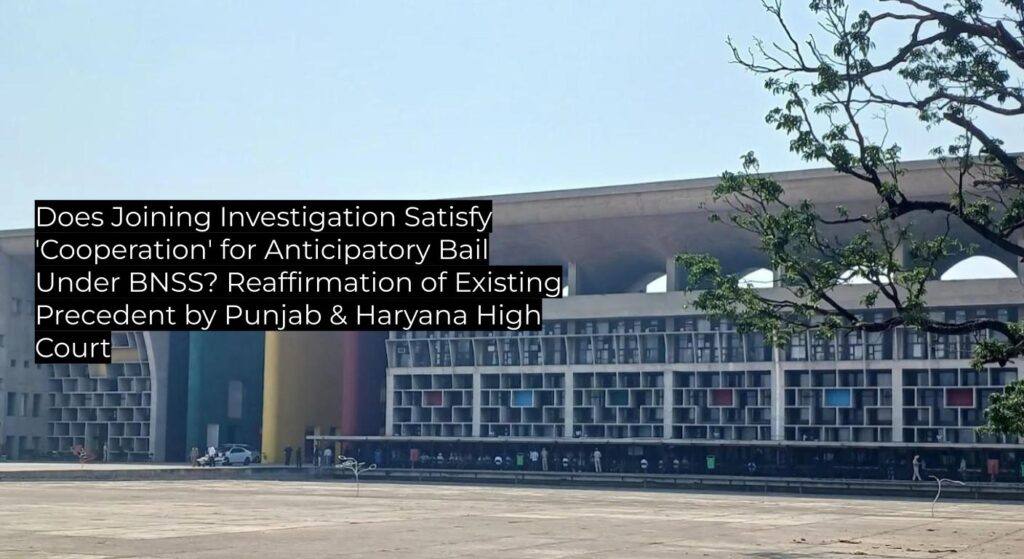
The High Court reaffirmed that, once an accused joins investigation and responds to lawful queries, their cooperation cannot be doubted merely because no incriminating recovery was made. Reliance placed on Santosh v. State of Maharashtra and recent Supreme Court authority. This binding judgement clarifies anticipatory bail standards under the Bharatiya Nagarik Suraksha Sanhita, 2023, and is authoritative for subordinate courts in Punjab & Haryana.
Summary
| Category | Data |
|---|---|
| Case Name | CRM-M/49090/2025 of GOLDY @ CHHOTU AND ANOTHER Vs STATE OF PUNJAB |
| CNR | PHHC011392892025 |
| Date of Registration | 02-09-2025 |
| Decision Date | 31-10-2025 |
| Disposal Nature | ALLOWED |
| Judgment Author | MRS. JUSTICE MANISHA BATRA |
| Court | High Court of Punjab and Haryana |
| Precedent Value | Binding on subordinate courts within the jurisdiction of Punjab & Haryana High Court |
| Overrules / Affirms | Affirms well-settled legal position and Supreme Court precedent |
| Type of Law | Criminal Procedure – Anticipatory Bail, Investigation Standards under BNSS |
| Questions of Law | Whether anticipatory bail can be denied for non-cooperation when the accused has duly joined and responded during investigation, though no recovery is effected. |
| Ratio Decidendi |
The purpose of joining investigation is to make oneself available and respond to lawful queries—not to secure incriminating recoveries or self-incriminating information. The mere non-recovery of incriminating articles does not constitute non-cooperation. Pre-trial incarceration should not mirror post-conviction imprisonment. The cooperation of the accused is adequately established by appearance and participation in investigation; hence, anticipatory bail should not be denied on the grounds of absence of recovery or lack of self-incriminating disclosures. Reliance placed on Santosh v. State of Maharashtra (2017) 9 SCC 714 and Jugraj Singh v. State of Punjab, SLP No.9190/2025. |
| Judgments Relied Upon |
|
| Logic / Jurisprudence / Authorities Relied Upon by the Court | The legal standard for cooperation is satisfied once the accused joins the investigation and responds to lawful questioning; recovery or self-incrimination is not required by law. |
| Facts as Summarised by the Court |
Petitioners sought anticipatory bail for offences registered under Sections 331(6), 115(2), 324(4), 351(1), 191(3), 190 of the BNS, 2023, joined investigation as per interim order, contended that they had fully cooperated. State sought custodial interrogation for recovery and to verify participation. Court found no grounds for custodial interrogation merely due to absence of recovery. |
Practical Impact
| Category | Impact |
|---|---|
| Binding On | All subordinate courts in Punjab & Haryana |
| Persuasive For | Other High Courts, may be cited in Supreme Court |
| Follows |
|
What’s New / What Lawyers Should Note
- Reaffirms that accused persons are considered to have “cooperated” with investigation upon joining and responding to lawful queries, regardless of whether recovery is made.
- Clarifies that non-recovery of incriminating evidence cannot be equated with non-cooperation to justify denial of anticipatory bail.
- Cites recent and binding Supreme Court precedent for this principle.
- Underscores that pre-trial incarceration should not be treated like punishment after conviction, further strengthening bail jurisprudence.
- Lawyers can cite this authority to counter arguments for custodial interrogation where the accused has joined the investigation in compliance with court directions.
Summary of Legal Reasoning
- The Court examined whether anticipatory bail should be denied merely due to the absence of incriminating recovery, where the accused have otherwise responded and joined investigation.
- It relied upon the Supreme Court decision in Santosh v. State of Maharashtra (2017) 9 SCC 714, and Jugraj Singh v. State of Punjab, SLP No.9190/2025, to hold that the legal obligation of the accused is to join the investigation and respond to lawful queries—not to make compulsory discoveries or confessions.
- The Court rejected the State’s submission that custodial interrogation was compulsory for recovery, observing that continued cooperation—taking part in investigation and responding to questions—satisfies the requirement of law.
- Iterated the settled principle that pre-trial incarceration must not mirror post-conviction punishment, and unnecessary imprisonment is not justified when the accused is cooperating with the investigation.
- Held, accordingly, the interim bail order was made absolute.
Arguments by the Parties
Petitioner
- The petitioners had joined the investigation as directed and had fully cooperated with the Investigating Officer.
- Asserted that continued prosecution and custodial interrogation was unnecessary as they had complied with all lawful requirements for anticipatory bail.
Respondent (State)
- Submitted that custodial interrogation was required for recovery of weapons and to verify participation in alleged offences and to ascertain motive.
- Argued that absence of recovery amounted to non-cooperation.
Factual Background
The petitioners were implicated in FIR No. 156 dated 28.06.2025, under Sections 331(6), 115(2), 324(4), 351(1), 191(3) and 190 of the Bharatiya Nyaya Sanhita, 2023, at Police Station City Kotkapura, District Faridkot. They sought anticipatory bail after being granted interim relief, joined investigation as directed, and responded to the queries of the Investigating Officer. The State insisted on custodial interrogation for effecting recovery and verification. The High Court analysed whether this sufficed to deny anticipatory bail.
Statutory Analysis
The case interprets Section 482 of the Bharatiya Nagarik Suraksha Sanhita, 2023 (analogous to Section 438(2) of CrPC), affirming that once an accused joins investigation and responds to lawful requirements, this fulfills their legal obligation under the statute. The Court clarified that there is no legal mandate for an accused to make self-incriminating disclosures or effect recoveries for anticipatory bail to be denied.
Alert Indicators
- ✔ Precedent Followed – The decision affirms existing Supreme Court precedent on anticipatory bail and standards of cooperation during investigation.