


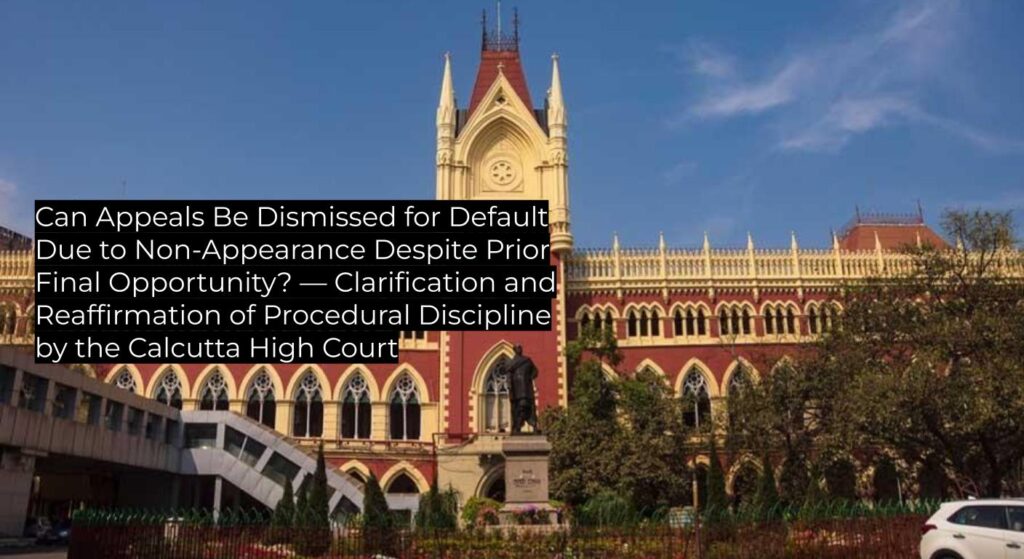
The Calcutta High Court reiterates that when appellants repeatedly fail to appear, even after the grant of a final opportunity, appeals may be dismissed for default. This judgment upholds settled procedural principles and reinforces the court’s authority to regulate its docket. It serves as binding authority for matters of default and procedural non-compliance.
Summary
| Category | Data |
|---|---|
| Case Name | SA/914/1965 of BUDGE BUDGE AMALGAMATED MILLS LIMITED Vs JAGANNATH |
| CNR | WBCHCA0002691965 |
| Date of Registration | 25-08-1964 |
| Decision Date | 31-10-2025 |
| Disposal Nature | DISMISSED FOR DEFAULT |
| Judgment Author | HON’BLE JUSTICE SABYASACHI BHATTACHARYYA |
| Court | Calcutta High Court |
| Bench | Single Bench (HON’BLE JUSTICE SABYASACHI BHATTACHARYYA) |
| Precedent Value | Binding for matters of procedural default in the Calcutta High Court |
| Questions of Law | Whether repeated non-appearance of parties, despite grant of final opportunity, justifies dismissal for default. |
| Ratio Decidendi |
The court observed that despite being given a last opportunity on the previous date to present arguments, the appellant was not represented when called. Owing to repeated absence on three successive dates, including after issuance of a last-chance warning, the court found no option but to dismiss the appeals for default. This upholds the principle that parties have a duty to diligently participate in proceedings, and continual non-appearance can justly lead to dismissal for non-prosecution. Interim orders were expressly vacated. |
| Facts as Summarised by the Court |
On multiple previous occasions (September 18 and October 24, 2025), none appeared for the parties. A last chance was accorded on October 24, 2025, but absence persisted on the hearing date (October 31, 2025). Consequently, all seven second appeals were dismissed for default. |
Practical Impact
| Category | Impact |
|---|---|
| Binding On | All subordinate courts within the jurisdiction of the Calcutta High Court |
| Persuasive For | Other High Courts for procedural matters involving dismissal for non-appearance |
What’s New / What Lawyers Should Note
- Reinforces that repeated non-appearance, even after a final opportunity, will result in dismissal for default.
- Reminds parties and lawyers of their duty to be present when matters are called or risk loss of their case.
- Interim orders in such dismissed cases stand vacated automatically.
- Last-chance warnings by courts are not mere formalities; failing to respond can have irreversible consequences.
Summary of Legal Reasoning
- The court noted that none of the parties appeared at the time of call, both on the present date and on two previous listed dates.
- A final opportunity had already been granted on October 24, 2025.
- Finding continued absence despite clear warning, the court held there was no alternative but to dismiss the matters for default.
- The judgment underscores the court’s obligation to ensure efficient docket management, validating dismissal as an appropriate remedy for non-prosecution.
Arguments by the Parties
- No submissions noted as none appeared for either party at any stage referenced in the judgment.
Factual Background
On multiple previous dates (September 18 and October 24, 2025), the parties in seven connected second appeals before the Calcutta High Court failed to appear or argue their cases. On October 24, 2025, the court specifically granted a last opportunity to the appellants to address the appeals. Despite this, when the matters were called on October 31, 2025, no party appeared. As a result, the appeals were dismissed for default, and interim orders, if any, were vacated.
Statutory Analysis
- The judgment is based on established principles that allow for dismissal of cases for default when parties fail to appear, particularly after a final opportunity.
- No specific statutory provisions are discussed in the text of the judgment.
Dissenting / Concurring Opinion Summary
- No dissenting or concurring opinions are recorded in this judgment.
Procedural Innovations
- No new procedural rules or innovations were introduced; the judgment applies settled procedural law regarding default dismissal.
Alert Indicators
- ✔ Precedent Followed – The judgment affirms existing law on dismissal for non-appearance and does not create new substantive precedent.