


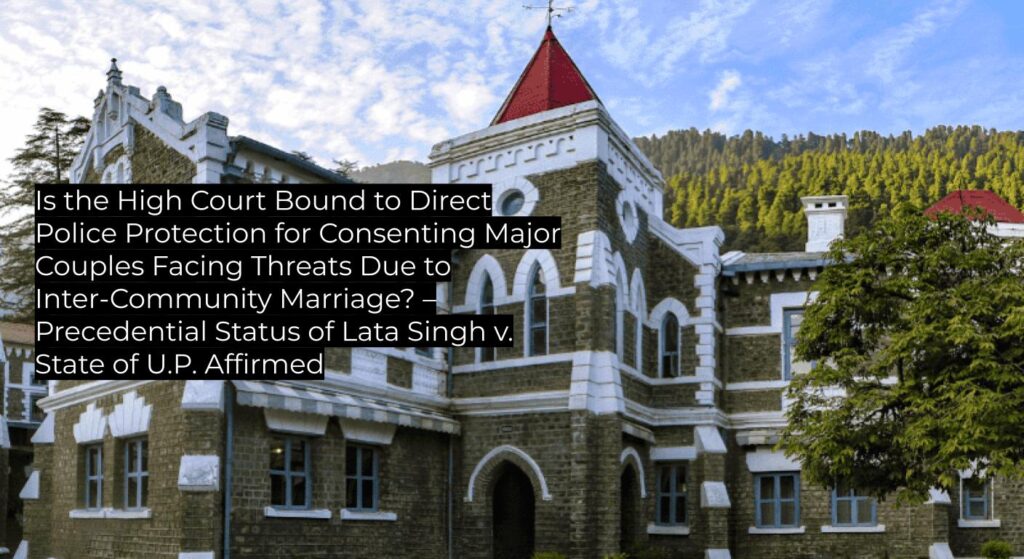
The Uttarakhand High Court upholds the Supreme Court’s precedent in Lata Singh v. State of U.P., reaffirming that police protection must be provided to consenting major couples facing threats for marrying against familial or societal opposition. This judgment confirms existing law, providing binding authority for subordinate courts and law enforcement agencies on the issue of life and liberty protection to such couples.
Summary
| Category | Data |
|---|---|
| Case Name | WPCRL/1354/2025 of TWINKAL Vs STATE OF UTTARAKHAND |
| CNR | UKHC010171062025 |
| Date of Registration | 29-10-2025 |
| Decision Date | 31-10-2025 |
| Disposal Nature | DISPOSED |
| Judgment Author | HON’BLE MR JUSTICE G. NARENDAR |
| Concurring or Dissenting Judges | HON’BLE MR. JUSTICE SUBHASH UPADHYAY (concurring) |
| Court | High Court of Uttarakhand |
| Bench | Division Bench: Chief Justice G. Narendar and Justice S. Upadhyay |
| Precedent Value | Binding authority within Uttarakhand; persuasive for other jurisdictions |
| Overrules / Affirms | Affirms Lata Singh v. State of U.P. (2006) 5 SCC 475 |
| Type of Law | Constitutional law (right to life and personal liberty under Article 21) |
| Questions of Law | Whether a major, consenting couple is entitled to police protection against threats arising from their marriage. |
| Ratio Decidendi |
The court held that where both petitioners are major and have performed marriage voluntarily, and face threats to their life and limb from relatives opposed to their union, they are entitled to protection in terms of the Supreme Court’s ruling in Lata Singh v. State of U.P. The Station House Officer concerned is duty-bound to assess the threat and provide police protection accordingly. The judgment reiterates that life and liberty of consenting adults cannot be jeopardized due to familial or societal opposition. |
| Judgments Relied Upon | Lata Singh v. State of U.P. (2006) 5 SCC 475 |
| Logic / Jurisprudence / Authorities Relied Upon by the Court | The judgment relies on documentary proof of marriage, age of majority, and legal principle from the Supreme Court judgment in Lata Singh. |
| Facts as Summarised by the Court |
Both petitioners, belonging to the same community, developed a relationship culminating in marriage, which is opposed by the first petitioner’s family. Facing threats and resistance, they approached the court seeking protection. The marriage was performed on 22.09.2025, and both are majors as per the documents produced. |
Practical Impact
| Category | Impact |
|---|---|
| Binding On | All subordinate courts and police authorities in Uttarakhand |
| Persuasive For | Other High Courts and law enforcement agencies across India |
| Follows | Lata Singh v. State of U.P. (2006) 5 SCC 475 |
What’s New / What Lawyers Should Note
- The judgment reinforces that police protection is to be provided to major, consenting couples threatened due to their marriage against collective family will.
- Directs the police not only to assess threat and provide protection, but also to actively counsel opposing family members and others.
- Reaffirms that the right to life and personal liberty of adults choosing their spouse is paramount under law, as previously held by the Supreme Court.
- Documentary proof of marriage and majority is sufficient for invoking police protection in similar circumstances.
Summary of Legal Reasoning
- The court established from the records and submissions that both petitioners are majors and have voluntarily entered into marriage.
- It took judicial notice of the ongoing threat from the first petitioner’s family, and the legal right of consenting adults to marry freely.
- The court placed explicit reliance on the Supreme Court decision in Lata Singh v. State of U.P., which mandates state protection for adult couples facing threats on account of their marriage.
- The judgment directed the Station House Officer to assess the threat to the petitioners’ lives and to provide protection, as warranted.
- It further directed the police to summon and counsel those opposing the marriage, ensuring compliance with lawful conduct.
Arguments by the Parties
Petitioner:
- Both petitioners are major, married by mutual consent, and are now living together.
- They face serious threats to life and limb from the family and relatives of the first petitioner, who oppose the marriage.
- Sought court intervention for police protection.
Respondent (State):
- The State counsel confirmed that the marriage had been solemnized and both parties are majors.
- No contest on the factual matrix regarding age and marriage.
Factual Background
Both petitioners, belonging to the same community, developed a relationship and entered into voluntary marriage on 22.09.2025. Their union faced strong opposition from the first petitioner’s family and relatives, leading to known threats to their safety. The couple, apprehending danger to their lives, filed a writ petition before the Uttarakhand High Court seeking protection. The petition included a marriage certificate evidencing their legal marriage and proof that both are of majority age.
Statutory Analysis
The court’s reasoning centered on the constitutional guarantee under Article 21 (right to life and personal liberty). The court applied the Supreme Court’s interpretation in Lata Singh v. State of U.P., which affirms that adult individuals are free to marry by choice, and that the state machinery, including the police, is obligated to protect couples facing threats due to such marriages. No other statutory or penal codes were specifically analyzed.
Dissenting / Concurring Opinion Summary
No dissenting opinion; both judges concurred in granting protection, with the judgment delivered per Chief Justice G. Narendar.
Procedural Innovations
- The court directed not merely protection but also proactive counseling by the police for those opposing the marriage.
- The approach requires SHO to both assess threat and mediate with the opposition under lawful guidelines.
Alert Indicators
- ✔ Precedent Followed – When existing law is affirmed.