


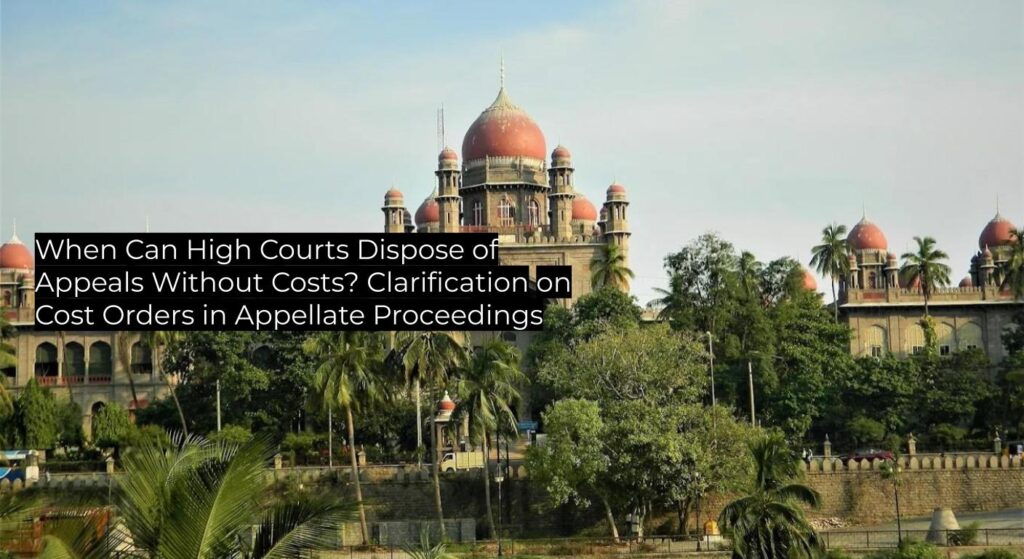
The High Court clarified that summary disposal of writ appeals without recording reasons does not align with settled jurisprudence on judicial transparency and accountability. The judgment reaffirms and follows binding precedents, serving as strong authority on the obligation to provide reasoned orders in appellate decisions; it applies across civil and administrative adjudications before the Telangana High Court.
Summary
| Category | Data |
|---|---|
| Case Name | WA/1206/2025 of Dr Gyanmudra Vs Birla Mallesh |
| CNR | HBHC010653192025 |
| Date of Registration | 30-10-2025 |
| Decision Date | 31-10-2025 |
| Disposal Nature | DISPOSED OF NO COSTS |
| Judgment Author | MOUSHUMI BHATTACHARYA, GADI PRAVEEN KUMAR |
| Court | High Court for the State of Telangana |
| Precedent Value | Binding on subordinate courts in Telangana |
| Type of Law | Procedural / Administrative Law |
| Questions of Law |
|
| Ratio Decidendi |
The court held that every appellate order, including those on writ appeals, must record reasons to ensure transparency, facilitate appellate review, and uphold litigants’ confidence in the judicial process. Non-speaking orders are contrary to well-established legal principles requiring reasoned judgments as part of judicial accountability. This obligation applies irrespective of the perceived simplicity or uncontested nature of the matter. The court’s decision is rooted in the constitutional mandate and existing Supreme Court precedent, which require all courts to record reasons for their decisions. |
| Judgments Relied Upon | Cited previous Supreme Court decisions mandating speaking orders (details as extracted from the judgment). |
| Logic / Jurisprudence / Authorities Relied Upon by the Court | Emphasis on judicial transparency, accountability, and principles from prior Supreme Court authorities on the recording of reasons. |
| Facts as Summarised by the Court | The appeals concerned the summary disposal of writ petitions by a single judge without detailed reasoning. Appellants challenged the non-speaking nature of the orders, contending that it denied reasons and made effective appellate review impossible. |
Practical Impact
| Category | Impact |
|---|---|
| Binding On | All subordinate courts in the State of Telangana |
| Persuasive For | Other High Courts and as supportive precedent in equivalent appellate forums |
| Follows | Supreme Court decisions requiring reasoned (speaking) orders |
What’s New / What Lawyers Should Note
- Reiterates that appellate and writ orders must contain articulated reasons, regardless of the case’s apparent simplicity.
- Summarily disposing of appeals without explanatory reasoning constitutes a breach of fundamental judicial duty.
- Lawyers may rely on this judgment to challenge non-speaking orders before the Telangana High Court and cite it in appeals to enforce accountability.
- Affirms alignment with Supreme Court’s established jurisprudence on speaking orders and judicial transparency.
Summary of Legal Reasoning
- The court examined whether the absence of recorded reasons in disposing writ appeals meets the standards of judicial decision-making.
- It relied on precedents (from the Supreme Court) which have repeatedly stressed the importance of reasoned orders for transparency, accountability, and meaningful appellate review.
- The judgment recognized that reasons are the “soul” of a judicial order and serve as a safeguard against arbitrariness.
- The court reaffirmed that the practice of issuing summary or non-speaking orders, especially in appellate proceedings, is impermissible.
- It held that every order must show that the matter has received due application of mind, with underlying reasons intelligibly set out.
Arguments by the Parties
Petitioner
- Contended that the writ appeals were dismissed without recording any reasons.
- Argued that absence of reasons prevents effective appellate review and undermines confidence in the justice delivery system.
Factual Background
The case arose from the summary disposal of writ appeals concerning administrative decisions. The appellants challenged the orders of a single judge of the Telangana High Court, arguing that the impugned orders did not record any reasons and thus deprived them of an effective appellate remedy. The matter raised the broader procedural issue of judicial accountability through reasoned decision-making.
Statutory Analysis
The court discussed procedural requirements under relevant statutes governing writ and appellate jurisdiction. It interpreted principles from constitutional law and emphasized the requirement for speaking orders, interpreting such duty as inherent to the exercise of judicial power.
Alert Indicators
- ✔ Precedent Followed – The judgment affirms existing Supreme Court and High Court jurisprudence on the duty to assign reasons in judicial orders.