


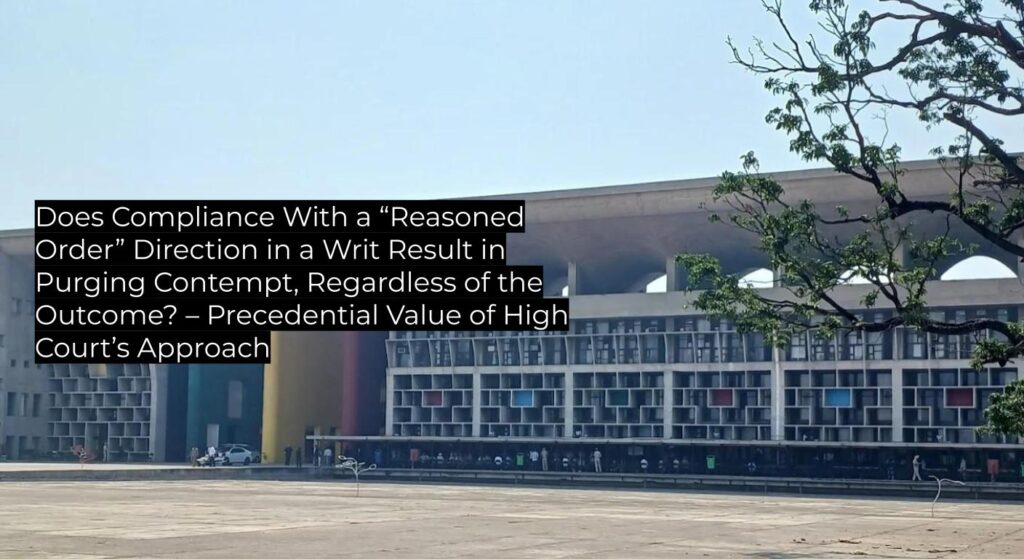
The Court clarified that once the authority passes a “speaking order” as directed in a writ, contempt proceedings stand closed regardless of the petitioner’s satisfaction with the order’s substance. This judgment affirms settled precedent and serves as binding authority for contempt matters in relation to compliance with writ directions for “reasoned orders.”
Summary
| Category | Data |
|---|---|
| Case Name | COCP/3899/2025 of BALJIT SINGH Vs ANISH YADAV |
| CNR | PHHC011229602025 |
| Date of Registration | 04-08-2025 |
| Decision Date | 31-10-2025 |
| Disposal Nature | DISPOSED OF |
| Judgment Author | MRS. JUSTICE SUDEEPTI SHARMA |
| Court | High Court of Punjab and Haryana |
| Bench | Single Bench |
| Precedent Value | Binding on subordinate courts within jurisdiction; persuasive for similar matters elsewhere |
| Type of Law | Contempt of court, administrative law – compliance with writ directions |
| Questions of Law | Whether passing a “reasoned order” as directed in a writ petition is sufficient compliance for purging contempt, even if the petitioner is dissatisfied with the order’s content? |
| Ratio Decidendi |
|
| Facts as Summarised by the Court |
|
Practical Impact
| Category | Impact |
|---|---|
| Binding On | All subordinate courts within the jurisdiction of the Punjab and Haryana High Court |
| Persuasive For | Contempt benches in other High Courts and tribunals addressing administrative compliance issues |
What’s New / What Lawyers Should Note
- Reinforces that compliance with a High Court direction to pass a “reasoned order” is satisfied upon issuance of such order, even if adverse to the petitioner.
- Contempt proceedings will not examine the correctness or sufficiency of reasoning if the direction to decide is facially complied with.
- Petitioners are free to challenge the substantive contents of the new “speaking order” in a separate forum, not in contempt jurisdiction.
- Lawyers should note that contempt is not a substitute for appellate/revisional scrutiny of administrative decisions following writ directions.
Summary of Legal Reasoning
- The Court reproduces and relies on the operative part of the original writ order, which required the respondent authority to consider a pending representation and pass a “reasoned order.”
- In the contempt proceedings, it was acknowledged that the respondent authority did issue a speaking order on 09.09.2025 in purported compliance.
- The Court holds that the core obligation in contempt was limited to passing a “reasoned order,” regardless of whether the order was favorable or unfavorable to the petitioner.
- It emphasizes that the avenue for challenge, if dissatisfied, lies in a substantive legal remedy against the new order, not in prolonging contempt proceedings.
- Consequently, the contempt is purged and the petition disposed of.
Arguments by the Parties
Petitioner
- Initiated contempt proceedings alleging non-compliance of High Court direction to consider representation and pass a reasoned order.
- Through counsel, later acknowledged that the authority had passed a speaking order in line with court directions.
Respondent
- Advised that the authority had complied with the direction by issuing a speaking order dated 09.09.2025.
Factual Background
The petitioner had sought compliance with a High Court order dated 03.04.2025, through which the administrator (respondent) was directed to consider his pending representation and pass an appropriate reasoned order. The petitioner alleged non-compliance, prompting contempt proceedings. During the hearing, it was brought to the Court’s notice that the respondent authority had passed a speaking order dated 09.09.2025. The Court, noting compliance, disposed of the petition, indicating other remedies remain open to challenge the content of the speaking order.
Statutory Analysis
- The judgment applies general principles of contempt law, specifically addressing compliance with writ directions under Article 226 and the obligation to pass “reasoned orders” in administrative law.
Alert Indicators
- ✔ Precedent Followed – The judgment affirms the established legal position concerning the scope of contempt in writ compliance matters.