


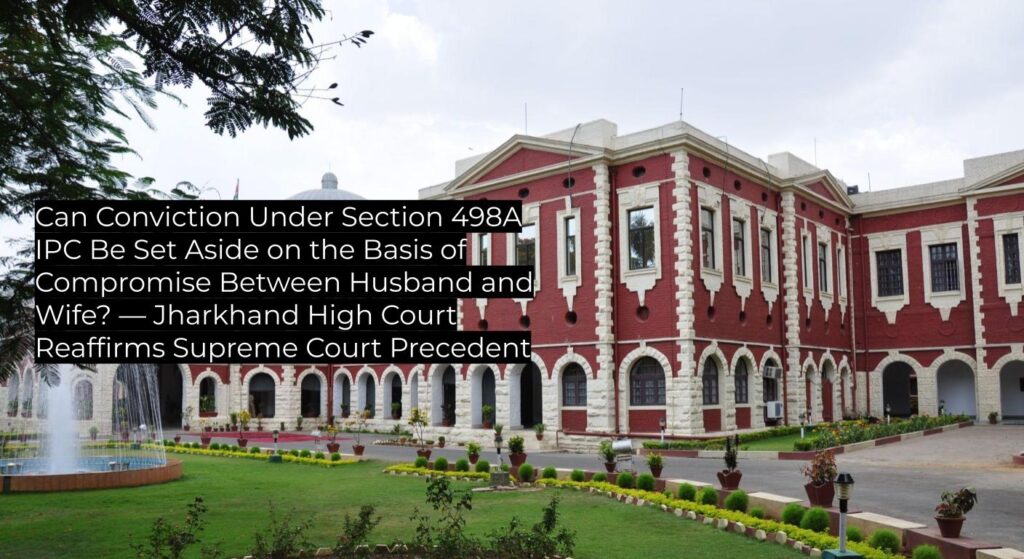
Where spouses have amicably settled matrimonial disputes and resumed cohabitation, courts may set aside convictions under Section 498A IPC based on compromise, following Supreme Court rulings. This judgment reaffirms binding precedent and clarifies the approach for subordinate courts handling similar cases.
Summary
| Category | Data |
|---|---|
| Case Name |
Cr.Rev./184/2025 of GANGA THAKUR Vs THE STATE OF JHARKHAND CNR JHHC010393192024 |
| Date of Registration | 18-02-2025 |
| Decision Date | 30-10-2025 |
| Disposal Nature | Allowed |
| Judgment Author | HON’BLE MR. JUSTICE SANJAY KUMAR DWIVEDI |
| Court | High Court of Jharkhand |
| Precedent Value | Binding authority for subordinate courts in Jharkhand; persuasive elsewhere |
| Overrules / Affirms | Affirms Supreme Court precedent (Narinder Singh; Gian Singh) |
| Type of Law | Criminal Law – Section 498A IPC; Compounding/Compromise in Matrimonial Disputes |
| Questions of Law | Whether conviction under Section 498A IPC can be set aside based on compromise and settlement between husband and wife. |
| Ratio Decidendi |
Where matrimonial disputes under Section 498A IPC are amicably settled and spouses resume cohabitation, courts may encourage compromise and set aside conviction. The court relied on the Supreme Court’s judgments in Narinder Singh (2014) 6 SCC 466 and Gian Singh (2012) 10 SCC 303. The compromise petition filed jointly and supported by affidavits of both parties confirmed reconciliation and settlement of issues. In such factual circumstances, the continuance of conviction serves no useful purpose, and exoneration from liability is warranted. |
| Judgments Relied Upon |
|
| Logic / Jurisprudence / Authorities Relied Upon by the Court | Supreme Court jurisprudence that supports quashing criminal proceedings or setting aside convictions in cases involving matrimonial disputes upon settlement between parties. |
| Facts as Summarised by the Court | The petitioner (husband) was convicted under Section 498A IPC based on a complaint by his wife (opposite party no.2), with conviction affirmed on appeal. Post-conviction, both parties filed a joint compromise petition affirming settlement and resumption of cohabitation. All counsels acknowledged the compromise in court. |
Practical Impact
| Category | Impact |
|---|---|
| Binding On | All subordinate courts in Jharkhand |
| Persuasive For | Other High Courts, Supreme Court |
| Follows |
|
What’s New / What Lawyers Should Note
- Reiterates that conviction under Section 498A IPC may be set aside if parties have genuinely settled matrimonial disputes and resumed cohabitation.
- Courts are encouraged to facilitate compromise in matrimonial cases involving Section 498A IPC, post settlement and based on binding precedents.
- Confirms that both conviction and sentence can be set aside upon joint application and mutual satisfaction by the court of the genuineness of the settlement.
- Provides a procedural example—necessity of a jointly sworn, affidavit-supported compromise petition.
Summary of Legal Reasoning
The High Court noted the admitted fact of settlement and cohabitation between the parties, evidenced by a joint compromise petition supported by affidavit. Relying on Supreme Court precedents, particularly Narinder Singh and Gian Singh, the judgment outlined that criminal proceedings in matrimonial disputes may be quashed or convictions set aside when parties have reached a genuine settlement and continue to live together. The court emphasized judicial encouragement of compromise in such matters, observing that perpetuating criminal conviction post-settlement serves no purpose. Thus, the conviction and sentence were set aside, and the petitioner was exonerated from liability.
Arguments by the Parties
Petitioner
- Petitioner and opposite party no.2 (wife) are married and the present case arose out of a matrimonial dispute.
- Both parties have resided together and settled their issues.
- Joint compromise petition (I.A. No.10837 of 2025), supported by individual affidavits, has been filed.
- Sought setting aside of conviction and sentence in light of the settlement.
State
- Confirmed that the matter arises out of a matrimonial dispute.
- Acknowledged that a compromise has been reached and a joint petition is on record.
Opposite Party No.2 (Wife)
- Admitted compromise has been reached and parties are residing together.
- Supported petition for setting aside previous orders based on settlement.
Factual Background
A matrimonial dispute arose between the petitioner husband and his wife, leading to registration of an FIR by the wife (Latehar Mahila P.S. Case No. 15/2015) and subsequent conviction of the petitioner under Section 498A IPC by the trial court, with judgment upheld in appeal. Subsequently, the parties resolved their differences, resumed cohabitation, and jointly moved the High Court under Sections 438 and 442 of the Bharatiya Nagarik Suraksha Sanhita, 2023, supported by affidavits, seeking to set aside the conviction and sentence on the basis of compromise.
Statutory Analysis
The judgment involves application of Section 498A IPC, pertaining to cruelty by husband or relatives of the husband. The court exercised powers in light of Sections 438 and 442 of the Bharatiya Nagarik Suraksha Sanhita, 2023, enabling revision and quashing procedures. The statutory framework is interpreted in line with Supreme Court pronouncements that allow compromise in matrimonial disputes to form the basis for quashing or setting aside conviction under Section 498A IPC, provided settlement is genuine and parties have resumed cordial relations.
Dissenting / Concurring Opinion Summary
No dissenting or concurring opinion is reported in the judgment.
Procedural Innovations
No new procedural innovations are indicated in the judgment.
Alert Indicators
- ✔ Precedent Followed – When existing law is affirmed.