


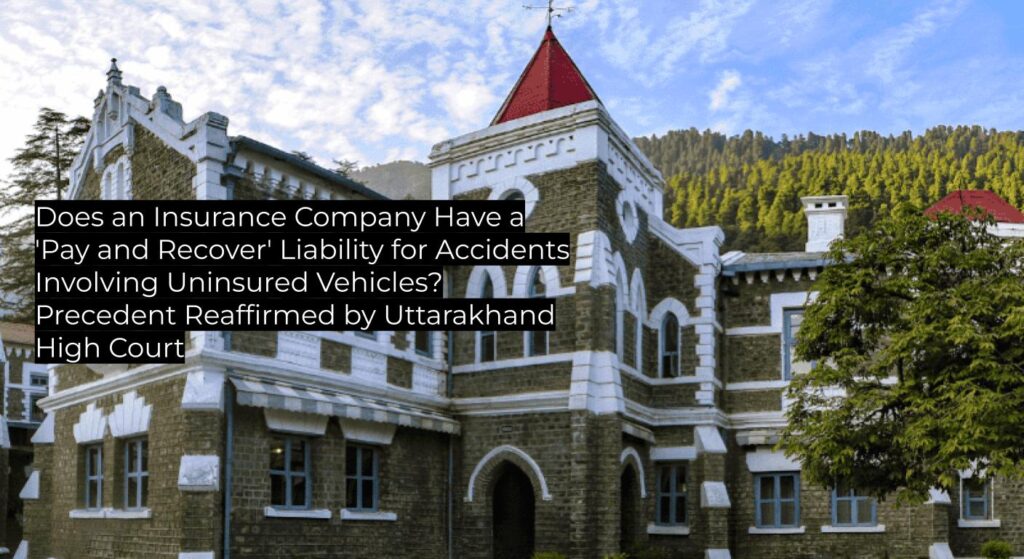
The High Court of Uttarakhand has reaffirmed that, in line with Supreme Court authority, Insurance Companies may be compelled to compensate third-party victims under the “pay and recover” principle even when the vehicle was not effectively insured on the date of the accident, with subsequent rights to recover from the vehicle’s owner. This judgment upholds, rather than overrules, existing binding Supreme Court precedent in motor accident compensation claims.
| Category | Data |
|---|---|
| Case Name | AO/110/2022 of THE UNITED INDIA INSURANCE COMPANY LTD. Vs LEKHPAL |
| CNR | UKHC010044962022 |
| Date of Registration | 11-04-2022 |
| Decision Date | 30-10-2025 |
| Disposal Nature | DISMISSED |
| Judgment Author | HON’BLE MR. JUSTICE ALOK MAHRA |
| Court | High Court of Uttarakhand, Nainital |
| Precedent Value |
|
| Overrules / Affirms | Affirms Supreme Court precedent (Inderjit Kaur, Rula) |
| Type of Law |
|
| Questions of Law | Whether the Insurance Company is liable to compensate victims (“pay and recover”) when there is no effective insurance on the accident date. |
| Ratio Decidendi |
The Court reaffirmed that Chapter XI of the Motor Vehicles Act, 1988, aims to protect third-party victims from suffering due to disputes or lapses between insurer and insured. Relying on Supreme Court judgments, the Court held that even if the vehicle was not effectively insured at the time of the accident, the Insurance Company must satisfy the award first and then recover the amount from the vehicle owner. The “pay and recover” doctrine is intended to provide prompt and effective relief to victims. There was no illegality or perversity in the Claims Tribunal applying this principle. |
| Judgments Relied Upon |
|
| Logic / Jurisprudence / Authorities Relied Upon by the Court | Supreme Court’s interpretation of Section 146(1), 147(5), and 149(1) of the Motor Vehicles Act; importance of third-party victim protection. |
| Facts as Summarised by the Court | On 21.11.2018, Jagram, while returning home, died when the car he was in collided with a truck being driven rashly. The truck did not have valid insurance at the time. The deceased’s family claimed compensation. The Tribunal awarded compensation and applied “pay and recover” against the Insurance Company, which contested its liability on grounds of non-insurance. |
Practical Impact
| Category | Impact |
|---|---|
| Binding On | All Motor Accident Claims Tribunals and subordinate courts in Uttarakhand |
| Persuasive For | Other High Courts and the Supreme Court |
| Follows | Oriental Insurance Co. Ltd. v. Inderjit Kaur (1998); New India Assurance Co. Ltd. v. Rula (2000) |
What’s New / What Lawyers Should Note
- Restates and applies the “pay and recover” doctrine even when the vehicle is not effectively insured, safeguarding third-party victims’ compensation rights.
- Courts will prioritize the interest of accident victims over insurer-insured disputes as per binding Supreme Court precedent.
- Insurance Companies directed to pay victims up front and pursue recovery from the owner, reinforcing speed and certainty of compensation.
- Can be cited to counter insurance company objections regarding lack of policy at time of accident in compensation matters.
Summary of Legal Reasoning
- The Court closely examined the text and object of Chapter XI of the Motor Vehicles Act, 1988, emphasizing its protective purpose for third-party victims.
- Reiterated Supreme Court decisions—Inderjit Kaur (1998) and Rula (2000)—that Insurance Companies, as authorized insurers, must indemnify third parties even if the policy had lapses (for example, premium cheque dishonoured), based on Sections 147(5) and 149(1) MVA.
- Rejected Insurance Company’s objection of non-liability due to non-insurance, explaining that third-party rights are prioritized, and insurer must pay compensation up front before exercising right to recover from the vehicle owner.
- Held that the Tribunal correctly applied the “pay and recover” principle and that no error, illegality, or perversity was found in the award.
Arguments by the Parties
Appellant (Insurance Company):
- The Tribunal was wrong to order “pay and recover” against the Insurance Company as the vehicle had no insurance cover on the accident date.
- Liability to pay compensation should lie solely on the owner, not the Insurance Company.
Respondents:
None present.
Factual Background
On 21.11.2018, Jagram died after the car he was travelling in collided with a rashly driven, uninsured truck. The fatal accident led to the registration of FIR No. 437/2018 at Police Station Bahadarabad. The deceased’s family sought compensation, citing loss of support, and the Tribunal awarded ₹2,22,250 with interest. The Insurance Company challenged the award, objecting to its liability on grounds of lack of valid insurance.
Statutory Analysis
- The Court interpreted Sections 146(1), 147(5), and 149(1) of the Motor Vehicles Act, 1988, emphasizing Section 146’s prohibition against using uninsured vehicles and the legislative intent of Chapter XI to protect third-party interests.
- The precedent established that, in light of these provisions, insurers can be made liable to satisfy awards for third parties even where insurance coverage was absent or defective at the accident date.
- Section 64-VB of the Insurance Act was referenced in connection with insurer liability where no premium had been realized, but held not to absolve the insurer of third-party liability.
Alert Indicators
- ✔ Precedent Followed – The decision affirms existing Supreme Court precedent on the “pay and recover” rule in motor accident compensation cases.