


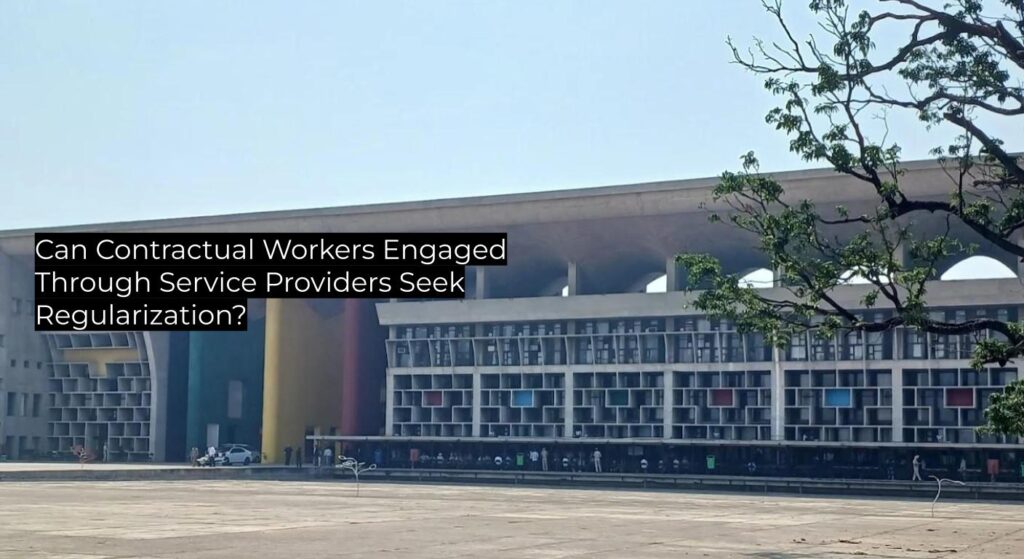
The High Court has addressed whether individuals employed through service providers (outsourcing agencies) possess the legal right to claim regularization against the principal employer. The ruling upholds established precedent that absence of direct employment precludes entitlement to regularization, reinforcing limitations on regularization claims by contractual workers. This decision is binding on lower courts within the court’s jurisdiction and serves as persuasive precedent elsewhere.
Summary
| Category | Data |
|---|---|
| Case Name | LPA/2697/2025 of JASWINDER SINGH Vs PUNJAB MANDI BOARD AND OTHERS |
| CNR | PHHC010918732025 |
| Date of Registration | 04-09-2025 |
| Decision Date | 30-10-2025 |
| Disposal Nature | DISMISSED |
| Judgment Author | ANUPINDER SINGH GREWAL, J.; MEENAKSHI I. MEHTA, J. |
| Court | High Court of Punjab and Haryana |
| Bench | Division Bench: Anupinder Singh Grewal, J. and Meenakshi I. Mehta, J. |
| Precedent Value | Binding within Punjab & Haryana; persuasive for other High Courts |
| Overrules / Affirms | Affirms Single Bench decision |
| Type of Law | Service Law; Employment Law |
| Questions of Law | Whether a person engaged through a service provider (outsourcing) can seek regularization as a direct employee of the principal employer. |
| Ratio Decidendi |
|
| Facts as Summarised by the Court |
The appellant was engaged for over 15 years through a service provider with the respondent Punjab Mandi Board. He sought regularization of his services, but the single judge dismissed his writ petition, holding there was no direct employment relationship. On appeal, the division bench found no merit and dismissed the LPA. |
Practical Impact
| Category | Impact |
|---|---|
| Binding On | All subordinate courts within Punjab & Haryana High Court’s jurisdiction |
| Persuasive For | Other High Courts, legal practitioners in service law matters |
| Follows | Upholds principles in previous decisions refusing regularization to outsourced/contractual appointees |
What’s New / What Lawyers Should Note
- Reaffirms that employees hired through service providers cannot claim direct regularization from the principal employer.
- Clarifies that mere long tenure or continued service through a contractor/service provider does not create a master-servant relationship.
- Provides a binding precedent against writ petitions seeking regularization by contractual or outsourced appointees in similar scenarios.
- Lawyers representing principal employers can rely on this judgment to counter regularization claims by outsourced personnel.
Summary of Legal Reasoning
- The appellant worked with the respondent Board for over 15 years but was appointed via a service provider (outsourcing agency).
- The primary legal question was whether such indirect engagement gave the appellant grounds for claiming regularization as a direct employee.
- The division bench observed that, per the facts, there was no relationship of master and servant between the appellant and official respondents, as the former was engaged only through a third-party service provider.
- The bench explicitly agreed with the reasoning and decision of the single judge in the earlier writ petition.
- The absence of direct employment disqualified the appellant from seeking regularization.
- The LPA (Letters Patent Appeal) was dismissed for want of merit.
Arguments by the Parties
Petitioner
- Asserted entitlement to regularization of services, citing over 15 years of service with the respondent Board.
Respondent
- Submitted that the appellant was appointed through a service provider and there was thus no direct employment relationship, making him ineligible for regularization.
Factual Background
The appellant worked with the Punjab Mandi Board for more than 15 years, but his engagement was through a service provider and not as a direct employee. He filed a writ petition seeking regularization of his services, which was dismissed by the single bench on the ground that no employer-employee relationship existed. Aggrieved, he filed an appeal before the division bench, which confirmed the prior decision and dismissed the appeal.
Statutory Analysis
- The judgment centered around the legal requirements for regularization under service and employment law.
- The court analyzed and applied the principle that only a direct master-servant relationship can give rise to a regularization claim.
- The court did not undertake any expansive or narrow interpretation but applied the prevailing statutory and case law framework.
Dissenting / Concurring Opinion Summary
No separate dissenting or concurring opinions were recorded in the judgment. The division bench was unanimous.
Procedural Innovations
- The court addressed and allowed an application for condonation of delay in re-filing the appeal.
- No new procedural guidelines or changes to the process were established.
Alert Indicators
- ✔ Precedent Followed – The judgment upholds existing law and affirms prior single bench and established judicial reasoning against regularization of outsourced workers.