


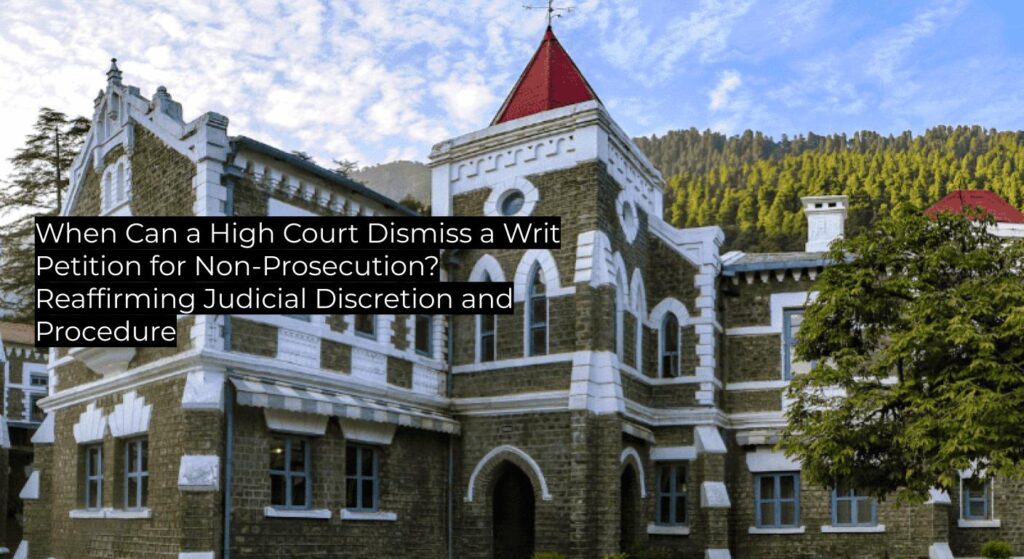
The judgment reiterates that the High Court retains discretion to dismiss writ petitions for non-prosecution where petitioners fail to appear, and vacates any interim order automatically on such dismissal—thereby upholding established procedural practice. This ruling maintains existing precedent, is binding authority within the High Court’s jurisdiction, and carries direct procedural significance for litigants and lawyers.
Summary
| Category | Data |
|---|---|
| Case Name |
WPMS/3168/2019 of DEEPAK KALRA Vs KUNAL KALRA CNR UKHC010165862019 |
| Date of Registration | 14-10-2019 |
| Decision Date | 30-10-2025 |
| Disposal Nature | DISMISSED IN DEFAULT |
| Judgment Author | HON’BLE MR. JUSTICE PANKAJ PUROHIT |
| Court | High Court of Uttarakhand |
| Precedent Value | Binding within High Court jurisdiction |
| Questions of Law |
|
| Ratio Decidendi |
The Court held that when a petitioner does not appear despite the matter being listed and revised, the writ petition can be dismissed for non-prosecution. Any interim order granted earlier stands vacated upon such dismissal. This process upholds judicial discretion and established procedure in the handling of writ petitions. |
Practical Impact
| Category | Impact |
|---|---|
| Binding On | All subordinate courts and original jurisdiction benches of the High Court of Uttarakhand |
| Persuasive For | Other High Courts in India |
What’s New / What Lawyers Should Note
- The Court reaffirmed that writ petitions may be dismissed for non-prosecution when petitioners are absent, following existing procedural norms.
- Any interim order stands vacated automatically upon such dismissal, eliminating the need for a separate order.
- Lawyers should ensure presence or proper representation when their petition is listed to avoid dismissal and vacation of interim relief.
Summary of Legal Reasoning
- The matter was listed and revised, and despite opportunity, none appeared for the petitioners.
- The Court exercised its discretion to dismiss the writ petitions for non-prosecution as per established procedure.
- The judgment explicitly records the vacation of any interim orders previously granted, which is standard practice when a case is dismissed in default.
Arguments by the Parties
Petitioner
No appearance on the date by or for the petitioner; no arguments recorded.
Respondent
Represented by Mr. Sandeep Kothari, learned counsel; specific arguments not detailed in the order.
Factual Background
Both writ petitions were listed before the High Court of Uttarakhand. On the date of hearing, the list was revised but no one appeared on behalf of the petitioners. The respondents were represented by counsel. The Court proceeded to dismiss the writ petitions for non-prosecution and vacated any interim orders.
Statutory Analysis
The judgment does not specify citation of statutory provisions but applies procedural norms established for writ proceedings and dismissal for non-prosecution as per High Court practice.
Dissenting / Concurring Opinion Summary
No dissenting or concurring opinions recorded in the order.
Procedural Innovations
No new procedural innovations or guidelines set forth in the judgment.
Alert Indicators
- ✔ Precedent Followed – The order follows established precedent and procedural norms for dismissal for non-prosecution and vacation of interim orders.