


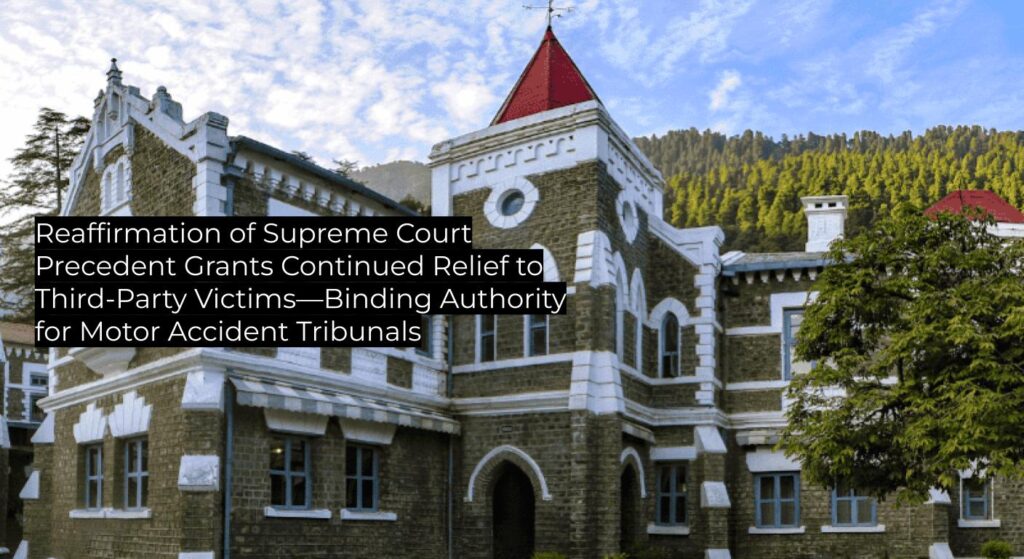
The High Court of Uttarakhand upholds the settled “pay and recover” principle, directing insurers to compensate third-party accident victims even when the offending vehicle lacked a valid insurance policy at the time of the accident, with right to recover from the vehicle owner—reaffirming Supreme Court authority and confirming continuing protection for third-party claimants before motor accident tribunals.
Summary
| Category | Data |
|---|---|
| Case Name | AO/111/2022 of THE UNITED INDIA INSURANCE COMPANY LTD. Vs SMT. SURESH |
| CNR | UKHC010044922022 |
| Date of Registration | 11-04-2022 |
| Decision Date | 30-10-2025 |
| Disposal Nature | DISMISSED |
| Judgment Author | HON’BLE MR. JUSTICE ALOK MAHRA |
| Court | High Court of Uttarakhand |
| Precedent Value | Binding on subordinate courts in Uttarakhand |
| Overrules / Affirms | Affirms Supreme Court judgments (Inderjit Kaur, Rula) |
| Type of Law | Motor Accident, Insurance, Tort |
| Questions of Law | Whether an insurer can be directed to pay compensation for an accident involving an uninsured vehicle, with a right to recover from the owner. |
| Ratio Decidendi |
The High Court held that, following Supreme Court judgments in Inderjit Kaur and Rula, motor accident tribunals are justified in directing insurance companies to pay compensation to third-party victims even if there was no valid insurance policy on the date of the accident. The right of the insurer to later recover the amount from the vehicle owner is preserved. This doctrine is designed to ensure that third-party victims promptly receive compensation, undisturbed by technical issues between the insurer and the vehicle owner. The law’s manifest object is to protect third-party interests under Chapter XI of the Motor Vehicles Act. |
| Judgments Relied Upon | Oriental Insurance Co. Ltd. v. Inderjit Kaur, (1998) 1 SCC 371; New India Assurance Co. Ltd. v. Rula, (2000) 3 SCC 195 |
| Logic / Jurisprudence / Authorities Relied Upon by the Court |
The court quoted Supreme Court observations on Sections 146(1), 147(5), and 149(1) of the Motor Vehicles Act and their effect in protecting third-party claimants irrespective of inter se disputes between owner and insurer. The court noted the insurer becomes liable to satisfy awards against third parties, with a right to recover from the owner if the policy is found to be void or inoperative. |
| Facts as Summarised by the Court |
On 21.11.2018, Dharampal died in a car accident involving a truck (HR-67B-1019) allegedly driven rashly. FIR No. 437/2018 was registered. The deceased supported his family as a labourer. The Tribunal awarded ₹7,82,530 compensation with 7% interest. The insurance company appealed, contending the offending vehicle was uninsured on the accident date and liability should fall only on the vehicle owner, not the insurer. |
Practical Impact
| Category | Impact |
|---|---|
| Binding On | All subordinate courts and Motor Accident Claims Tribunals in Uttarakhand |
| Persuasive For | Other High Courts; relevant and persuasive before Supreme Court and tribunals across India |
| Follows | Oriental Insurance Co. Ltd. v. Inderjit Kaur, (1998) 1 SCC 371; New India Assurance Co. Ltd. v. Rula, (2000) 3 SCC 195 |
What’s New / What Lawyers Should Note
- Reiterates that insurance companies can be directed to pay the compensation to third-party victims, even if the offending vehicle was not effectively insured on the date of the accident, with right to recover the amount from the vehicle owner.
- Confirms that “pay and recover” remains a binding doctrine for all motor accident claim cases in Uttarakhand, ensuring uninterrupted and prompt relief for third-party claimants.
- Lawyers for claimants should be prepared to invoke Inderjit Kaur and Rula to resist insurer defences based on policy absence or lapses.
- Insurance companies retain a statutory right to recover such amounts from the vehicle owner after paying compensation to the claimant.
Summary of Legal Reasoning
- The High Court considered the insurance company’s argument that, since the offending vehicle was uninsured on the accident date, liability should have been imposed solely upon the owner.
- The legal aid counsel for the claimants argued the Tribunal correctly relied on Supreme Court precedents—Oriental Insurance Co. Ltd. v. Inderjit Kaur and New India Assurance Co. Ltd. v. Rula—which laid down that compensation must not be denied to third parties due to insurance disputes.
- The Court reviewed the objects behind Chapter XI of the Motor Vehicles Act, especially Section 146(1), which mandates insurance for all vehicles.
- It cited the Supreme Court’s observations that the insurance contract is for the benefit of third parties under law, irrespective of payment of premium or technical policy lapses.
- The key principle is that insurers are required to pay awards to third-party victims and then recover any amounts from the vehicle owner if the policy is inoperative, to ensure third-party compensation is not delayed.
- The Tribunal’s application of “pay and recover” was held correct, and the appeal was dismissed.
Arguments by the Parties
Petitioner (Insurance Company):
- The Tribunal erroneously directed the insurer to pay when the vehicle was not insured at the time of the accident.
- Only the owner should have been held liable to pay compensation.
Respondent (Claimants):
- The Tribunal relied on Supreme Court judgments (Inderjit Kaur, Rula) holding that third parties must not suffer due to insurer-insured disputes.
- The Tribunal was justified in passing the “pay and recover” order to protect the victims under the law.
Factual Background
On 21 November 2018, Dharampal was returning home with relatives after a feast when their car was struck by a truck (HR-67B-1019), allegedly driven rashly. Dharampal died from his injuries. An FIR was filed at Police Station Bahadarabad. The deceased, a labourer earning Rs. 10,000 per month, supported his family. The claimants sought compensation; the Tribunal awarded ₹7,82,530 with 7% interest. The insurance company appealed, disputing liability due to lack of insurance on the accident date.
Statutory Analysis
- Sections 146(1), 147(5), and 149(1) of the Motor Vehicles Act, 1988 were analyzed.
- Section 146(1) prohibits use of motor vehicles without an insurance policy in accordance with Chapter XI. The purpose is to protect third parties from being denied damages due to financial incapacity of drivers or owners.
- Section 149(1) places a statutory liability on insurers to satisfy awards relating to third-party risk.
- The court affirmed the Supreme Court interpretation that these provisions mandate insurer liability regardless of policy lapses, with right to recover from owner.
Alert Indicators
- ✔ Precedent Followed – Existing Supreme Court precedent reaffirmed regarding “pay and recover” doctrine for third-party victims in motor vehicle accidents.