


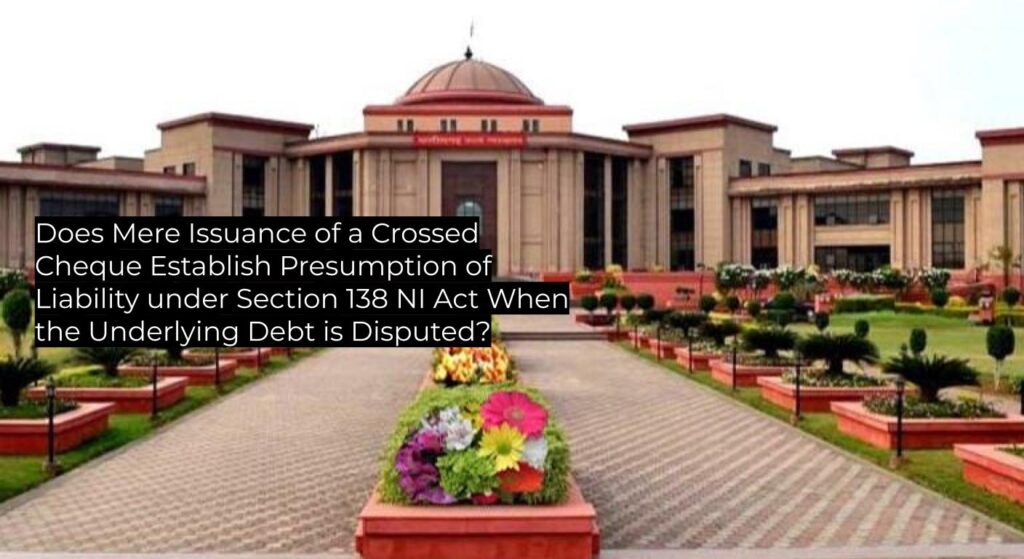
A crossed cheque alone does not raise conclusive presumption of a legally enforceable debt under Section 138 of the Negotiable Instruments Act, especially where evidence regarding the consideration and underlying transaction is ambiguous or absent. The High Court reaffirmed the established legal position, clarifying requirements for criminal liability in cheque dishonour cases, and its ruling is binding on subordinate courts in Chhattisgarh.
Summary
| Category | Data |
|---|---|
| Case Name | ACQA/759/2024 of SUDHARAM CHOUHAN Vs SAJAN SINGH @ SAHAJAN SINGH |
| CNR | CGHC010278832024 |
| Date of Registration | 13-08-2024 |
| Decision Date | 30-10-2025 |
| Disposal Nature | DISMISSED |
| Judgment Author | HON’BLE SHRI JUSTICE SANJAY KUMAR JAISWAL |
| Court | High Court Of Chhattisgarh |
| Precedent Value | Binding on all subordinate courts in Chhattisgarh |
| Questions of Law | Whether mere issuance and dishonour of a crossed cheque is enough to raise presumption of liability under Section 138 of NI Act when substantive evidence regarding underlying debt or liability is lacking or disputed. |
| Ratio Decidendi |
The court held that the mere issuance and dishonour of a cheque—especially a crossed cheque—does not automatically result in conviction under Section 138 NI Act unless there is clear, independent evidence establishing legally enforceable debt or liability. Ambiguity or lack of clarity in evidence regarding the alleged liability means the statutory presumption cannot stand. The court reaffirmed that the complainant must prove the debt’s existence and legality. The scope of Section 138 does not extend to situations where material contradictions, inconsistencies, or evidentiary gaps exist about the debt or its consideration. Only where legally enforceable debt is proven does the presumption operate in favour of the complainant. |
| Judgments Relied Upon | Details not specified in the judgment. |
| Logic / Jurisprudence / Authorities Relied Upon by the Court | The court emphasised the need for clear evidence of underlying liability or debt, evaluating inconsistencies in witness statements and documentary evidence. The legal burden remains on the complainant to establish consideration and enforceability. |
| Facts as Summarised by the Court |
The complainant alleged that a sum of ₹3,00,000 was advanced as a loan to the accused, who in turn issued a crossed cheque as repayment, which was dishonoured. Several evidentiary contradictions arose: lack of clarity in the evidence regarding the nature, mode, and details of the loan transaction; inconsistencies regarding who issued instructions for the crossed cheque; absence of supporting documentation regarding the alleged loan or its purpose; and ambiguity about whether delivery or encashment was intended. The courts below, on detailed scrutiny, found the complainant’s version unreliable and dismissed claims of criminal liability under Section 138. |
Practical Impact
| Category | Impact |
|---|---|
| Binding On | All subordinate courts in Chhattisgarh |
What’s New / What Lawyers Should Note
- Reinforces that mere issuance and dishonour of a crossed cheque do not conclusively establish guilt under Section 138 NI Act if there are evidentiary doubts about the underlying debt.
- Sets out that ambiguous, inconsistent, or unsubstantiated evidence regarding loan transactions or consideration will defeat the statutory presumption.
- Requires the complainant to clearly establish the existence, legality, and enforceability of the debt—section 138 cannot be invoked solely on the cheque’s presentation and dishonour.
- Evidence (oral or documentary) must support the version of a legally enforceable debt; mere possession of a cheque is insufficient.
- Demonstrates the critical importance of careful documentation and congruent witness testimony for successful prosecution under Section 138.
Summary of Legal Reasoning
- The court closely examined evidence regarding the transaction’s nature, the alleged loan, and the circumstances of cheque issuance.
- Noted inconsistencies in the complainant’s evidence about the party advancing the loan, its consideration, and the method of disbursement.
- Highlighted that the crossed nature of the cheque raised further doubts about clear delivery and intended encashment.
- Emphasised that Section 138 NI Act requires the prosecution to establish existence and enforceability of debt—presumption under Section 139 is rebuttable and cannot prevail where the material evidence is equivocal or absent.
- Affirmed that, in the face of contradictions and lack of corroborative evidence, criminal liability under Section 138 cannot attach.
- The High Court concurred with the findings of the trial and appellate courts, upholding their factual and legal analysis.
Arguments by the Parties
Petitioner
- Asserted that ₹3,00,000 was lent to the respondent as a loan, and the cheque was issued in repayment.
- Argued that dishonour of the cheque attracted liability under Section 138 NI Act.
- Contended that their oral and documentary evidence established the transaction.
Respondent
- Denied liability and disputed the existence and nature of any enforceable debt.
- Pointed out inconsistencies, lack of corroboration, and absence of documentary proof regarding the alleged loan.
- Questioned the manner and circumstances of cheque issuance and challenged the complainant’s credibility and evidence.
Factual Background
The dispute arose from an alleged transaction where the complainant claimed to have advanced ₹3,00,000 as a loan to the accused, who issued a crossed cheque as repayment. When presented, the cheque was dishonoured. The complainant initiated criminal proceedings under Section 138 of the Negotiable Instruments Act. During the trial, multiple inconsistencies surfaced in evidence regarding the existence, mode, and terms of the loan, leading the lower courts to dismiss the complaint for want of legally enforceable liability.
Statutory Analysis
- The court interpreted Sections 138 and 139 of the Negotiable Instruments Act, 1881.
- It clarified that while Section 139 creates a presumption of liability upon dishonour of a cheque, the presumption is not absolute.
- If evidence regarding consideration or underlying debt is shaky, ambiguous, or contradicted, the presumption does not stand.
- A crossed cheque’s status was analysed—a crossed cheque does not have the same implications as a bearer cheque and can further complicate the presumption if there is no proof of delivery or intention for encashment.
Dissenting / Concurring Opinion Summary
No dissenting or concurring opinion is recorded in the judgment.
Procedural Innovations
No new procedural rules, guidelines, or innovations were introduced in the judgment.
Alert Indicators
- ✔ Precedent Followed – The judgement reaffirms the existing requirement that a legally enforceable debt must be proven and the presumption under Section 139 NI Act is rebuttable through the facts and evidence of the case.