


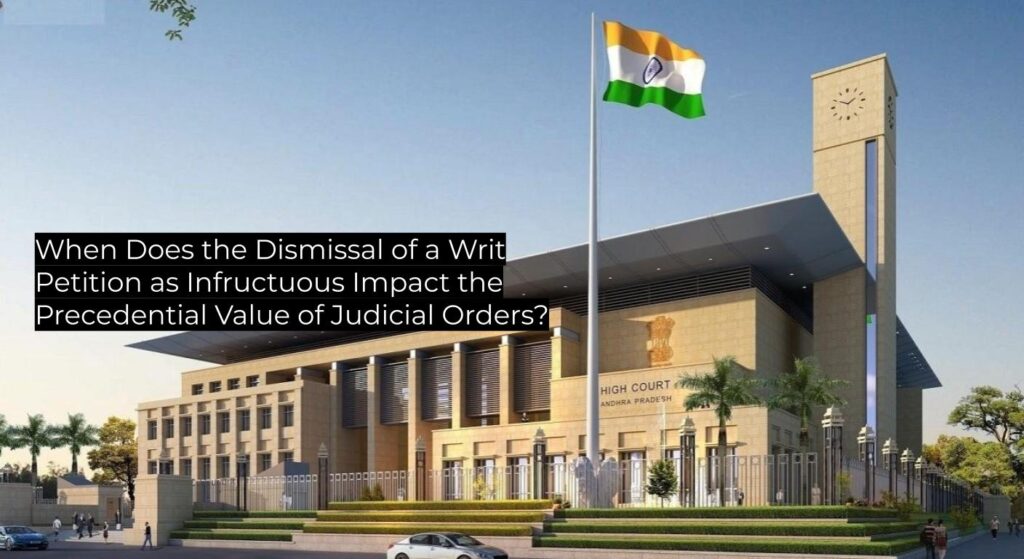
A High Court judgment clarifies that dismissal of a writ petition as infructuous does not result in a substantive ruling on the questions of law raised, limiting its precedential value in the context of administrative decisions regarding appointments.
Summary
| Category | Data |
|---|---|
| Case Name |
WP/31924/2017 of KOYYALAMUDI PAUL, GUNTUR. Vs THE STATE OF A.P.,ENERGY,AMARAVATHI,& 3 OTRS. CNR APHC010074012017 |
| Date of Registration | 18-09-2017 |
| Decision Date | 30-10-2025 |
| Disposal Nature | DISMISSED AS INFRUCTUOUS |
| Judgment Author | MAHESWARA RAO KUNCHEAM |
| Court | High Court of Andhra Pradesh |
| Precedent Value | No precedential or binding value since issues not adjudicated on merits |
| Questions of Law | Legality and validity of administrative appointments and adherence to procedural norms |
| Facts as Summarised by the Court | Petition dismissed as infructuous due to subsequent events rendering adjudication unnecessary |
Practical Impact
| Category | Impact |
|---|---|
| Binding On | None—No binding legal precedent created |
| Persuasive For | None—Not available for use as persuasive authority |
What’s New / What Lawyers Should Note
- The High Court explicitly recorded the matter as infructuous, following submissions based on subsequent events, and therefore made no pronouncements on the legal or factual issues.
- No legal principle was created or clarified due to non-adjudication on merits.
- Lawyers should not rely on this order as precedent for questions regarding administrative appointments or writ maintainability.
- Such dismissals do not affect or alter existing legal standards or precedents.
Summary of Legal Reasoning
- The Court noted the representation by learned counsel that, in view of subsequent events, the lis (dispute) does not survive.
- Consequently, the writ petition was dismissed as infructuous, and no orders were issued regarding the merits or the substantive legal issues raised.
- No analysis, discussion, or interpretation of legal provisions or arguments took place due to non-adjudication.
Arguments by the Parties
Petitioner:
- Through counsel, submitted that due to subsequent events, the petition had become infructuous and did not require further adjudication.
Respondents:
- No submissions of substance recorded, as the matter was concluded without contest on merits.
Factual Background
The petitioner challenged the legality of G.O.Rt. No. 147 (Energy, Infrastructure & Investment Department, dated 14.09.2017) relating to the appointment of the Chairman & Managing Director of the Andhra Pradesh Eastern Power Distribution Company Ltd., alleging violation of norms in the selection process. However, before adjudication, it was submitted that subsequent events had rendered the petition infructuous.
Statutory Analysis
- There was no discussion or interpretation of statutory provisions, as the petition was decided solely on the ground of infructuousness.
- The relief was sought under Article 226 of the Constitution of India, but no substantive opinion was rendered on this basis.
Procedural Innovations
- The order reflects standard judicial practice of dismissing petitions as infructuous upon representation by counsel, without any procedural innovation.
Alert Indicators
- ✔ Precedent Followed – The court followed the general principle that infructuous petitions should be dismissed without going into merits.