


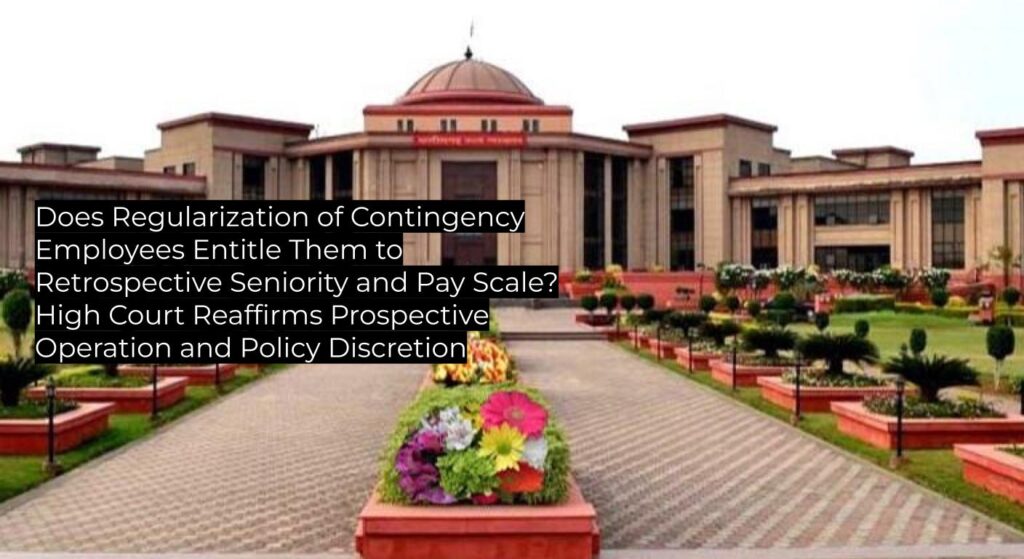
The Chhattisgarh High Court held that regularization of ad-hoc/contingency employees is to operate prospectively, not retrospectively, and refusal to grant seniority or pay scale from the initial date of appointment does not violate constitutional rights when supported by policy or administrative rationales. This judgment upholds long-standing Supreme Court precedent and reinforces limited judicial interference in regularization policy, serving as binding authority for subordinate courts in Chhattisgarh.
Summary
| Category | Data |
|---|---|
| Case Name | WA/696/2025 of GHURAU CHOUHAN Vs STATE OF CHHATTISGARH |
| CNR | CGHC010387672025 |
| Date of Registration | 17-09-2025 |
| Decision Date | 30-10-2025 |
| Disposal Nature | DISMISSED |
| Judgment Author | Ramesh Sinha, Chief Justice |
| Concurring or Dissenting Judges | Arvind Kumar Verma, Judge (concurring) |
| Court | High Court of Chhattisgarh at Bilaspur |
| Bench | Division Bench (Chief Justice Ramesh Sinha and Justice Arvind Kumar Verma) |
| Precedent Value | Binding authority within Chhattisgarh jurisdiction |
| Overrules / Affirms | Affirms existing Supreme Court precedent; upholds order of single judge |
| Type of Law | Service Law; State employment policy; Regularization; Constitutional Law |
| Questions of Law | Whether regularization of contingency/ad-hoc employees must be given retrospective effect with pay/seniority from initial appointment, or whether it is limited to prospective operation based on government policy. |
| Ratio Decidendi | The High Court reaffirmed that regularization of ad-hoc/daily-wage/contingency staff should be only prospective unless a vested or accrued right is shown, in line with Supreme Court precedent. Judicial interference in the cut-off and beneficent dates of regularization is limited, as these are considered policy decisions. The possibility of upsetting the seniority of regular appointees and administrative considerations justifies the refusal to grant retrospective benefits. The absence of manifest error or illegality in the State’s decision precludes interference. The appellant’s reliance on earlier judgments for similarly situated employees and the argument of violation of constitutional rights were found unsustainable in view of binding Supreme Court law and policy discretion. |
| Judgments Relied Upon | Vikau K. Dhand v. State of Punjab (2004) 13 SCC 707; Punjab State Electricity Board v. Swaran Singh (2005) 13 SCC 246; Union of India v. Sheela Rani (2007) 15 SCC 230 |
| Logic / Jurisprudence / Authorities Relied Upon by the Court | Supreme Court authority on prospective regularization, administrative discretion, policy limits |
| Facts as Summarised by the Court | Appellant was a contingency employee/peon appointed on ad-hoc basis in 1995, regularized in 2009, and sought pay and seniority from initial appointment, tracing entitlement to various government circulars and judgments. The claim was denied by authorities after representation. The single judge relied on Supreme Court precedents to dismiss the plea for retrospective benefits, and this decision was challenged in appeal. |
Practical Impact
| Category | Impact |
|---|---|
| Binding On | All subordinate courts and tribunals within the State of Chhattisgarh |
| Persuasive For | Other High Courts; relevance in analogous service regularization contexts |
| Follows | Vikau K. Dhand v. State of Punjab (2004) 13 SCC 707; Punjab State Electricity Board v. Swaran Singh (2005) 13 SCC 246; Union of India v. Sheela Rani (2007) 15 SCC 230 |
What’s New / What Lawyers Should Note
- Reiterates that prospective regularization is the norm; retrospective seniority/pay only when explicit accrued rights exist.
- Upholds the primacy of administrative policy over individual equitable claims regarding cut-off dates and commencement of regularization benefits.
- Clarifies judicial restraint: refusal of retrospective regularization is not arbitrary when supported by policy and precedent.
- Affirms binding application of Supreme Court authority on this issue, even where fellow employees may have received different benefits erroneously.
Summary of Legal Reasoning
- The Court confirmed that, consistent with Supreme Court judgments (Vikau K. Dhand; Swaran Singh; Sheela Rani), regularization of ad-hoc/daily wage employees should be only from the date specified by the Government, generally not from the initial appointment.
- Retrospective regularization risks disrupting existing seniority structures and is a matter of executive/policy discretion rather than legal entitlement.
- The State’s reliance on the 1992 Circular and post-1988 appointment cut-off was not found arbitrary, especially where the existence of vested rights was not established.
- No perversity, illegality, or jurisdictional error by the Single Judge was identified; High Court appellate interference is limited to manifest errors.
- The appellant’s argument of discriminatory treatment or violation of Articles 14, 16, 21, and 39(d) was deemed unsubstantiated in light of prevailing law and legitimate policy distinctions.
- The benefit given to similarly situated employees in the past does not create a perpetual legal right when contrary to binding precedent.
- The judgment is policy-based, maintaining the balance between equity for employees and administrative exigency.
Arguments by the Parties
Petitioner
- Sought regular pay scale and seniority from the initial date of appointment, based on earlier administrative orders and judicial precedents.
- Argued that similarly situated employees had been granted such benefits even when appointed after 1988.
- Claimed denial is arbitrary, discriminatory, and contrary to Articles 14, 16, 21, and 39(d) of the Constitution.
- Cited Supreme Court and State Administrative Tribunal decisions in support.
Respondent (State)
- Supported the single judge’s order, contending that retrospective regularization is contrary to law and policy.
- Maintained that the writ petition was rightly dismissed and judicial interference is unwarranted.
Factual Background
The appellant was appointed as a contingency employee/peon on an ad-hoc basis in December 1995. Over the years, his services were regularly extended until his eventual regularization in February 2009. Following the denial of his claim for pay and seniority from the date of initial appointment, he approached the High Court, relying on several orders and judgments which, in his view, supported similar benefits for other employees. The single judge dismissed his writ petition, leading to the present intra-court appeal.
Statutory Analysis
- The Court examined the application of government circulars dated 10.05.1984 and 15.12.1992 regarding regularization and pay scales for contingency employees.
- Consideration was given to constitutional provisions: Articles 14, 16, 21, and 39(d) as invoked by the petitioner (particularly equality and right to livelihood).
- The bench interpreted regularization policy as not conferring retrospective benefits unless specifically stated.
- The statutory framework and government policy, as applied, did not entitle the petitioner to retrospective seniority or pay.
Dissenting / Concurring Opinion Summary
No dissenting opinion. Both judges concurred in upholding the reasoning and conclusion of the single judge.
Procedural Innovations
- Application for condonation of delay (87 days) in filing the appeal was considered and allowed but did not affect merits or procedure generally.
- No new procedural rules or innovations enunciated in the judgment.
Alert Indicators
- ✔ Precedent Followed – The judgment strictly adheres to established Supreme Court precedent and affirms existing law.