


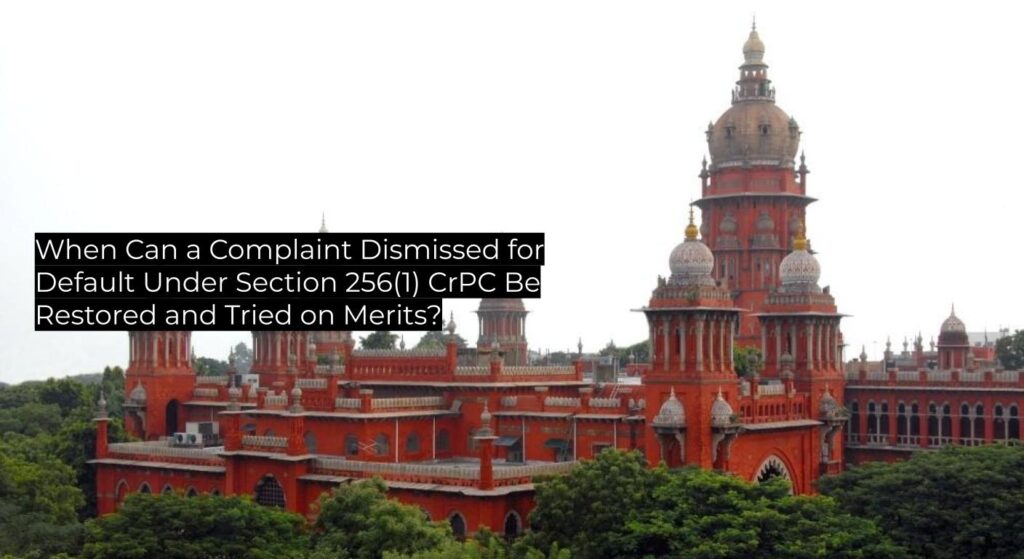
The Madras High Court reaffirms that complaints dismissed for default under Section 256(1), CrPC, rather than on the merits, can be restored and directed for trial. The decision maintains established judicial precedent and is binding on subordinate courts in Tamil Nadu—practitioners should cite this as authoritative where procedural default, rather than merit-based dismissal, is challenged.
Summary
| Category | Data |
|---|---|
| Case Name | CRL A/625/2012 of M/S.SANGEETHA TRADERS Vs M/S.AGK PACKERS |
| CNR | HCMA010684222012 |
| Date of Registration | 21-09-2012 |
| Decision Date | 29-10-2025 |
| Disposal Nature | ALLOWED |
| Judgment Author | Honourable Mr Justice M. Nirmal Kumar |
| Court | Madras High Court |
| Precedent Value | Binding authority for subordinate courts |
| Overrules / Affirms | Affirms the established principle that complaints dismissed for default under Section 256(1) CrPC may be restored if not decided on merits |
| Type of Law | Criminal Procedure, Negotiable Instruments Act |
| Questions of Law | Whether a complaint dismissed for default (absence of complainant), and not on merits, can be restored and directed for trial? |
| Ratio Decidendi |
The High Court held that where a complaint is dismissed under Section 256(1) CrPC for default—i.e., absence of the complainant and not on the merits of the case—the dismissal does not bar restoration of proceedings. The restoration is justified especially where due diligence was shown, and dismissal was not for lack of prosecution but for procedural default. On facts, the appellant consistently prosecuted the case and took necessary steps, and the absence was not willful. Directing restoration advances substantial justice and ensures cases are decided on merits, not procedural lapses. |
| Facts as Summarised by the Court |
The appellant filed a complaint under Section 138 of the Negotiable Instruments Act. The accused evaded court process despite repeated NBWs; the appellant continued diligent prosecution, paying process fees and taking steps. On a single date (19.10.2011), the appellant failed to appear due to inadvertence, leading the trial court to dismiss the case under Section 256(1) CrPC for default. The High Court found this dismissal was not on merits and directed restoration. |
Practical Impact
| Category | Impact |
|---|---|
| Binding On | All subordinate courts in Tamil Nadu |
| Persuasive For | Other High Courts with similar factual matrices |
| Follows | Reaffirms prior precedent on restoration of complaints dismissed for default, not on merits |
What’s New / What Lawyers Should Note
- Reiterates that dismissal for default (non-appearance) under Section 256(1) CrPC is not a bar to restoration, provided the dismissal was not on merits.
- Lawyers should highlight diligent prosecution and procedural lapses to secure restoration.
- Emphasizes that trials should be decided on merits; procedural defaults may be condoned in the interest of justice.
- Deemed service of notice is sufficient where respondents cannot be located after due effort.
Summary of Legal Reasoning
- Diligent Prosecution: The appellant showed seriousness in prosecuting the case—process fees were paid, and NBWs sought and executed, indicating lack of default in conduct.
- Nature of Dismissal: The trial court’s dismissal was not a decision on merits but for procedural default under Section 256(1) CrPC (complainant’s absence on one occasion).
- Restoration Justified: Since the dismissal was not a barrier to further prosecution, and default was not willful or chronic, the High Court ordered restoration.
- Equitable Considerations: Ensured substantial justice by allowing the complaint to be heard on merits, especially considering unsuccessful attempts to serve the respondents who were found to have vacated the premises.
- Deemed Service: When respondents are not traceable after reasonable steps, service is deemed sufficient, avoiding undue delay.
Arguments by the Parties
Petitioner (Appellant)
- The appellant was diligent, prosecuting the matter and taking all necessary steps including obtaining NBWs and paying process fees.
- The absence on 19.10.2011 was not intentional and was an isolated incident.
- The trial court should have adjourned the matter in view of ongoing NBW and pending process, rather than dismissing for default.
Respondent
- No appearance or contest; notices returned unserved with the endorsement “Left without Instruction”.
- Police inquiry revealed that the respondent-company had vacated its address; no effective contest from respondents.
Factual Background
The appellant filed a private complaint under Section 138 of the Negotiable Instruments Act against the respondents for dishonour of cheque. Respondents repeatedly evaded court process despite non-bailable warrants issued on several occasions. The appellant regularly took steps, including paying process fees and seeking warrants. On 19.10.2011, the complainant failed to appear, leading to dismissal of the complaint for default under Section 256(1) CrPC by the trial court. The appellant contested this order, leading to a protracted appellate journey before restoration was finally ordered.
Statutory Analysis
- Section 256(1) CrPC: Authorizes Magistrate to dismiss a complaint for complainant’s absence. This provision is to prevent vexatious and non-prosecuted complaints but is not meant as a technical barrier where diligent prosecution is evident.
- Negotiable Instruments Act, Section 138: No specific analysis, but forms the substantive basis for the complaint.
- Deemed Service Principle: Recognized where summons cannot be served after due efforts, service can be deemed effective.
Procedural Innovations
- Directed deemed service for respondents who could not be traced after due diligence.
- Priority direction: Trial court ordered to give early disposal due to the aged nature of the proceeding.
Alert Indicators
- ✔ Precedent Followed – Existing principles on restoration of complaints dismissed for default (Section 256(1) CrPC) are reaffirmed and followed.