


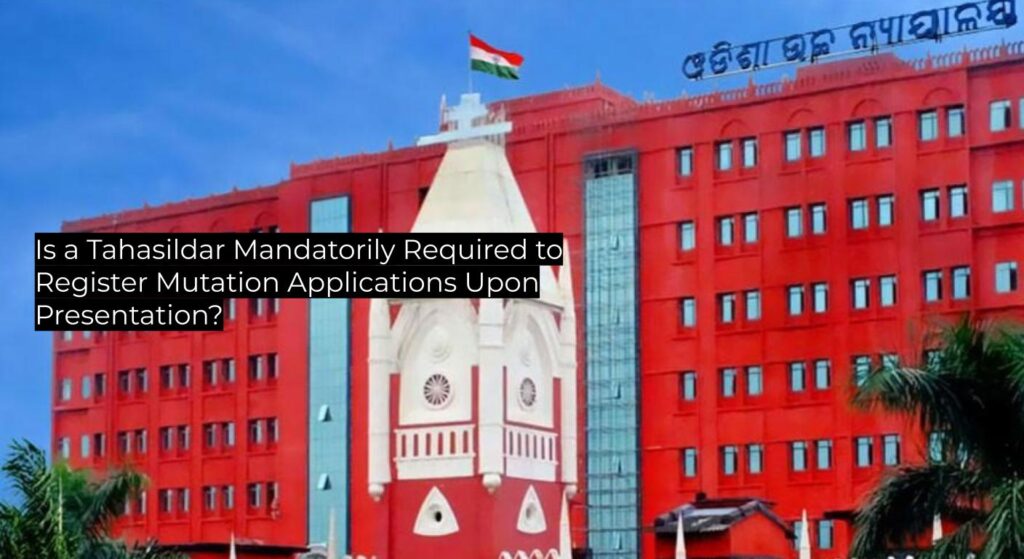
The Orissa High Court expressly confirms that Tahasildars must register applications for mutation as a matter of legal duty and proceed for final disposal as per law, following existing precedent. This decision upholds the settled position and is binding on subordinate revenue authorities, reinforcing the enforceability of applicant rights in mutation proceedings.
Summary
| Category | Data |
|---|---|
| Case Name | WP(C)/18902/2025 of AJITA KUMAR SAHOO Vs STATE OF ODISHA |
| CNR | ODHC010353842025 |
| Date of Registration | 10-07-2025 |
| Decision Date | 28-10-2025 |
| Disposal Nature | Disposed Off |
| Judgment Author | MR. JUSTICE ANANDA CHANDRA BEHERA |
| Court | Orissa High Court |
| Precedent Value | Binding on subordinate courts/revenue authorities in Odisha |
| Overrules / Affirms | Affirms existing precedent |
| Type of Law | Mutation proceedings / Revenue law / Administrative duties |
| Questions of Law | Whether Tahasildar is under a legal duty to register a mutation application upon filing |
| Ratio Decidendi |
The court reaffirmed that Tahasildars are legally bound to accept and register mutation applications presented before them. Registration must occur prior to any disposal on merits, ensuring access to statutory rights and compliance with natural justice. The authority’s role is mandatory at the registration stage and discretionary only in the subsequent adjudication after hearing concerned parties. This clarification removes ambiguity and enforces procedural accountability within mutation proceedings. |
| Judgments Relied Upon | Sunil Kumar Yadav v. District Magistrate, Lucknow and others, 2025(3) Civil Court Cases-159 (Allahabad) |
| Logic / Jurisprudence / Authorities Relied Upon by the Court | The judgment relies on established principles of administrative law and cited precedent (Sunil Kumar Yadav v. District Magistrate, Lucknow) which imposes a legal obligation upon revenue officers to register mutation applications and process them as per law with opportunity to be heard. |
| Facts as Summarised by the Court | Petitioner filed a mutation application on 25.10.2024 with Tahasildar, Nayagarh, but it was not registered. Petitioner approached the High Court seeking a direction for registration and disposal as per law. The non-registration persisted for a prolonged period, necessitating judicial intervention. |
Practical Impact
| Category | Impact |
|---|---|
| Binding On | All subordinate courts and revenue authorities in Odisha |
| Persuasive For | Other High Courts; similar revenue authorities in other states |
| Follows | Sunil Kumar Yadav v. District Magistrate, Lucknow and others, 2025(3) Civil Court Cases-159 (Allahabad) |
What’s New / What Lawyers Should Note
- Explicit affirmation of the mandatory duty of Tahasildars to register mutation applications upon presentation.
- Registration is an enforceable right; non-registration is subject to judicial correction under Article 226.
- The procedural obligation to provide an opportunity of hearing and comply with natural justice is restated for mutation proceedings.
- Clear citation to binding precedent strengthens reliance in writ challenges against administrative inaction in mutation matters.
Summary of Legal Reasoning
- The Court heard both sides and noted the petitioner’s complaint—namely, failure of the Tahasildar to register a mutation application since its filing.
- Citing Sunil Kumar Yadav v. District Magistrate, Lucknow (2025(3) Civil Court Cases-159 Allahabad), the Court reiterated that the Tahasildar has no discretion at the stage of registration and registration must be done forthwith on presentation.
- Only after registration may the Tahasildar proceed to consider and dispose of the mutation case on merits, after giving notice and hearing all affected parties, in compliance with principles of natural justice.
- The Court found legal justification to compel registration and directed that the process must move forward in accordance with law.
- The writ petition was thus allowed, and clear directions were issued to ensure enforceability and prevent future administrative delay or denial of applicant rights.
Arguments by the Parties
Petitioner
- The mutation application was submitted on 25.10.2024 but has not been registered by the Tahasildar.
- Sought a writ directing the Tahasildar to register and decide the application as per law.
Respondent
- Represented by Learned Additional Standing Counsel.
- No specific arguments of the State/opposite parties are recited in the judgment.
Factual Background
The petitioner filed a mutation application before the Tahasildar, Nayagarh, on 25.10.2024. Despite passage of time, the application was not registered nor processed as a mutation case. The petitioner approached the Orissa High Court by way of writ petition, seeking directions to the Tahasildar to register the application and to proceed for final disposal of the mutation matter as per law.
Statutory Analysis
The judgment was rendered in the context of Articles 226 and 227 of the Constitution of India, emphasizing the writ jurisdiction to enforce administrative duty. The Court referenced principles from administrative law and binding precedent to construe the legal duty of registration. It clarified the authority’s role in securing proper administration of mutation proceedings and upholding natural justice.
Procedural Innovations
No new procedural innovations were recorded in the judgment; the order follows established writ jurisdiction protocol.
Alert Indicators
- ✔ Precedent Followed – The judgment affirms and applies existing legal precedent regarding the duty to register mutation applications by revenue authorities.