


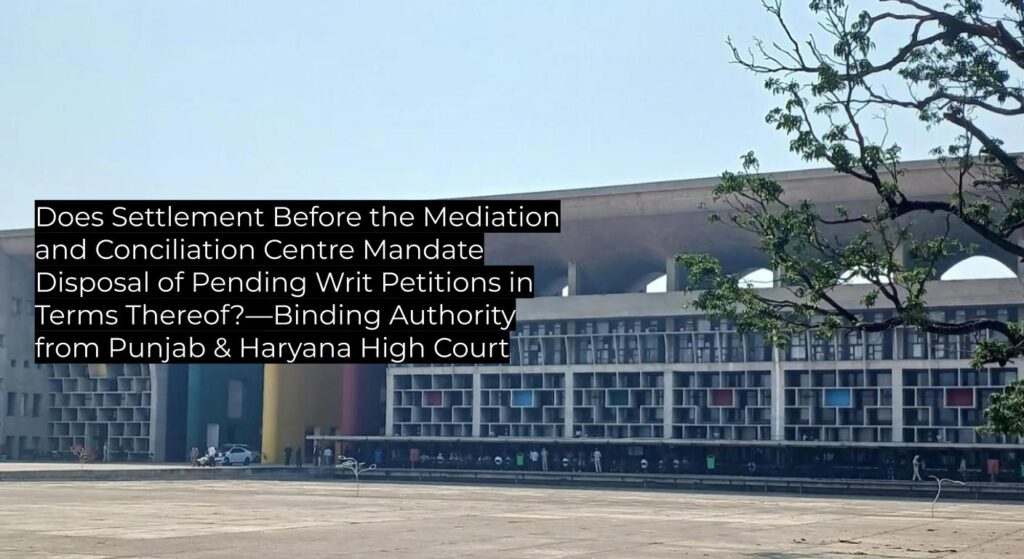
The High Court holds that when parties to a writ petition arrive at a mediated settlement formally recorded before the Mediation and Conciliation Centre, the writ petition is to be disposed in terms of the settlement. This judgment upholds the practice of judicial disposal post-mediation and serves as binding authority for similar scenarios in civil writ jurisdiction.
Summary
| Category | Data |
|---|---|
| Case Name |
|
| Date of Registration | 05-05-5500 |
| Decision Date | 28-10-2025 |
| Disposal Nature | DISPOSED OF |
| Judgment Author | MR. JUSTICE HARPREET SINGH BRAR |
| Court | High Court of Punjab and Haryana |
| Bench | Single Judge |
| Precedent Value | Binding on coordinate benches and subordinate courts within jurisdiction |
| Type of Law |
|
| Questions of Law | Whether a writ petition must be disposed in terms of a mediated settlement recorded before the court’s Mediation and Conciliation Centre. |
| Ratio Decidendi |
Where parties to a civil writ petition reach a formal settlement before the Court’s Mediation and Conciliation Centre, and communicate their acceptance, the writ petition should be disposed in terms of the settlement. The Court recognized communication of agreement through electronic means, such as WhatsApp, as valid. The express wish of the parties not to pursue the petition further, as conveyed to the mediator, eliminates the necessity for further adjudication on merits. The Court thus upholds the sanctity and finality of court-facilitated settlements in writ proceedings. |
| Facts as Summarised by the Court |
The writ petition sought quashing of promotion orders and related promotions, with petitioners seeking their own promotion. During pendency, parties referred the matter to mediation and reached a written settlement, communications made via personal appearance and WhatsApp. All petitioners indicated their wish not to pursue the matter post-settlement, leading to disposal accordingly. |
Practical Impact
| Category | Impact |
|---|---|
| Binding On | All subordinate courts and authorities under jurisdiction of Punjab & Haryana High Court |
| Persuasive For | Other High Courts in India; relevant wherever mediated settlement before court is at issue |
What’s New / What Lawyers Should Note
- Recognizes formal mediated settlements (even communicated by digital means like WhatsApp) as binding when recorded before a court’s Mediation Centre.
- Clarifies procedural effect: a writ petition is to be disposed of in terms of a formal settlement, obviating merits-based adjudication.
- Lawyers can cite this precedent when seeking disposal of petitions following court-moderated settlements.
- Advancement of electronic communication (e.g., WhatsApp) in evidencing consent/acceptance in mediation.
Summary of Legal Reasoning
- The Court emphasized that once parties have arrived at a formal, court-recognized settlement, the basis for the writ petition ceases to exist and thus mandates disposal in accordance with the settlement’s terms.
- Recognition of communication of consent through WhatsApp and personal appearance before the Mediator as valid modes of evidencing party agreement.
- Court respected the autonomy of parties as reflected in mediated outcomes, thus avoiding further judicial intervention on merits.
- Miscellaneous applications rendered infructuous upon settlement, emphasizing finality of mediated resolution in writ context.
Arguments by the Parties
Petitioner
- Not detailed in final arguments stage; prior to settlement, petitioners sought quashing of certain promotion orders and asked for their own promotion.
Respondents
- Not detailed in final arguments stage.
Mediation
- All petitioners conveyed to the Mediator (by WhatsApp and personal appearance) that they agree to settlement and do not wish to pursue the petition.
Factual Background
The writ petition was filed seeking quashing of promotion orders that advanced respondents No.4 and 5 to the post of Deputy Director and sought orders for promoting the petitioners instead. During proceedings, the matter was referred to the High Court’s Mediation and Conciliation Centre as part of a Special Mediation Drive. All petitioners either appeared in person or confirmed via WhatsApp their agreement to the settlement. The petitioners also informed the Mediator they did not wish to pursue the petition further, as the dispute had been settled.
Statutory Analysis
- The judgment is rendered under Articles 226/227 of the Constitution of India (writ jurisdiction).
- No other statutory provision was substantively interpreted; procedural aspects of recognizing settlements reached before the Mediation Centre were applied.
Dissenting / Concurring Opinion Summary
No concurring or dissenting opinions; the judgment is by a single judge.
Procedural Innovations
- Recognition of WhatsApp (electronic) communication to the Mediation Centre as sufficient proof of petitioner’s consent and settlement acceptance.
- Application of settlement completely disposes of both main petition and connected miscellaneous applications without substantive merits hearing.
Alert Indicators
- ✔ Precedent Followed – The judgment affirms and restates judicial practice of disposing writ petitions on the basis of formal, court-mediated settlements.