


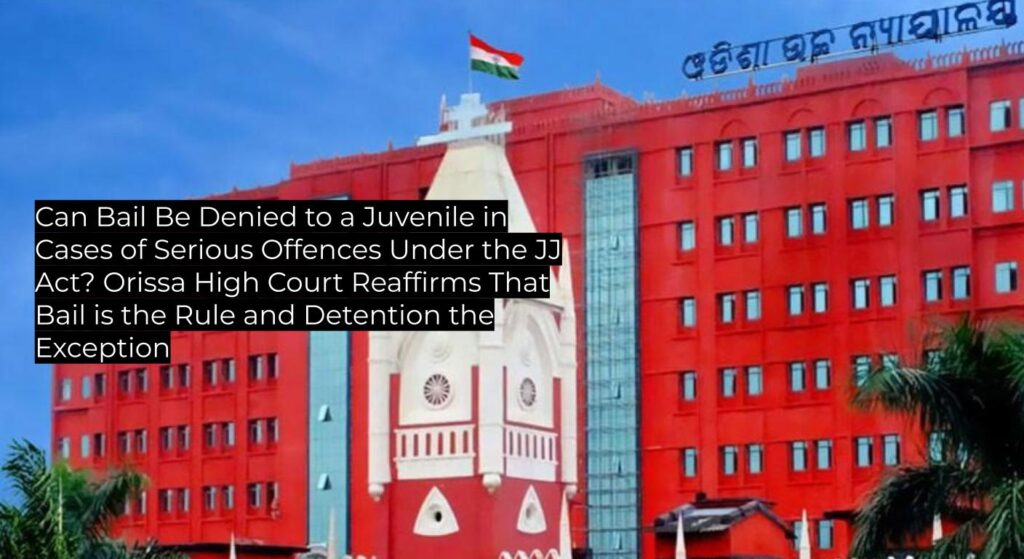
Orissa High Court clarifies that even in cases of serious offences including those under POCSO and IT Act, bail to a Child in Conflict with Law (CICL) is the norm unless specific statutory exceptions apply. The prior orders denying bail were set aside, robustly reaffirming settled precedent—useful as binding authority within jurisdiction for future bail applications involving juveniles.
Summary
| Category | Data |
|---|---|
| Case Name | CRLREV/579/2025 of SIBUN PRADHAN Vs STATE OF ODISHA |
| CNR | ODHC010591682025 |
| Date of Registration | 01-09-2025 |
| Decision Date | 27-10-2025 |
| Disposal Nature | Disposed Off |
| Judgment Author | MR. JUSTICE GOURISHANKAR SATAPATHY |
| Court | Orissa High Court |
| Bench | Single Judge (Justice Gourishankar Satapathy) |
| Precedent Value | Binding within Orissa; useful persuasive value elsewhere |
| Overrules / Affirms | Affirms the principle that bail is the rule for juveniles; sets aside prior bail refusals |
| Type of Law | Criminal Law, Juvenile Justice, POCSO, Information Technology Act |
| Questions of Law | Whether a CICL accused of serious offences under BNS, POCSO, and IT Act should be routinely denied bail—or whether statutory presumption of bail prevails absent exceptions |
| Ratio Decidendi |
The High Court held that under Section 12 of the Juvenile Justice (Care and Protection of Children) Act, 2015, bail to a Child in Conflict with Law is the rule and detention is the exception. The Court reasoned that bail may be denied only when reasonable grounds exist to believe that release would bring the juvenile into association with criminals, expose him to danger, or defeat the ends of justice. In the present case, no such grounds were found: the juvenile was a first-time offender, the social investigation report was not adverse, and no risk to the administration of justice was shown. The previous orders refusing bail were thus set aside, granting bail with protective conditions. |
| Logic / Jurisprudence / Authorities Relied Upon by the Court | The statutory intent of Section 12 of JJ Act, reading of Social Investigation Report, and absence of adverse material against the CICL were relied upon. |
| Facts as Summarised by the Court |
Petitioner was a juvenile alleged to have committed rape and aggravated penetrative sexual assault, including circulation of obscene photographs/videos of the victim. Both parties belonged to the same village and were in some form of relationship. The petitioner had been detained since 14.07.2025, charge-sheet was submitted, and no prior bad conduct or risk factors were recorded in the SIR. Both the Juvenile Justice Board and Children’s Court had denied bail prior to this revision. |
Practical Impact
| Category | Impact |
|---|---|
| Binding On | All subordinate courts within Orissa |
| Persuasive For | Other High Courts, especially in matters relating to juvenile bail under JJ Act |
| Overrules | Sets aside the bail refusal orders of the Juvenile Justice Board and the 4th Additional Sessions Judge-cum-Children’s Court |
| Follows | Affirms the statutory principle under Section 12 of Juvenile Justice (Care and Protection of Children) Act, 2015 that bail is the rule for juveniles |
What’s New / What Lawyers Should Note
- The Orissa High Court has reaffirmed that even for grave offences under POCSO Act and IT Act, bail should ordinarily be granted to juveniles unless specific statutory exceptions in Section 12 JJ Act are met.
- The existence of a charge sheet, severity of allegations, or media attention alone does not justify denial of bail to a juvenile in conflict with law.
- First-time offenders with clean Social Investigation Reports and absence of threat to victim or society should expect bail as a rule.
- Lawyers can use this ruling to challenge routine or mechanical detention orders against juveniles.
Summary of Legal Reasoning
- The court examined the statutory framework of Section 12 of the Juvenile Justice (Care and Protection of Children) Act, 2015, which mandates that bail is the rule and detention the exception for Children in Conflict with Law.
- It was found that bail could only be refused if there are reasonable grounds for believing that the release would (a) bring the juvenile into association with criminal elements, (b) expose the juvenile to moral, physical or psychological danger, or (c) defeat the ends of justice.
- The court noted the Social Investigation Report produced by the Addl. PP revealed the petitioner was a first-time offender, with no prior bad conduct, and no evidence of risk or danger.
- Both the Juvenile Justice Board and the Children’s Court had refused bail without finding any of the above statutory exceptions.
- The High Court set aside these orders, restoring the statutory presumption in favour of bail, while imposing a protective condition (no contact with victim or her family).
- The logic of the judgment is rooted in the legislative intent to protect CICLs and avoid unnecessary detention except in clearly warranted situations.
Arguments by the Parties
Petitioner
- The petitioner was a juvenile and a first-time offender.
- The Social Investigation Report was not adverse; no previous bad conduct reported.
- The petitioner had been in detention since 14.07.2025.
- The relevant statutory exceptions for denial of bail did not apply in this case.
Respondent (State/Informant)
- Alleged serious offences committed by the CICL, including rape and aggravated sexual assault, and circulation of obscene photographs and videos of the victim.
- The seriousness of allegations underlying the opposition to bail.
Factual Background
The case involved a juvenile accused (CICL) from the same village as the victim, allegedly involved in rape and aggravated penetrative sexual assault, as well as making obscene photographs and videos of the victim viral, with the co-accused. FIR arose from Tangi PS Case No.465 of 2025, invoking offences under BNS, POCSO Act, and IT Act. The petitioner had no prior criminal record or negative conduct per the social investigation report. Bail had been denied by both the Juvenile Justice Board and the Children’s Court; the petitioner sought revision before the High Court.
Statutory Analysis
The court analyzed Section 12 of the Juvenile Justice (Care and Protection of Children) Act, 2015, which mandates that bail is to be granted to a child in conflict with law—regardless of the nature of the offence—unless the court finds reasonable grounds that such release would bring the child into association with criminals, expose them to moral, physical or psychological danger, or defeat the ends of justice. The court read the statute as embodying a presumption of bail and requiring the prosecution or authorities to show specific exceptions to withhold bail.
Alert Indicators
- ✔ Precedent Followed – The decision reaffirms well-settled statutory principle of bail for juveniles under Section 12 of the JJ Act.