


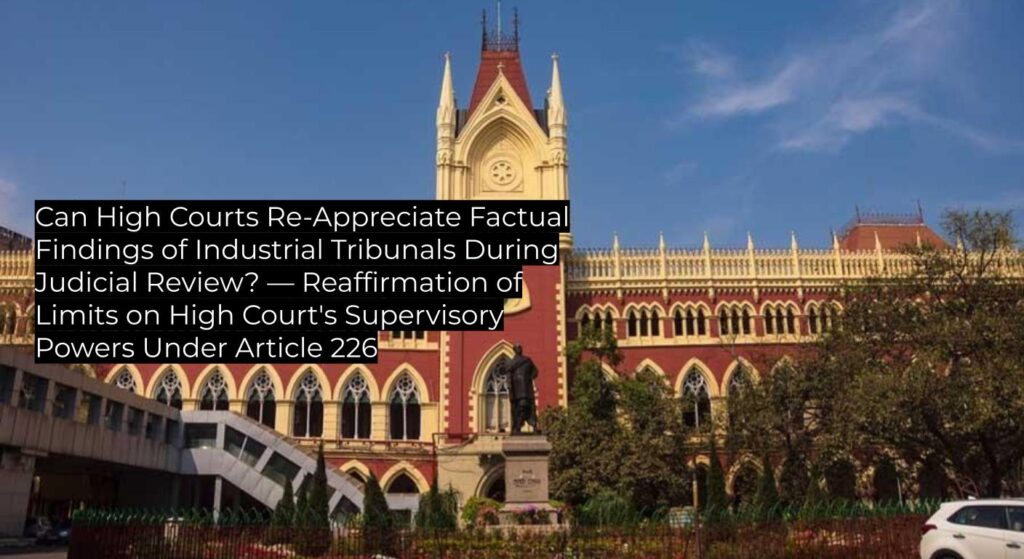
Calcutta High Court reasserts that, in the context of industrial disputes, High Courts may not substitute their own factual assessments for those of tribunals unless there is manifest perversity or jurisdictional error. Upholds existing precedent on restraint in writ jurisdiction; judgment has binding authority within West Bengal and persuasive value for other jurisdictions in service and labour law matters.
Summary
| Category | Data |
|---|---|
| Case Name | MAT/197/2024 of CENTRAL BANK OF INDIA Vs SANJAY SUTRADHAR AND ORS. CNR WBCHCA0039902024 |
| Date of Registration | 25-01-2024 |
| Decision Date | 27-10-2025 |
| Disposal Nature | DISMISSED |
| Judgment Author | Hon’ble Justice Rai Chattopadhyay |
| Concurring or Dissenting Judges | Hon’ble Justice Lanusungkum Jamir (concurring) |
| Court | Calcutta High Court |
| Bench | Division Bench: Justice Lanusungkum Jamir and Justice Rai Chattopadhyay |
| Precedent Value | Binding within jurisdiction; persuasive for other High Courts |
| Overrules / Affirms | Affirms the award of the Central Government Industrial Tribunal and judgment of Single Judge; reaffirms settled principles on judicial review |
| Type of Law | Service & Labour Law; Industrial Disputes |
| Questions of Law |
|
| Ratio Decidendi |
The High Court’s role in reviewing Tribunal awards under Article 226 is supervisory and not appellate; factual findings are not to be re-assessed save for jurisdictional error, manifest illegality, or perversity. Employer-employee relationship can be established by conduct and ongoing payment of wages, not solely by existence of an appointment letter. The Tribunal had applied proper standards and the High Court found no reason for interference. |
| Judgments Relied Upon |
|
| Logic / Jurisprudence / Authorities Relied Upon by the Court |
Established principle limiting judicial review to supervision of legality and excess/abuse of jurisdiction, not full reassessment of facts or evidence. Recognition that employer-employee relationship can be established by implied conduct and payments, not just appointment letter; consistent with Supreme Court. |
| Facts as Summarised by the Court |
Respondent was engaged as a peon by the bank from 1986 to 2007, working continuously and paid via vouchers and later bank credits. Terminated verbally by the manager in 2008 without compliance with Section 25F of the Industrial Disputes Act. Bank denied any formal employment relationship, stating respondent was an irregular, voluntary or contract worker. Tribunal and Single Judge found in favour of the respondent; bank appealed to Division Bench. |
Practical Impact
| Category | Impact |
|---|---|
| Binding On | All subordinate courts and tribunals within the territorial jurisdiction of Calcutta High Court |
| Persuasive For | Other High Courts and tribunals dealing with industrial dispute judicial review; Supreme Court (as persuasive) |
| Follows |
|
What’s New / What Lawyers Should Note
- Reaffirms that absence of an appointment letter does not by itself defeat a claim of employer-employee relationship if long-term, regular wage payments and job functions are proven.
- Clarifies the High Court’s limited role under Article 226 when reviewing findings of industrial tribunals: only manifest perversity, jurisdictional error, or violation of natural justice permits interference.
- Lawyers should ensure that appeals to High Courts from industrial tribunals demonstrate clear legal or jurisdictional error, not mere disagreement over factual findings.
- Emphasizes that inconsistent or self-contradictory employer defenses (e.g., denying employment while evidencing wage payments) may strengthen employee claims.
Summary of Legal Reasoning
- The Division Bench confirmed that the High Court’s supervisory jurisdiction over industrial tribunal awards is limited and does not extend to re-assessing facts except in cases of manifest perversity or jurisdictional breach.
- Cited Sadhu Ram v. Delhi Transport Corporation to confirm that High Courts act in a supervisory—not appellate—capacity with respect to tribunal decisions.
- Endorsed the approach in Devinder Singh that employer-employee relationships can be inferred from long-term service, consistent wage payments, and actual work performed, even in the absence of a written appointment letter.
- Found the tribunal had adequately considered documentary and oral evidence and that there was no manifest error, illegality, or excess of jurisdiction.
- Stated that both the tribunal and Single Judge had properly applied legal principles, and that the Division Bench would not substitute its own factual view in the absence of clear error.
- Noted inconsistency in the employer’s position further justified drawing adverse inferences.
Arguments by the Parties
Petitioner (Appellant — Bank)
- Denied any formal employer-employee relationship; asserted no appointment letter was ever issued.
- Claimed respondent’s activities (maintaining two-wheelers outside premises) were voluntary or at best performed under limited, short-duration contract.
- Argued respondent’s claim of long-term peonage was baseless; any payments were for sporadic, unrelated services.
- Asserted tribunal failed to require sufficient documentary proof and was not allowed to conclude cross-examination.
- Relied on Supreme Court authorities to urge against recognition of implied employment in such circumstances.
Respondent (Employee)
- Pointed to continuous employment from 1986 to 2007, regular salary, and duties performed as evidence of workman status.
- Cited correspondence and admissions from bank showing ad-hoc and ongoing employment and wage payments.
- Cited Supreme Court’s Devinder Singh ruling—employer-employee relationship may be implied and proven by conduct, not requiring a written contract.
- Argued that High Court under Article 226 cannot re-assess factual findings absent jurisdictional breach or patent illegality.
- Noted that tribunal and Single Judge findings were concurrent and based on evidence.
Factual Background
The respondent was engaged by the Central Bank of India at Siliguri branch, serving as a peon (Class IV staff) from January 1986 until abrupt verbal termination in December 2007. He consistently received monthly wages, initially through vouchers, then bank transfer, with duties like cleaning and assisting with office work. The respondent challenged his termination as illegal, lacking compliance with Section 25F of the Industrial Disputes Act. The bank denied any employer-employee relationship, characterizing his work as casual, voluntary, or limited short-term contract. The Industrial Tribunal directed reinstatement with back wages, a decision upheld by the Single Judge; the bank’s appeal to the Division Bench was dismissed.
Statutory Analysis
- Section 2(s), Industrial Disputes Act, 1947: “Workman” definition construed broadly, encompassing employment implied by conduct and regular wage payments, not confined to written contracts or appointment letters.
- Section 25F, Industrial Disputes Act, 1947: Mandates procedural safeguards before termination of workman in continuous service.
- Article 226, Constitution of India: High Court’s power to supervise, not to exercise appellate jurisdiction over factual findings of specialized tribunals except in cases of manifest illegality, perversity, or lack of jurisdiction.
Dissenting / Concurring Opinion Summary
No dissenting or separately reasoned concurring opinions are reported in the judgment; both judges agreed in dismissing the appeal and upholding the Single Judge’s and tribunal’s decisions.
Procedural Innovations
No new procedural guidelines or innovations are set out in the judgment.
Alert Indicators
- ✔ Precedent Followed – The judgment restates and applies existing Supreme Court authority on the limits of High Court intervention in industrial tribunal matters and on implied employer-employee relationships.